
If a buyer sends a check for more than your asking price, pause the sale and don't send the difference back. If you deposited it, contact your bank through its official app or a known number. Tell the bank about the suspected overpayment scam before spending, transferring or refunding any money.
1. Stop the refund and the handoff
The Federal Trade Commission's fake-check guidance identifies a familiar pattern: an online buyer sends too much, then asks the seller to return the excess. The check may be fake even when the deposit appears in your balance. Discovery can take weeks, and the bank can require repayment.
Pause shipment or collection while you contact the bank. Don't send money to a driver, relative or shipping agent named by the buyer. A request to pay someone else still takes money out of your account.
Keep the sale record separate from the payment record. A genuine listing and a plausible conversation don't establish that a check is valid.
2. Work out which stage you're in
Use the branch that matches what actually happened. Record actions already taken; don't describe a payment as a loss unless it was sent.
- Check received, not deposited: Don't deposit it to test whether it works. Save the messages and report the buyer through the marketplace's reporting tools.
- Check deposited, no refund sent: Contact your bank, explain the suspected fake check and ask how to handle the deposit. Don't use the apparent proceeds.
- Refund or third-party payment sent: Contact the bank or payment provider used for that outgoing payment immediately. Give them its transaction details and ask whether reversal is possible.
- Item already shipped or collected: Include that fact in your report. Keep the tracking number or collection record with the payment evidence. Don't send another payment in response to a promise to return the item.
This checklist organizes your next conversation. It doesn't determine whether your bank can recover money or whether a marketplace will cover the transaction.
3. Read the two transactions separately
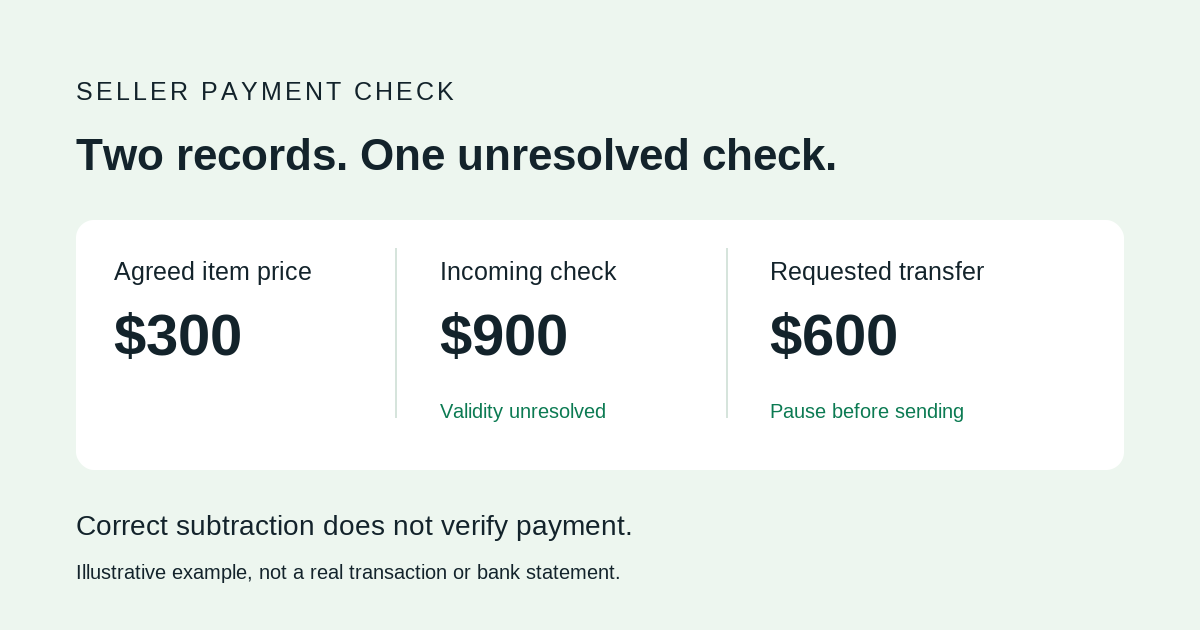
Consider an illustrative sale, not a reported customer case. Your item costs $300. The buyer sends a $900 check and asks you to transfer $600 to a supposed courier.
The buyer calls this a refund. In your records, there are two separate events:
- Incoming check: $900, validity unresolved.
- Outgoing transfer: $600, requested by the buyer.
The calculation, $900 − $300 = $600, explains the story. It doesn't verify the check or protect the transfer. Don't let correct arithmetic stand in for payment evidence.
When speaking to the bank, name both events. “I received a $900 check and was asked to send $600 elsewhere” is more useful than “the buyer overpaid.” If nothing went out, say that clearly.
4. Contact the provider that handled your outgoing payment
The FTC's guidance for people who paid a scammer says to contact the payment provider promptly and ask about reversal or a refund. Recovery isn't guaranteed.
For a bank transfer, contact your bank. For a payment app or wire service, report it to that provider. If you sent gift-card details, contact the issuer and keep the card and receipt. For cryptocurrency, contact the exchange or ATM operator and ask whether reversal is possible.
Use contact details you obtain independently. For a bank card, the number on the back or the bank's official app is a better starting point than a phone number supplied in the buyer's message.
5. Prepare a short incident record
Put these details in one private note before contacting support:
- Listing reference, agreed price and buyer's account name.
- Amount and date of the check; whether you deposited it.
- Requested refund destination and any outgoing transaction reference.
- Whether the item left your possession, plus the messages and receipts.
Keep the sequence factual. “Requested,” “deposited” and “sent” describe different actions. Leave unknown details marked unknown instead of guessing.
You can use this message with your bank:
I'm selling an item for [price]. A buyer sent a check for [amount] and asked me to send [amount] to [destination]. I [have/have not] deposited it and [have/have not] sent money. I suspect a fake-check overpayment scam. How should I handle the deposit, and can you review any outgoing payment?
Send account documents only through the provider's secure channel. Don't publish check images or banking details in a public complaint.
Can I just wait until the check clears?
Don't use a fixed waiting period as permission to send the buyer money. The FTC warns that available funds don't establish a valid check and that fake checks can take weeks to uncover. Ask your bank about the specific deposit; don't rely on the buyer's deadline.
What if I already gave the buyer my login details?
The FTC recommends changing the compromised password, changing it on any other account where you reused it, and enabling two-factor authentication. Its recovery guide also covers accounts you can no longer access. Treat account recovery as a separate task from reporting the payment.
Report the scam at ReportFraud.ftc.gov. For the separate process of arranging a private vehicle sale, see our Craigslist car-selling safety guide.