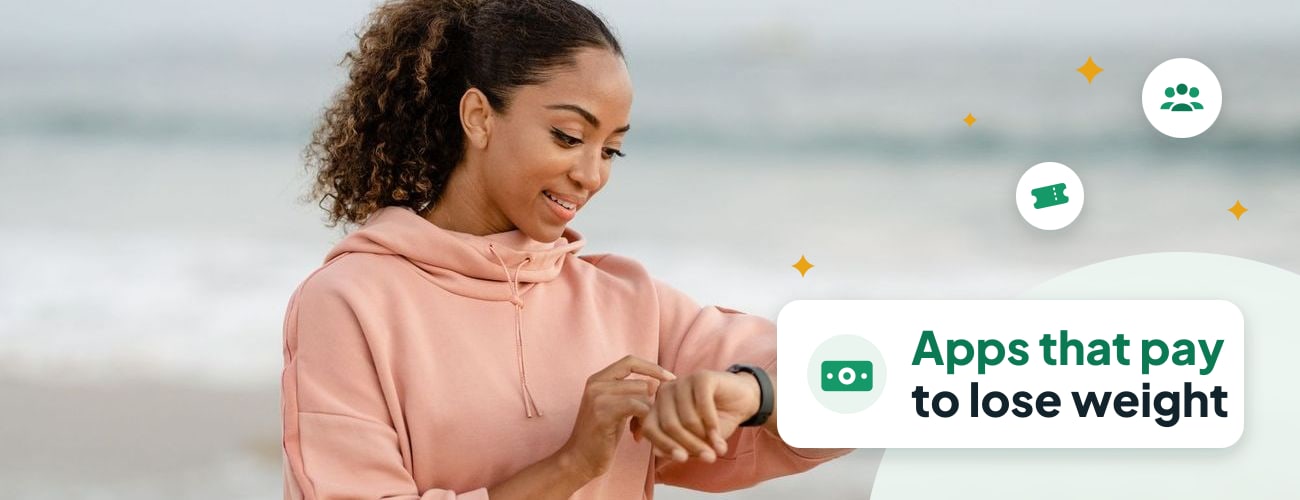
The apps that pay you to lose weight split into two camps: weight-loss bets that put your own money on the line, and step apps that hand out gift cards for walking. For each one below you get the entry cost, what it pays, how you cash out and who can join.
Key takeaways
- Bets pay the most: HealthyWage (1) and DietBet (5) pay out of a pot you have paid into, and HealthyWage's top prize offer is $10,000.
- Step apps pay small: Sweatcoin (2), CashWalk (7), WeWard (8) and Winwalk (9) cap what a day of walking is worth and pay in gift cards or vouchers.
- No stake needed with Evidation (3): it pays $10 per 10,000 points for synced activity and health cards.
- Weigh-ins are verified: HealthyWage uses a 30-second video, DietBet photos of you on the scale, StepBet (4) your tracker's own step data.
- Three apps left this list: LifeCoin shut down, Higi stopped paying, and Charity Miles pays charities rather than you.
Best Apps That Pay You to Lose Weight
HealthyWage
HealthyWage pays you to lose weight by having you bet on yourself. You set the goal, the deadline and the stake, and its prize calculator fixes what you win. The top prize offer is $10,000.
Your total bet has to be at least $200, paid up front or in monthly installments, and your goal must be at least 10% of your starting weight. You can run up to 10 challenges at once, including team, jackpot and step challenges, but only one individual wager.
Healthy Wage Summary
- Meet your weight loss goal and win cash
- Win up to $10,000 from challenges
- Total bet starts at $200, up front or monthly
- Join up to 10 challenges at once
Worth it? Yes if you are confident, because you keep the stake and the prize when you hit the goal and lose the stake when you miss. Both weigh-ins are verified on a 30-second video.
Sweatcoin
Sweatcoin turns the steps your phone already counts into its own currency. Every 1,000 verified steps become 1 sweatcoin, minus a 5% fee, so a 10,000-step day earns 9.5 sweatcoins.
You spend sweatcoins in the in-app marketplace, where the offers change at least once a day. Some cost sweatcoins alone; others are discounts you still pay cash for, so read the offer description before you swipe to buy.
Sweatcoin does not pay out to PayPal or a bank account. The closest thing to cash is a PayPal or Amazon voucher from its auctions.
The free plan suits most walkers. Premium costs a monthly or annual fee and lifts the daily limit to 100 sweatcoins, which takes about 52,000 steps.
Referrals pay 5 sweatcoins for each friend who installs the app through your link and starts walking. Sweatcoins can no longer be sent between users, and the Sweat Wallet app and its SWEAT token close on 30 December 2026.

Sweatcoin Summary
- Every 1,000 verified steps become 1 sweatcoin, minus a 5% fee
- Get 5 sweatcoins per friend who installs the app
- Spend sweatcoins on marketplace offers and voucher auctions
- Accurate step counting
Worth it? Only as a free extra. The steps are counted for you, but nothing here converts straight into cash.
Evidation
Evidation, formerly Achievement, pays points for health data you already generate, with no stake and no weight target. Our Evidation review walks through the sign-up.
After you register, connect Evidation to the health and fitness apps you already use:
- Apple Health
- Fitbit
- Garmin
- Google Fit
- MyFitnessPal
- Oura
- Samsung Health
- Strava
- Withings
Points then come from two places: the activity your apps sync, and the cards in the app, which are surveys, quizzes and check-ins.
Synced activity is capped, so the cards decide how fast you earn:
| What you do | What it earns |
|---|---|
| Synced activity in one category (steps, heart rate, sleep) | Up to 8 points a day |
| All synced activity together | Up to 40 points a day |
| Health cards, surveys and check-ins | Not capped |
| 10,000 points | $10 |
Cash out 10,000 points for $10 through Tremendous, as a bank transfer, PayPal, a gift card or a donation. Evidation is open to US residents aged 18 and over.
Worth it? Yes as background earning. You risk nothing, but the daily caps mean steps alone take months to reach $10.
Stepbet
StepBet puts money on your step count rather than the scale. You join a game, pay into the pot, and everyone who hits their targets splits it.
StepBet reads your steps from:
- Apple Health
- Apple Watch
- Fitbit
- Garmin
- Health Connect on Android
Most bets are $40 and most games run six weeks, starting with a warm-up week. Each week you have to hit Active days and harder Power days, set from your own step history. StepBet says it has paid $148.9 million to winners.
Worth it? Good value if you already walk: the targets come from your own history, so the bet is a deadline rather than a gamble.
DietBet
DietBet comes from WayBetter, the company behind StepBet, and it bets on the scale instead of your steps. A Kickstarter game asks you to lose 4% of your weight in four weeks; a Transformer runs six months for 10%.
Games take bets from $35 to $100, and $40 is typical. Everyone who hits the target splits the pot, so what you make back on top of your stake depends on how many players miss.
You weigh in at the start and the end with photos of yourself and the scale. DietBet says it has paid $101,121,996 to winners across 1,039,224 players, and its apps run on iPhone and Android.
Worth it? The best fit for a short, specific target. Four weeks at 4% is realistic, and the pot is split rather than paid by the house, so expect your stake back plus a little.
Runtopia
Runtopia pays Sports Coins for tracked runs and walks and for daily fitness tasks, on Android and iPhone.
Coins feed the app's Lucky Wheel, which gives out PayPal cash, gift cards and other prizes. They also expire: every 1 March, Runtopia clears the coins you earned before the previous 31 December.
Worth it? Only if you run anyway. The rewards come through a prize wheel, so what a month of running is worth is never fixed.
CashWalk
CashWalk is a free pedometer that pays coins for the steps it counts, up to 10,000 steps a day.
Coins buy gift cards from well-known brands inside the app. It counts steps without GPS, so it works indoors and costs little battery, and it tracks calories, distance and time alongside the step count.
The app is on iPhone and Android and holds 4.6 stars from more than 60,000 US App Store ratings.
Worth it? A reasonable second step counter. The 10,000-step ceiling means a long walk earns nothing extra, so pair it with an app that pays on a different measure.
WeWard
WeWard pays Wards for every step it counts, and it is the biggest of the walking apps here: 30 million walkers in 29 countries and $50 million transferred to them so far.
Wards cash out through PayPal or Venmo, or buy deals from more than 100 brands, or go to a charity. WeWard quotes CNBC saying its top users earn up to $1,000 a year, which takes a lot of walking.
Worth it? The best of the step apps for real money, because PayPal and Venmo pay out in cash rather than vouchers.
Winwalk
Where most fitness apps use GPS, Winwalk counts steps with your phone's built-in sensor, and it asks for no account, email address or phone number.
You earn 1 coin per 100 steps, up to 100 coins a day, and spend coins on gift cards from Amazon, Walmart, Google Play and other brands inside the app.
Winwalk does not publish what a card costs. Reviewers on Google Play put a $10 gift card at 16,000 coins, which is about five months at the daily cap.
Worth it? Low effort, low reward. The hard cap of 100 coins a day means walking more than 10,000 steps earns you nothing.
Fit for Bucks
Stay active and trade the steps for rewards through the Fit for Bucks app. Running, walking and even a trip round the grocery store all count.
Link it to your Apple Watch or another activity tracker, then spend the steps at businesses near you. Two limits matter: it is iPhone only, and the rewards come from merchants around its Santa Monica base, so most of the country gets nothing.
Rewards are things like a free dessert or a coffee at a local shop, never cash.
Worth it? Only in Los Angeles. The App Store listing has not been updated since April 2023, so treat it as a local perk rather than a payout.
Bottom line: Use the betting apps as a deadline with your own money behind it, and the step apps as small change for walking you would do anyway. Nothing on this list pays enough to count as income.
No Longer on This List
LifeCoin has gone. There is no LifeCoin app in the US App Store or on Google Play, and lifecoin.ai has not changed since 2018, so we replaced it on this list with DietBet.
Higi still runs free blood pressure and weight stations, but its app and FAQ now cover results tracking only and its rewards pages are gone, so it pays members nothing. We replaced it on this list with WeWard.
Charity Miles turns the miles you walk, run and bike into money for a charity you pick, paid by its corporate sponsors. You get nothing yourself, so we replaced it on this list with CashWalk.
Apps That Pay You to Lose Weight FAQ
Can you really get paid to lose weight?
Yes, but almost always by staking your own money first. HealthyWage, DietBet and StepBet pay out of pots that entrants have paid into, so the money comes from the people who missed their goal.
Which app pays the most for losing weight?
HealthyWage, whose top prize offer is $10,000. Your own offer depends on your stake, your goal and your starting weight, and you lose the stake if you miss the target.
Is there an app that pays you to lose weight without betting your own money?
Evidation pays $10 per 10,000 points for synced activity and health cards, with nothing to pay in. Sweatcoin, CashWalk, WeWard and Winwalk pay for steps the same way. None of them pays much.
How do these apps know you lost the weight?
HealthyWage verifies your starting and finishing weight with a video that takes about 30 seconds. DietBet asks for photos of you and of your weight on the scale at both ends of a game.
How much can you earn from a walking app?
Not much. WeWard says it has transferred $50 million to 30 million walkers, and Winwalk caps you at 100 coins a day, roughly a $10 gift card every five months.