Twenty free stuff apps are below, grouped by what they actually hand over. Every rule, floor and rating comes from a help center, an SEC filing or a store listing read on 13 October 2026 — including the app the search results recommend that does not appear to exist.
Key takeaways
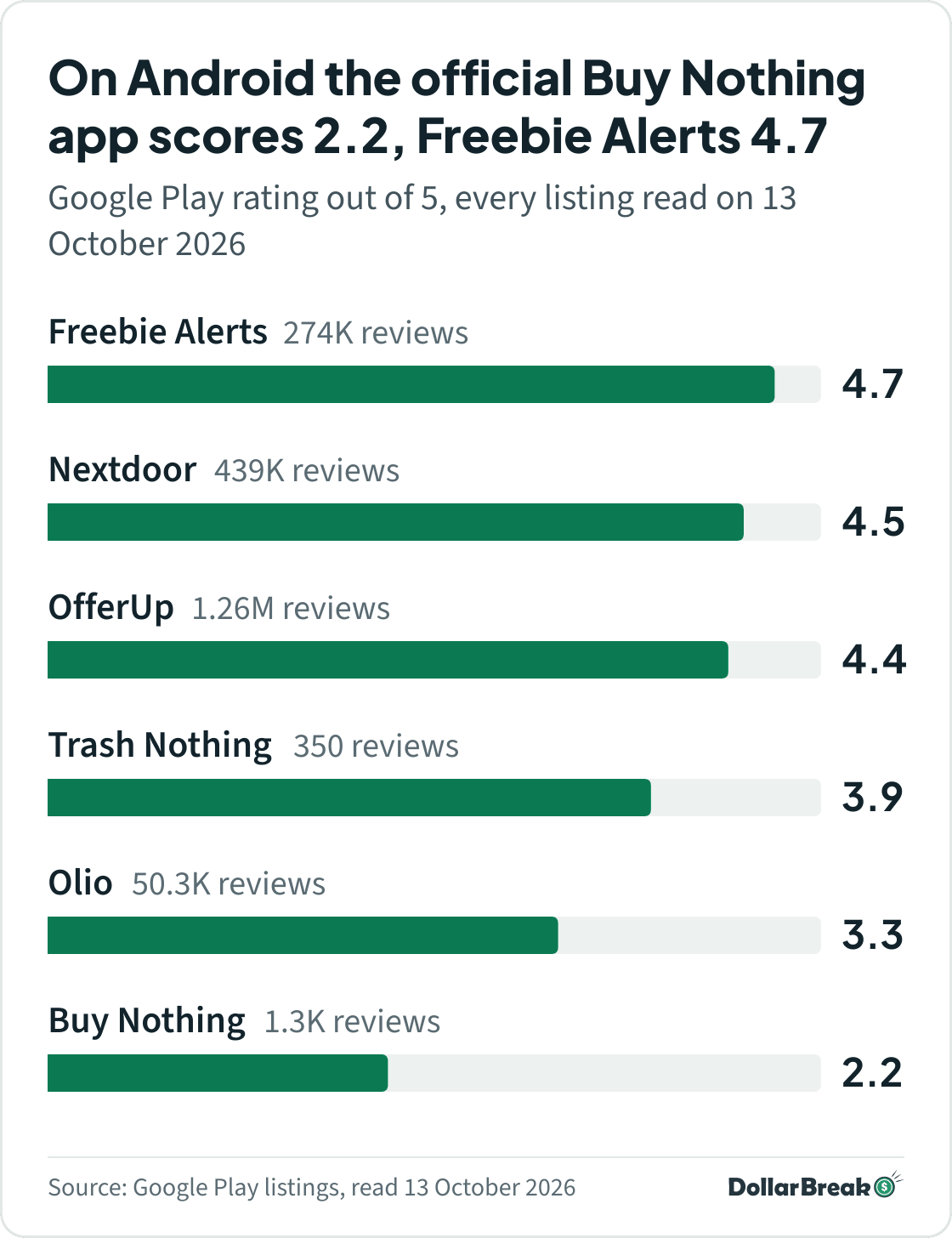
- The best free stuff finder: Freebie Alerts reads four public listing sources at once and scores 4.7 on Google Play from 274,000 reviews, the highest here.
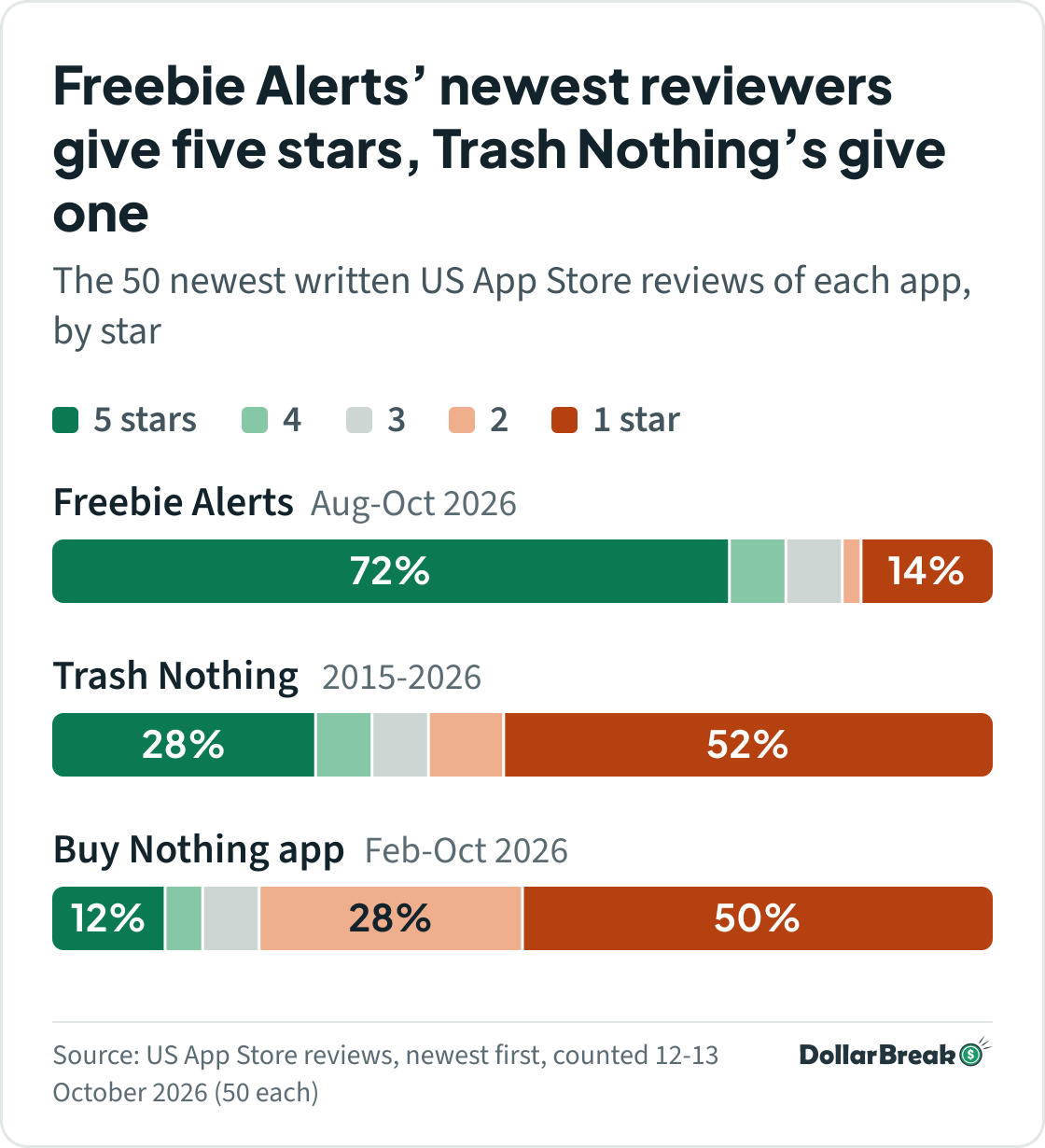
- The official Buy Nothing app is the weak link, not the idea: 2.2 on Google Play, and 25 of its 50 newest App Store reviews give one star. The Facebook groups are the real network.
- Samples are rationed, not requested: Influenster picks you by profile, Amazon Vine is invitation-only, and PINCHme now charges 500 coins to check out a box.
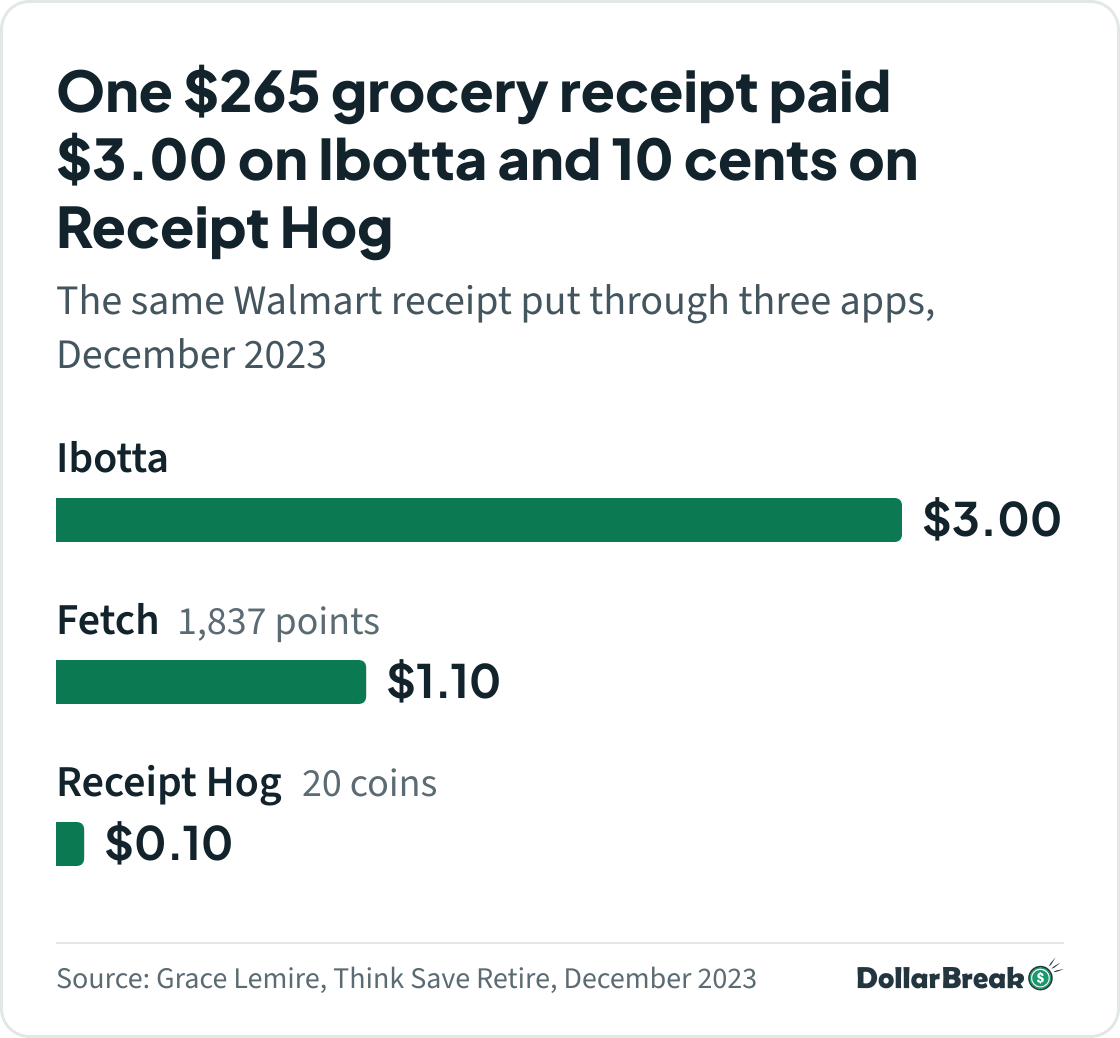
- Reward apps pay slowly: one $265 grocery receipt returned $3.00 on Ibotta, about $1.10 on Fetch and 10 cents on Receipt Hog.
- Read the floor before the bonus: Ibotta holds your cash back until it reaches $20, then charges $3.99 per 30 days once an account sits unused for 180 days.
- Shopkick is gone: Chapter 7, 29 May 2026. Any list still naming it has not been checked.
All 20 free stuff apps at a glance
Four of the twenty have no app of their own: Facebook Marketplace sits inside Facebook, and Amazon Vine, PINCHme and SampleSource run in a browser. Ratings are from Google Play, every listing read on 13 October 2026.
| App | What you get | Rating |
|---|---|---|
| Freebie Alerts | Free local listings | 4.7 |
| Buy Nothing | Gifts from your street | 2.2 |
| Trash Nothing | Freecycle and Freegle posts | 3.9 |
| Freecycle | Free-only local groups | Too new |
| Nextdoor | Verified neighbors' giveaways | 4.5 |
| OfferUp | A Free category | 4.4 |
| Facebook Marketplace | The most free listings | Not an app |
| Olio | Spare food and goods | 3.3 |
| Influenster | Free product boxes | 3.9 |
| Amazon Vine | Free goods to review | No app |
| PINCHme | Sample boxes, 500 coins | No app |
| SampleSource | Free sample packs | No app |
| Home Tester Club | Products to test | 3.2 |
| TYB | Brand discounts | 4.9 |
| Ibotta | Free-after-offer items | 4.5 |
| Fetch | Gift cards from receipts | 4.7 |
| Swagbucks | Gift cards from tasks | 4.2 |
| Receipt Hog | Coins from receipts | 4.6 |
| Freecash | Gift cards from offers | 4.5 |
| Capital One Shopping | Coupons and credits | 4.7 |
Apps that get you free stuff from your neighbors
These are the only apps here that cost nothing at all. Someone near you is clearing a garage, and the app is how you hear before the curb does. The trade is a car trip, and it lives or dies on how many people near you use it.
Freebie Alerts
Freebie Alerts does not host anything. It watches other people's free listings and pings you the moment one appears near your ZIP code. Its own site names four US sources it scans: Facebook Marketplace, Nextdoor, OfferUp and Trash Nothing.
That makes it a reader, not a network, and the reason to install it before any of the others here. Set a radius and a keyword list, and "dresser" or "lumber" reaches you and nothing else does. It is free with ads, plus a paid Gold tier whose price it publishes nowhere.
It is also the highest-rated app here: 4.7 on Google Play from 274,000 reviews and 4.76 on the App Store from 248,589 ratings. The warning sign is elsewhere — both apps were last updated in March 2026, the longest gap on this page.
Worth it? Yes, first — the cheapest way to learn whether anything is being given away where you live, without joining four communities.
Buy Nothing
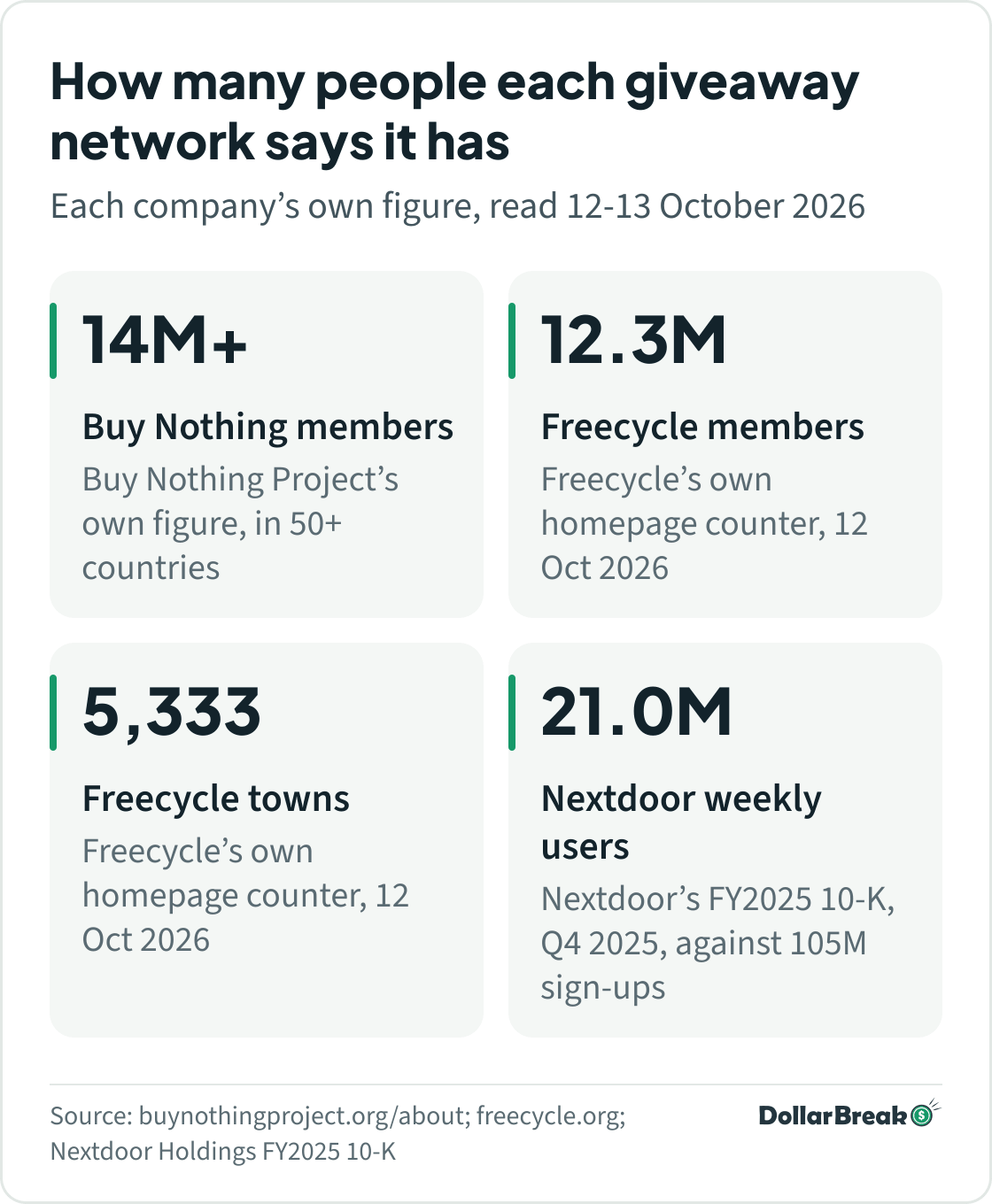
Buy Nothing is a gift economy, not a marketplace. Its published rules are absolute: no buying or selling, no trades or bartering, no asking for cash. You must be 18 or older, and groups are drawn tight — about a mile for a Hyperlocal circle, three for Neighborhood+, six for Surrounding. The Project claims more than 14 million members in over 50 countries, passing around 162,000 metric tons of goods a year that it values at $360 million.
The problem is the app. Its iPhone version rates 4.27, but on Google Play it is 2.2 from 1,300 reviews — the lowest score here. Of its 50 newest written US App Store reviews, half give one star; 24 report bugs from the 2026 redesign, 12 cannot log in, and four say limiting posts by distance now sits behind a paid tier.
Worth it? Join the idea, not the app: find your local Buy Nothing group on Facebook first, and install the app only if your group has moved there.
Trash Nothing
Trash Nothing is a better front end for groups that already exist. Its iOS app is titled "Trash Nothing + Freecycle" and its directory is largely Freecycle and Freegle groups: it reads them, it does not replace them.
That is also its oldest complaint. Of its 50 newest written US App Store reviews, 22 say some version of "this is not Freecycle" — the name misled them, and it uses neither Freecycle's logins nor its posts. All 22 are dated 2016 to 2023, and four of its seven newest are five-star, so the picture has improved. It publishes no member count at all.
Worth it? Yes if your town's activity is on Freecycle or Freegle: the app beats either website. Otherwise skip it — we compare the field in our guide to sites like Freecycle.
Freecycle
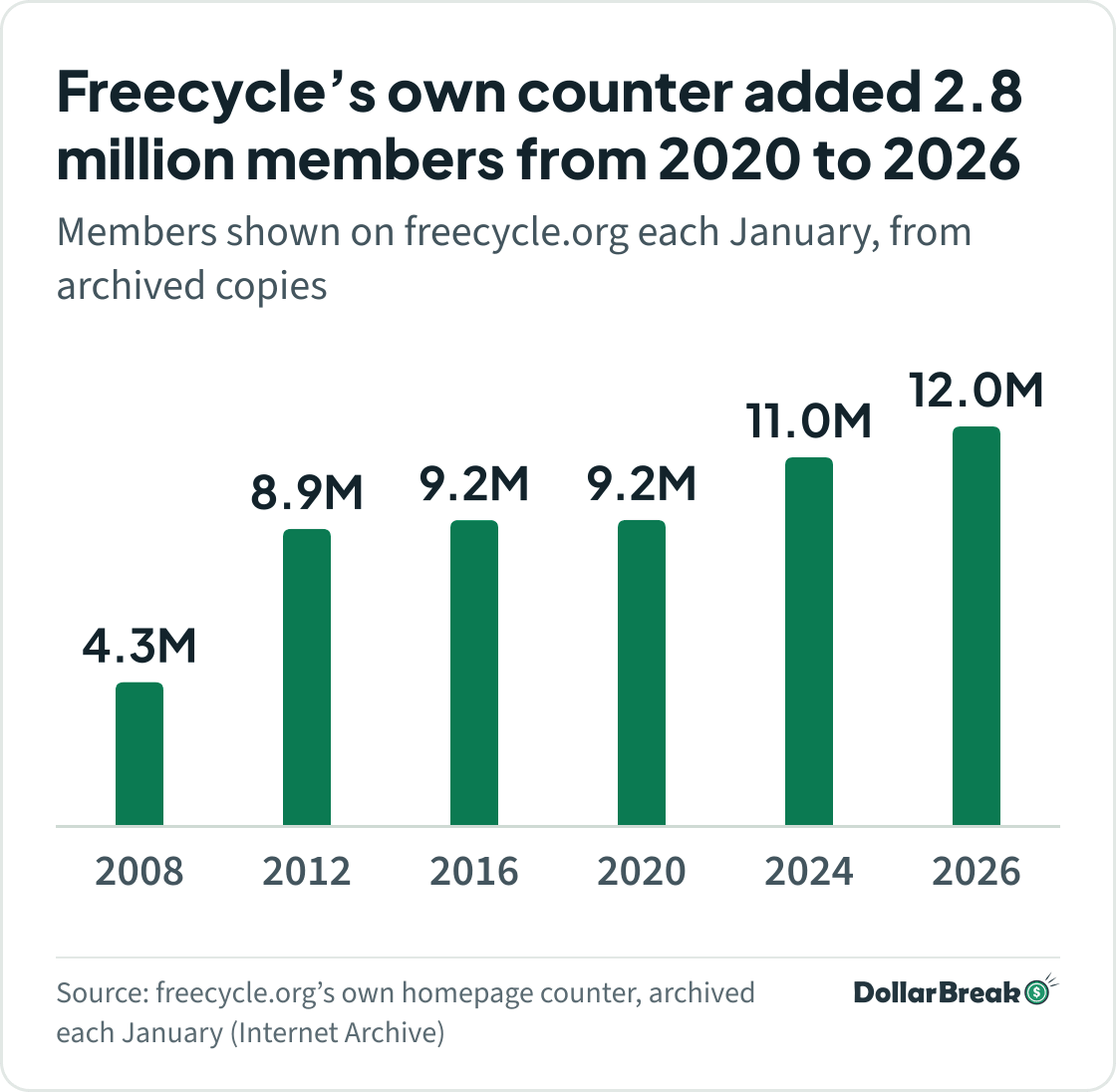
Freecycle is the oldest network of the lot, a registered nonprofit running town-by-town groups where everything posted must be free, legal and suitable for all ages. Its homepage counter read 12,316,762 members in 5,333 towns on 12 October 2026.
"Does Freecycle have an app?" is one of Google's own suggested questions, and the answer changed in 2026. It now has both: an official Android app, updated 11 September 2026, and an iPhone app that Apple dates to a first release of 13 July 2026. Neither has enough ratings yet to carry a score.
The experience is slower than the app stores suggest. Across the 55 newest Trustpilot reviews of freecycle.org, from a profile scoring 1.8 out of 5, the commonest complaint was no-shows and time-wasters (12), then moderation — posts left unapproved for one to three days (11).
Worth it? Worth joining for the volume in older suburbs, but expect to re-offer things nobody collects, and do not count on a post going live the same day.
Nextdoor
Nextdoor has a named "For Sale & Free" section, and giving personal items away is explicitly allowed in it. Because everyone posting is tied to a real address, it is the lowest-friction pickup here. Verification comes first, though: an unverified account cannot post, comment or join groups, and phone verification wants the address on your mobile bill to match.
Scale is worth knowing first. Nextdoor's own annual report gives 21.0 million weekly active users in the last quarter of 2025, down 5% on the year, against "over 105 million Verified Neighbors" signed up. Five sign-ups in six never open it in a given week.
Worth it? Yes in a dense suburb, where the free section moves daily. In a rural ZIP code it will be the quietest app you install.
OfferUp
OfferUp is a US-only marketplace with a real Free category: you tap the Free pill in search and sort by price. It is huge — 4.4 on Google Play from 1.26 million reviews and 50 million-plus downloads — so the free pool refreshes faster than on any dedicated giveaway app.
The catch lands on the giving side. Free posting is now metered by category: one Cars & Trucks listing a month, 15 for Appliances, 15 for Cell Phones. Past that you buy listings or a subscription.
Worth it? Install it to receive. Clearing a house, post the bulky things on one of the sites that sell stuff locally and keep your free OfferUp slots for what needs the audience.
Facebook Marketplace
Facebook Marketplace is not a separate app and never appears in an app store, which is why list after list leaves it out. Free is a real category with its own city pages, and in most US metros it holds more free listings than every dedicated app combined.
Marketplace's Free category and the Buy Nothing groups on Facebook are different places: the groups are moderated gift economies, Marketplace is not moderated at all. Nobody checks that "free" means free, which is why four of Freebie Alerts' 50 newest reviews describe posters who then asked for money.
Worth it? Yes, for volume — but read it through Freebie Alerts rather than scrolling, and treat every listing as unverified until you have messaged the person.
Olio
Olio started with surplus food and now covers books, toys and toiletries too. It is free, and its help center says it works anywhere in the world.
For a US reader that "anywhere" needs a caveat. Olio's supermarket partnerships are British (its homepage names Tesco, Sainsbury's and Iceland) and its US base is thin: 791 US App Store ratings against 50,300 Android reviews worldwide. Its own site advertises "Apple 4.9 / Google Play 4.6"; the live Play listing read 3.3 on 13 October 2026.
Worth it? Install it, check your radius once, and delete it if the map is empty. In most US ZIP codes it will be.
| App | Where its free listings come from |
|---|---|
| Freebie Alerts | Reads Facebook Marketplace, Nextdoor, OfferUp and Trash Nothing |
| Buy Nothing | Its own gift groups at about 1, 3 or 6 miles; many still run on Facebook |
| Trash Nothing | Freecycle and Freegle groups, read through a better app |
| Freecycle | Its own 5,333 town groups, where every post must be free |
| Nextdoor | Its "For Sale & Free" section, address-verified neighbors only |
| OfferUp and Facebook Marketplace | Their own Free categories: unmoderated, and the deepest pools in most metros |
Apps that send free samples and products to test
Nothing here works like a shop. You do not pick a product; a brand picks you from a profile, because it is buying reviews and data, not giving stock away. Expect weeks before anything arrives, and tasks attached to whatever does. For samples requested by mail instead, see our guide to getting free samples.
| Service | How you qualify, and what turns up |
|---|---|
| Influenster | Profile and past reviews decide; VoxBoxes arrive with review tasks attached |
| Amazon Vine | Invitation only, on how helpful your past reviews were; taxable on a 1099 |
| PINCHme | Browser only; 500 coins a box of trial sizes, four to six weeks, no tracking |
| SampleSource | Browser only; batches a few times a year, one package per address |
| Home Tester Club | Profile plus a survey per test; the 20 most active members get the best ones |
| TYB | Join a brand's community; rewards redeem for discounts, not free product |
Influenster
Influenster is the best-known of these, and the one with the clearest business behind it. It is owned by Bazaarvoice, whose sampling page tells brands it targets campaigns using up to 1,000 data points per member and gets 85% of its sampled content completed within eight weeks.
You fill in a long profile, review products you already own, then wait to be told you qualify for a VoxBox, which carries tasks of its own.
Two documented accounts show how uneven that is. Anna Thurman of Real Ways to Earn got her first VoxBox inside a month, full-size products, then no further invitation at all. A blogger writing as Stevie M Starks waited about three months and priced the contents at roughly $55.
Worth it? Yes, if you fill in the profile properly and can forget about it for months. Our Influenster review goes through the qualification rules in full.
Amazon Vine
Amazon Vine ships the most valuable free products of anything on this page, and you cannot apply for it. Amazon's own help page says so flatly: "You cannot ask to be in the program, you are invited in", and the invitation follows how helpful shoppers rated your past reviews.
There is no Vine app — it runs inside a normal Amazon account. One blogger writing on Making Sense of Cents logs more than 100 products with a stated retail total above $4,500 in her first six months, including a $160 projector. She was invited two to three weeks after writing half a dozen ordinary reviews.
The catch is the IRS. Vine products are taxable income at their estimated taxable value and are reported on a 1099, so that $4,500 is a tax bill, not a windfall.
Worth it? Only if you write careful Amazon reviews anyway. You cannot game your way in, and the tax makes a high-value year expensive.
PINCHme
PINCHme is alive, and it no longer works the way almost every list says. There is no app — it runs in a browser. More to the point, "Sample Tuesday" is gone: the word "Tuesday" appears nowhere on pinchme.com as of 13 October 2026.
It now runs on coins. Checking out a box costs 500 coins, coins also bid up your chances of qualifying for one, and 5,000 coins buys a $50 gift card. Coins expire if you miss a box's timer, and delivery takes four to six weeks with no tracking and no returns. What arrives is small: My Subscription Addiction itemized a PINCHme box at about $2.48 of retail value, and it took over a month to come.
Worth it? Marginal. It is free, and we earn nothing from naming it, but expect a couple of dollars of trial sizes. Our PINCHme review covers what actually ships.
SampleSource
SampleSource is the simplest thing here: a website, no app, mailing a pack of trial sizes a few times a year to the US and Canada. Its own terms are first come, first served, one package per address, email or IP, and quantities are capped. Our SampleSource review found no US drop on its public site since early 2023, while Canadians still get boxes. For a US box that still ships, our Daily Goodie Box review counts how many recent reviewers got one.
It also has the most positive public record on this page: 4.9 on Trustpilot from 1,539 reviews, 96% of them five stars, read 13 October 2026. Treat that with care — a free-sample service collecting reviews from people who just got free samples is not a neutral measurement.
Worth it? Yes. Sign up, set a reminder, and claim the pack the day it opens: batches run out in hours.
Home Tester Club
Home Tester Club is free to join and run by Brand Power. Fill in a profile, take a pre-qualifying survey on each test page, and chosen products arrive one to three weeks later.
Its rationing rule is unusually explicit: the 20 members per country with the most points that month get the exclusive tests, and points break ties between everyone else who qualifies. The app is the least loved here, 3.2 on Google Play from 599 reviews.
Worth it? Only if you use it weekly: a dormant account sees the ordinary tests and never the good ones. Our list of product testing apps covers the better-paying alternatives.
TYB (Try Your Best)
TYB appears on almost every "apps that give free products" list, and it does not, as a rule, give free products. Its own App Store description says you join a brand's community, complete challenges and earn rewards that redeem for discounts.
It is brand-gated too: rewards exist only inside the brands you join. Lindsey Ellefson of Lifehacker reported banking $542 of coins across 10 brands and redeeming $100.
Worth it? Only for brands you already spend money with. Treat it as a loyalty program, not a source of free stuff.
Apps whose points turn into free stuff
This group is where the money is, for us and for the apps, so read the floors first. Nothing here is free the way a neighbor's old bookshelf is free: you spend, you scan, and a fraction comes back as a gift card.
This group is what replaced the Sunday coupon insert: manufacturer money, paid after the shop instead of taken off at the till. Our guide to free coupons by mail sets out what is left of the paper version.
Ibotta
Ibotta is the only app here with a tab of genuinely free items. Its Freebies are labeled "Free after offer", and an "Any Brand" offer pays on a product type whatever brand you pick up. Its own figures are 2,600+ retailers and $218 a year for the average saver.
Read the freebie rule carefully. A "Free after offer" deal pays the item's average cost, not what your store charged, so if your shelf price is higher you pay the difference.
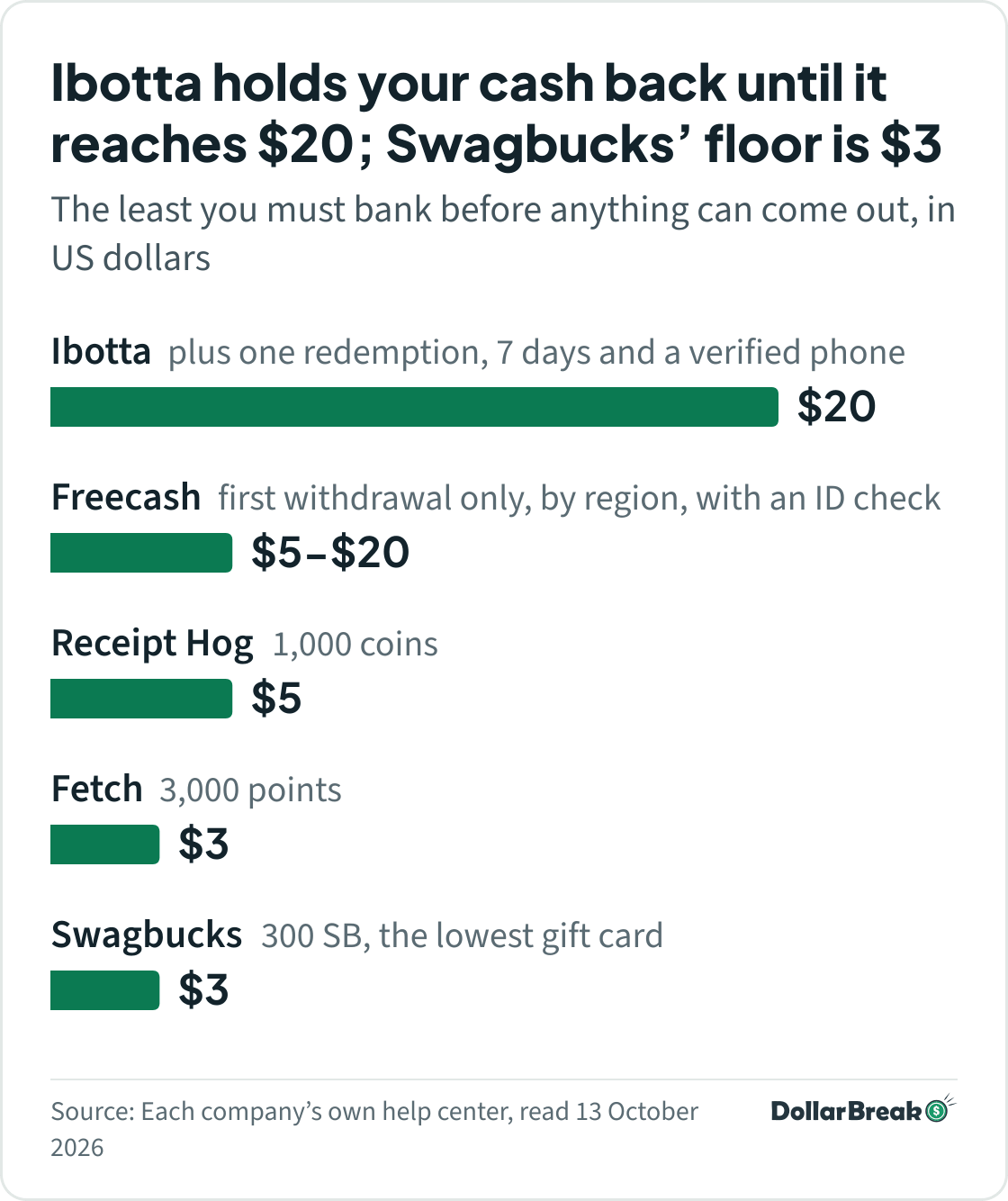
Two more rules matter more than any bonus. The withdrawal floor is $20, and a new account must also have redeemed one offer, waited seven days after it and verified a phone number. And since a help center update in September 2026, Ibotta charges $3.99 per 30 days once an account has gone 180 days without activity — taken from the Ibotta balance only, never from your bank, and avoided by one redemption, gaming offer or referral in that window.
Its public record is mixed. On BBB it holds a D- with 409 complaints closed in three years; Trustpilot gives it 3.4 from 4,333 reviews. Of the 150 newest Google Play reviews we read, about 11% report a rejected receipt or an uncredited purchase.
Ibotta Summary
- DollarBreak's test earnings - $5.20 cashback from six shopping trips
- On average 2% cashback on purchases
- Cash out from $20 to bank, PayPal or gift card
- Over 2,600 stores you can earn cash back at
- Android and iOS apps available
- Stackable savings
Worth it? The best of this group if you shop at big grocers weekly, but set a reminder to cash out at $20 and never let it go quiet. Our Ibotta review has the full payout history.
Fetch
Fetch takes any receipt from any store, which makes it the lowest-effort app in this group. Points come automatically, with extra on the 500-plus brands it names, and 3,000 points — about $3 — unlocks most rewards. Its two hard rules are easy to trip over: receipts older than 14 calendar days earn nothing, and it is US-only.
The documented returns are modest and consistent. Hillary Swetz of The Ways to Wealth logged 15 receipts over two weeks for 2,502 points — but 2,000 of those were a welcome-back bonus, so the receipts themselves paid about 50 cents for 23 minutes of work. The same site's editor uploaded 252 receipts against $10,661 of spending and got $14.45 back, or 0.13%. Both posts carry Fetch referral links.

Fetch Rewards Summary
- Easy to use
- Earn points with any grocery store receipt
- Earn points on over 500 product brands
- Rewards - gift cards and sweepstakes
Worth it? Yes, as a background app: snap every receipt, expect a $3 to $5 gift card every month or two. Read our Fetch Rewards review before counting on the bonuses.
Swagbucks
Swagbucks is the broadest of these: surveys, games, shopping, offers and receipts all pay SB, at 100 SB to the dollar. It says it has paid members nearly $700 million across more than 15 million accounts.
Know two things before you start. Swagbucks does not convert SB to cash — its help center states there is no direct exchange, only gift cards and PayPal — and the lowest gift card is 300 SB, or $3. Redeem $600 or more in a year and you must file tax information before redeeming again.
The rate is the honest problem. In its own timed test, sidehustles.com clocked eight and a half hours for about $15 — $2.04 an hour, including a $2.50 bonus. An hour of one game returned nothing, and most surveys disqualified the tester. That test carries no referral link.

Swagbucks Summary
- Many ways to earn money and e-gift cards
- $10 welcome bonus after a $25 shop purchase
- Up to 10% cashback when shopping online
- $3 minimum e-gift card withdrawal
- Play games and enter tournaments for SB
- Legit platform run by Prodege
Worth it? Use the shopping and offer side, skip the games, and judge it by our Swagbucks review rather than on an hourly rate you will not hit.
| App | Floor | Paid in |
|---|---|---|
| Ibotta | $20 | Bank, PayPal, gift cards |
| Fetch | $3 | Gift cards, sweepstakes, charity |
| Swagbucks | $3 | Gift cards, PayPal |
| Receipt Hog | $5 | PayPal, Amazon, Visa |
| Freecash | $5-$20 first | PayPal, gift cards, crypto |
| Capital One Shopping | No floor stated | Gift cards only |
Receipt Hog
Receipt Hog is owned by Numerator, a market research firm, which tells you what the product really is: your shopping data, bought with coins. Its reward table is fixed — 1,000 coins for $5, 2,900 for $15, 4,300 for $25, 6,500 for $40 — identical for PayPal, Amazon and Visa.
Earning is both capped and tapered, and the taper is the part nobody mentions. Only fast-moving consumer goods receipts count as Coin-Receipts, at most 20 a week, and once you pass 100 coins in an in-app week every further receipt earns a flat five coins no matter what it totals.
That shows up in the one side-by-side test anyone has published, below: the same $265 Walmart receipt paid 20 coins here, roughly 10 cents, against $3.00 on Ibotta — about 50 weeks of weekly receipts to reach the $5 floor.

Receipt Hog Summary
- Wide variety of receipts you can upload
- Easy-to-use app
- 5 additional ways to earn coins
- Use the app to save your receipts
Worth it? Only as a third app stacked on the same receipt you are already photographing. On its own the math does not work.
Freecash
Freecash pays coins for offers, app installs, free trials, surveys and games, at 1,000 coins to the dollar, cashed out in PayPal, gift cards or crypto. The first withdrawal is where it differs from everything else here: the threshold is $5 to $20 depending on your region, and it requires ID verification, a selfie plus a government document. Neither applies after that.
Be straight about the evidence: nobody has published a Freecash test with their own hours and total. Side Hustle School, which says it carries no affiliate link, gives ranges only, $3 to $8 an hour. Every page we checked claiming a full test was a review farm.
Worth it? Reasonable if you are happy handing ID to a rewards app and you stick to shopping and trial offers. Cancel any free trial the day you start it.
Capital One Shopping
Capital One Shopping is not a freebie app and belongs here anyway, because it is the only thing on this page that cuts what you pay without any effort. It applies coupons at checkout, compares prices including shipping, and pays Shopping Rewards credits that redeem for gift cards. You do not need a Capital One account: its own page says it is "100% free for everyone".
For scale, FinanceBuzz's Yahia Barakah logged 60 online orders over roughly two years and recorded $1,484.27 in coupon savings and rewards, including $213 off a $533 purchase. He flags the limits too: gift cards only, posting one to four weeks.
Worth it? Yes — install the extension once and forget it. The highest-value app here for anyone who shops online monthly.
What happened when people tried these apps
Nobody at DollarBreak has run these apps on their own accounts, so the evidence below is other people's, each with a date and a number. Where a reviewer posted a referral code, we say so.
| Who and when | What they did and what happened |
|---|---|
| Lindsey Ellefson, Lifehacker, Aug 2025 | Free product from Influenster since 2017 for reviews, with the social-post tasks declined; $542 of TYB coins across 10 brands, $100 of it redeemed. |
| Hillary Swetz, The Ways to Wealth, Jan 2025 (referral link) | 15 Fetch receipts in two weeks earned 2,502 points, 2,000 of them a bonus — so the receipts paid about 50 cents for 23 minutes. |
| Grace Lemire, Think Save Retire, Dec 2023 | One $265 Walmart receipt through three apps: Ibotta $3.00, Fetch about $1.10, Receipt Hog about 10 cents. Calculated about 50 weeks to Receipt Hog's $5 minimum. |
| Vanessa Zeigler, The Ways to Wealth, Jul 2024 (affiliate link) | Seven shopping trips in 30 days on Ibotta returned $38.10: $32.10 from item offers, $6.00 from bonuses. |
| sidehustles.com staff test, Jun 2025 (no referral link) | Eight and a half hours on Swagbucks produced about $15 — $2.04 an hour, including a $2.50 bonus. |
| Yahia Barakah, FinanceBuzz, Oct 2025 | 60 online orders over about two years with Capital One Shopping: $1,484.27 in savings and rewards. |
| Nicole Nicolet, Making Sense of Cents, Jul 2024 | More than 100 Amazon Vine products, a stated retail total above $4,500 in six months, every value on a 1099. |
| Paige Bennett, EcoWatch, Mar 2022 | Joined her Los Angeles Buy Nothing group when money was tight: gave away a desk, coffee makers and pots, and collected nearly new ankle weights the same day. |
Three things repeat. Receipt apps return a fraction of a percent of what you spend. Sample apps run on waiting, not asking. And almost every reviewer of a receipt app earns a commission on your sign-up, which is why the figures carrying no referral link read lower than the ones that do.
The gaps are real: no US reporter's hands-on account of Nextdoor's or Olio's free listings, and no Freecash test publishing its own hours. Where a number is missing here, nobody has published it.
Bottom line: giveaway apps produce furniture, reward apps a few dollars a month, sample apps a box or two a year. Install them for different reasons.
Six things the search results say that the companies do not
Searching this topic turns up a lot the companies never published. These six came from the top results and Google's AI summaries for "free stuff apps", "freebie apps" and "apps that give free products".
| What you will read | What the company publishes |
|---|---|
| "Iris" is an app that pays you in gems for product reviews | No such US app could be opened on either store. Google's own AI summary and a Lifehacker article recommend it; we could not confirm it exists for a US reader. |
| Freebie Alerts scans Craigslist | Its own site lists four US sources: Facebook Marketplace, Nextdoor, OfferUp and Trash Nothing. Craigslist appears in the page header but not in the scanned list. |
| PINCHme releases samples on "Sample Tuesday" | The word "Tuesday" is nowhere on pinchme.com. It runs on coins: 500 to check out a box. |
| Fetch pays extra on 300 brands | Fetch's own brands page says 500+. Its FAQ and terms give no number at all, only "hundreds". |
| Freecycle has no app | It has both. Apple dates the iPhone app's first release to 13 July 2026, and the Android app was updated on 11 September 2026. |
| Shopkick is a good free stuff app | Shopkick, Inc. filed for Chapter 7 on 29 May 2026 in Delaware, case 26-10877. Its site serves that notice and nothing else. |
Why these companies give things away
The neighbor apps are easy: the goods belong to your neighbors, and the app sells ads or a subscription. The other two groups are advertising budgets, and the filings say by how much.
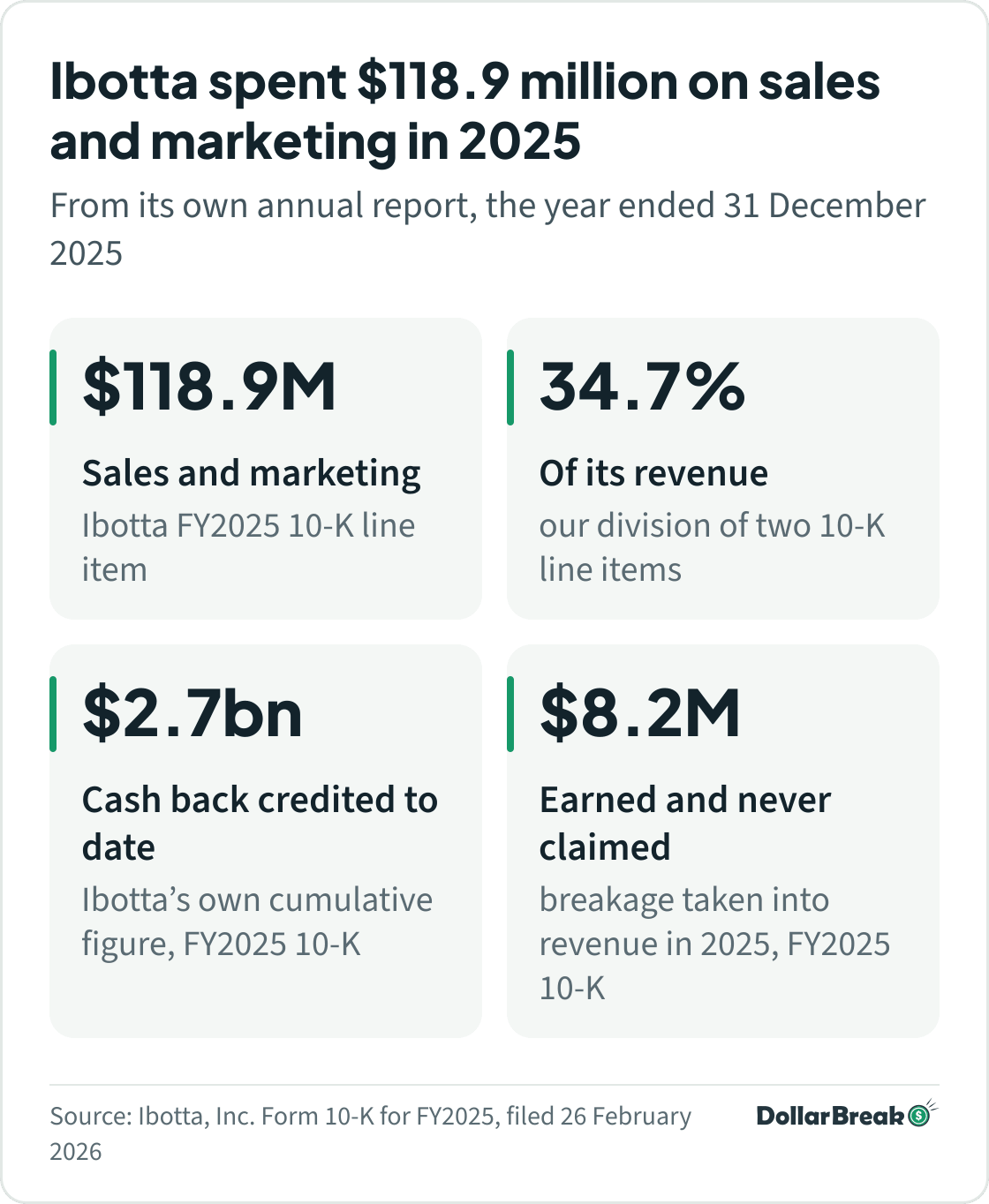
Ibotta is a public company, so its numbers are audited. In the year to 31 December 2025 it booked $342.4 million of revenue and spent $118.9 million on sales and marketing — 34.7% of revenue by our own division of the two line items.
One line in the same filing explains the $20 floor better than any help page. "Breakage", meaning cash back people earned and never took out, was $8.2 million of revenue in 2025, after $13.0 million in 2024 and $26.0 million in 2023. Unredeemed rewards are income.
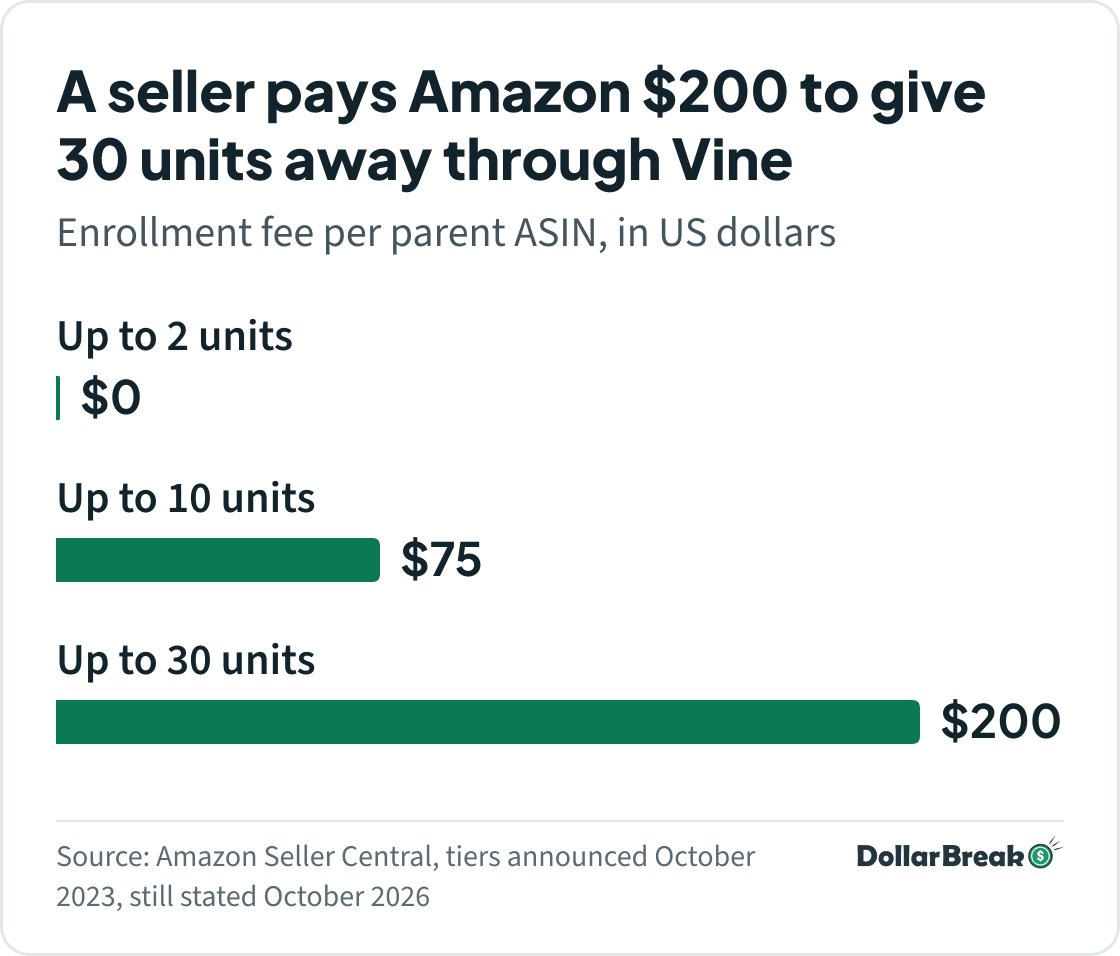
The sample apps work the same way from the brand's side. Bazaarvoice sells Influenster campaigns on targeting from up to 1,000 data points per member and 85% content completion inside eight weeks — the free product buys a review, at a known rate. Amazon publishes its price list outright: a seller pays nothing for two Vine units, $75 for ten and $200 for thirty.
Nextdoor's filing shows the limit of all this. It earned $257.6 million in 2025 and spent $91.0 million on sales and marketing to hold 21.0 million weekly users, down 5% on the year. A giveaway section is worth nothing if the people near you have stopped opening the app.
Bottom line: every free item here is a line in somebody's marketing budget, and the rules exist to cap that line. Floors, expiry dates and task lists are the part worth reading.
The traps: what to watch for
Free attracts bad actors, and regulators have a record on these mechanics. The FTC says about $16 billion was reported lost to fraud in 2025, the highest on record; in 2024 online shopping was the second most commonly reported fraud category.
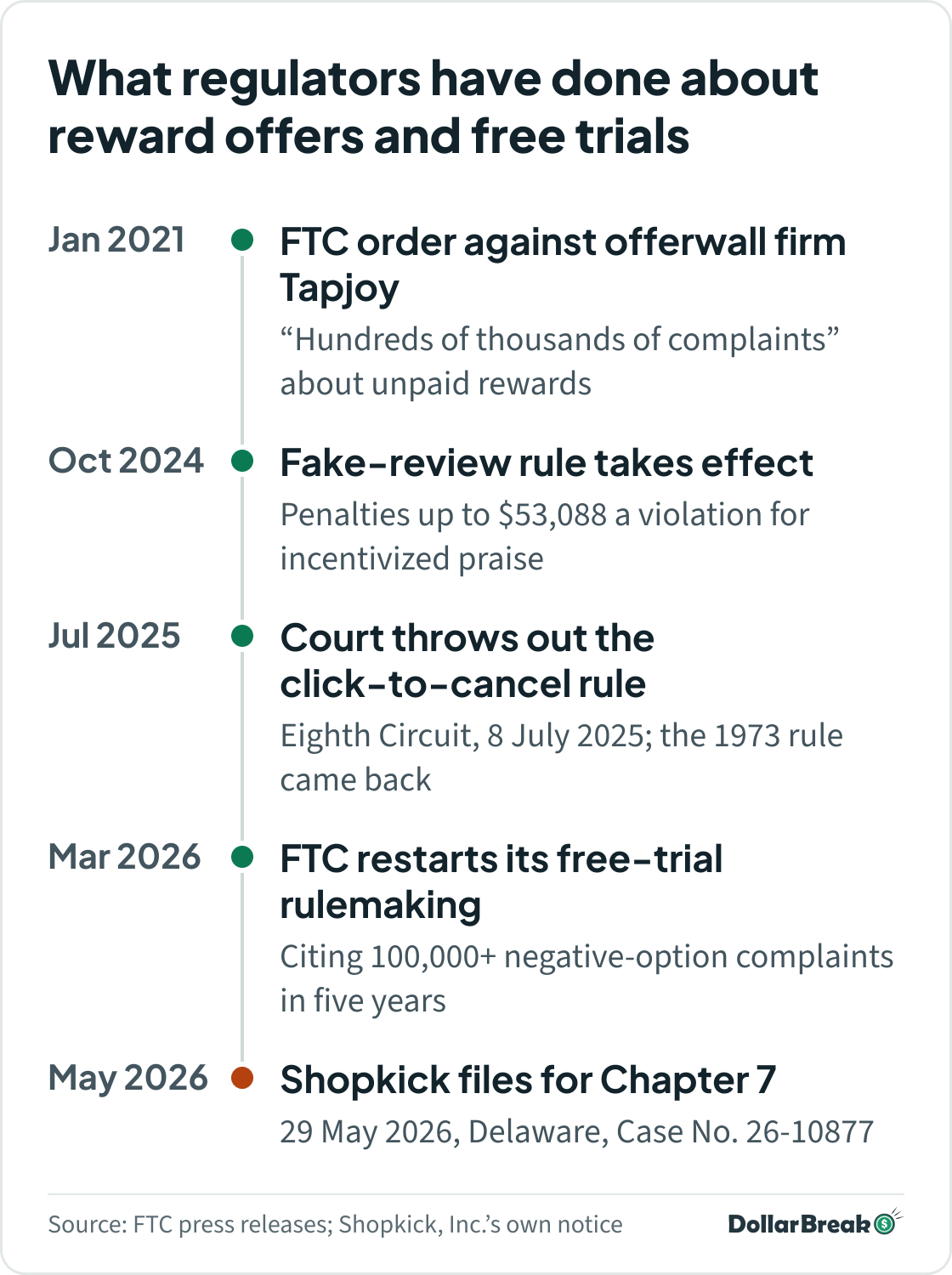
- "Free" that wants a free trial first. The FTC's click-to-cancel rule was thrown out by the Eighth Circuit on 8 July 2025 and is not in force; the agency reopened the rulemaking in March 2026, citing 100,000+ negative-option complaints in five years. Canceling is your job.
- A listing that is free until you message. Four of the 50 newest Freebie Alerts reviews we read describe posters who then asked for payment. Nothing on Facebook Marketplace is moderated for this.
- Rewards that never pay. The FTC's 2021 order against Tapjoy, the offer wall behind many in-app reward offers, said it had received "hundreds of thousands of complaints" from people who completed offers and got nothing.
- A review you were told to make positive. The FTC's consumer reviews rule took effect on 21 October 2024, penalties up to $53,088 a violation. A free product is legal; requiring praise for it is not.
- An app that has already closed. Shopkick filed for Chapter 7 on 29 May 2026. Check a store listing is still live before you spend a week earning in an app.
- An account left to go quiet. Ibotta's $3.99 per 30 days after 180 days of inactivity comes out of your balance. Cash out rather than bank points you will forget.
Bottom line: the honest free stuff needs no card details. If an app asks for a payment method before it gives you anything, close it.
Which to install first
Install one app and make it Freebie Alerts: it reads four listing sources at once and costs nothing. Install three and add Ibotta for grocery freebies and Fetch for receipts you already hold. The rest are slower or narrower versions of those three.
Worth doing
- Freebie Alerts, first, before you join any individual community
- Ibotta for its Freebies tab, with a reminder to cash out at $20
- Fetch on every receipt, inside 14 days
- Receipt Hog stacked on the same receipt, as a third scan
- Swagbucks for shopping and offers, not for its games
- SampleSource, claimed the day a batch opens
- Your local Buy Nothing group, found on Facebook first
Skip
- Olio, unless your radius shows listings on day one
- Home Tester Club, unless you will open it weekly
- TYB, unless you already buy from its brands
- Any app promising free goods for a paid trial
- Shopkick, and anything else a list recommends without checking it still exists
- Chasing an hourly rate on any of these — none pays one
How we researched this
We read every app's own terms, help center and US store listing on 13 October 2026, taking every rating the same day. Company figures came from the filings themselves: the SEC, Amazon Seller Central, the FTC and Shopkick's bankruptcy notice.
Nobody here has used these apps on a real account, so what arrives and what it is worth is credited to the people who recorded it, with their dates and their referral disclosures. We counted what we could ourselves: the 50 newest US App Store reviews of three apps, the 150 newest Google Play reviews of Ibotta and the 55 newest Trustpilot reviews of Freecycle.
Where a company publishes nothing, we say so.
Free stuff apps FAQ
What app gives you the most free stuff?
For physical goods, Freebie Alerts: it surfaces free listings from four sources at once rather than one community. For products a brand ships you, Amazon Vine moves the most value — one account logged over $4,500 of retail value in six months — but you cannot apply for it.
Does Freecycle have an app?
Yes, two official ones, both linked from freecycle.org's own mobile page. Apple dates the iPhone app's first release to 13 July 2026, and the Android app was updated on 11 September 2026. Both are new, so Trash Nothing is still the more polished way to read Freecycle groups.
Which free stuff apps are actually free to use?
All 20 are free to install. Freebie Alerts, Buy Nothing and OfferUp each sell a paid tier, and OfferUp caps free listings per category each month. No app here should ever ask for a card before it gives you something.
What apps actually give you money for free?
None of them, strictly. Ibotta, Fetch, Swagbucks, Receipt Hog and Freecash pay for an action — a receipt, a survey, an offer — and most of it comes out as gift cards. Swagbucks states outright that it does not exchange SB for cash.
How can I get free items on Amazon?
Through Amazon Vine, and only by invitation: Amazon's help page says you cannot ask to join. Invitations follow how helpful shoppers found your past reviews. Everything you receive is taxable income at its estimated value and is reported on a 1099.
What is the fastest way to get free samples by mail?
SampleSource, claimed the day a batch opens: first come, first served, one package per address. Influenster and Home Tester Club take weeks to months and select you, not the other way round. Our guides to free samples, free food apps and free stuff on Temu cover the offers that are not app-based.