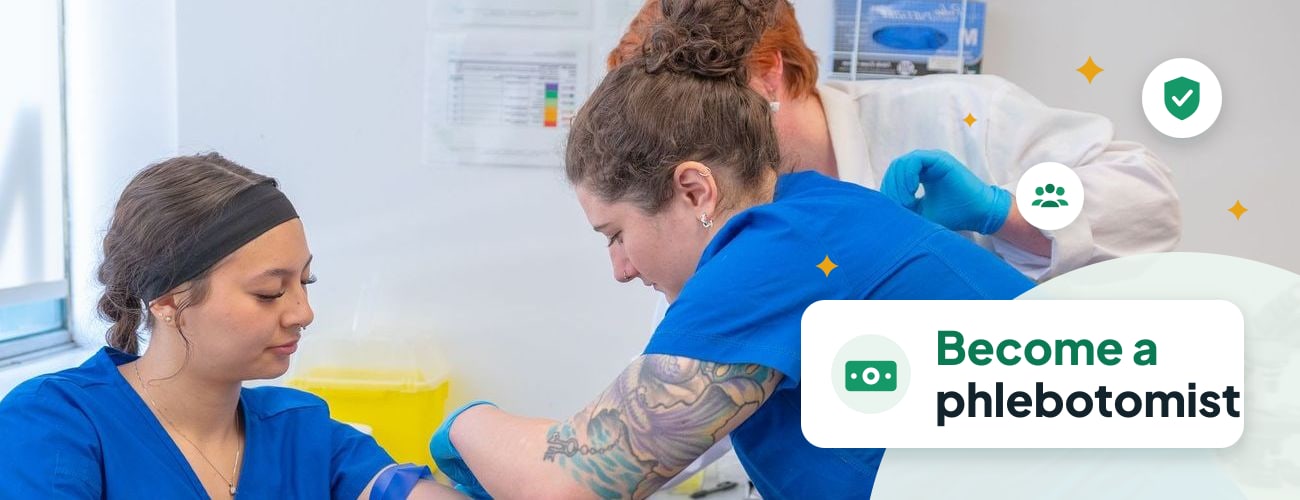
A phlebotomist draws blood for tests, transfusions and donations, mostly in hospitals and labs, and you may not have to pay to train. Here is what you can earn, how to become a phlebotomist step by step, and who pays you to learn.
Our verdict
For a fast, low-cost start in healthcare, yes. The ceiling is the catch: the top tenth earned over $28.26 an hour.
Worth doing if
- You want paid healthcare work within months, not years
- A blood center, plasma center or hospital near you trains new hires on the clock
- You plan to move on to lab or nursing work and want patient experience first
Skip it if
- Needles or blood bother you
- You need more than about $28 an hour soon
- You can't work early starts, nights or weekends
How much do phlebotomists make?
The median phlebotomist earned $45,230 a year, or $21.75 an hour, in May 2025, the Bureau of Labor Statistics (BLS) reports. The lowest-paid tenth earned under $35,780 ($17.20 an hour) and the top tenth over $58,780 ($28.26).
New hires start near the bottom of that range. Four employers pay $16 to $28 an hour:
New hires earn $16 to $28 an hour in four postings
Pay an hour in four postings
Median, all phlebotomists $21.75
BioLife in Mobile, Alabama, asks for a high school diploma and trains you, and CHOP in Philadelphia paid its 2023 class $15 an hour while training. Labcorp in Chicago wants certification, a finished program or 3 months of experience; Quest in Forest Lake, Minnesota, prefers certification.
Your state moves pay most. Averages run from Mississippi's $36,710 a year to California's $56,600; six areas average $50,000 or more and six under $40,000.
Six areas average $50,000 or more, six under $40,000
Average (mean) annual wage by state, May 2025
Under $40,000$40,000–$44,999$45,000–$49,999$50,000+State credential required
Your workplace moves it less. Medians ran from $39,930 a year in other ambulatory care to $48,030 at outpatient care centers; hospitals, the biggest employer, paid $44,220.
To earn more, travel or move up. Travel contracts pay “$29 and up” an hour, a working phlebotomist, Flo's Corner, said in a January 2026 video. Lab technologists and technicians earned a median $62,930 in May 2025, usually with a bachelor's degree, and licensed practical nurses $64,400.
The median rose 27% from $17.07 an hour in May 2019, while prices rose 25.5% by BLS's consumer price index: the raise barely beat inflation.
The median hourly wage rose 27% from 2019 to 2025, prices 25.5%
Median pay an hour, May of each year, not adjusted for inflation
+1.5%
after prices: pay rose 27% from May 2019 to May 2025, prices 25.5%
May 2019's pay, grown with prices
Bottom line: The first jobs above pay $16 to $28 an hour, and your state moves the number more than the kind of workplace does.
How to become a phlebotomist in 6 steps
Most phlebotomists start with a certificate from a program that takes under a year, BLS says, and need no degree. Some employers hire people with a high school diploma and train them on the job.
What can stop you. Check these before you pay for a program:
- Age and schooling. Expect to need a high school diploma or GED and to be 18 or older, as Delgado Community College in New Orleans asks.
- A criminal record. Stark State College warns that a felony or misdemeanor conviction may bar you from its program, the certification exam or a clinical placement.
- A drug test and a background check. Delgado's students need a negative test and a clean check before they start at a hospital.
- Your state. California, Louisiana, Nevada and Washington require their own credential (Step 5).
- Meet the entry requirements: a physical, shots and a CPR card ($93 at one center).
- Finish a training program: $1,095 to $4,200, 48 hours to two semesters.
- Log 30 to 100 supervised draws over 40 to 120 clinical hours, usually in tuition.
- Pass a national exam: $119 to $175; NHA's and ASCP's take two hours.
- Get a state credential in California, Louisiana, Nevada or Washington: $40 to $150.
- Land your first job: no fee; some employers hire before you certify.
Added up, the path takes three weeks to two semesters and costs about $1,188 to $4,470 with the exam and a CPR card, plus a state fee in four states.
Step 1: Meet the entry requirements
Before its students start at a hospital, Delgado also wants a physician's exam, a two-year American Heart Association CPR card, five vaccines, a TB test and proof of immunity to measles, mumps, rubella and chickenpox. A CPR (Basic Life Support) class cost $86, plus $7 for the card, at UT Health San Antonio's AHA training center from July 2026.
Step 2: Choose a program with supervised blood draws
Programs run at colleges, hospitals, private schools and online; the six priced here run from $1,095 for a 48-hour course to $4,200 for two semesters.
Six phlebotomy programs cost $1,095 to $4,200
Published price, what is included varies (Oct 2026)
Phlebotomy Training Specialists in Phoenix includes the exam fee and spends half of its 48 hours on blood draws. Stony Brook Medicine in New York runs six weeks, with 100 hours of clinical rotation and $95 in fees on top. Stark State College estimates $2,641.60 for its one-semester program, and 911 Programs in Rhode Island runs 12 weeks.
Penn Foster sells an online, self-paced Phlebotomy Technician Career Diploma. Its site, as search results quote it, lists $1,399 or $69 a month. That includes a 40-hour externship its team helps you find and your first NHA exam attempt.
Before you pay, ask who arranges your clinical draws. BMCC's 200-hour online course (run by ed2go, $2,467) ships a practice arm and says it “cannot guarantee placement at any clinical site.”
Find a program near you. CareerOneStop, sponsored by the US Department of Labor, lists phlebotomy programs by ZIP code, city or state in its Local Training Finder. California accepts only the schools on its health department's approved list, which gives each school's city.
Worth it? Pay for the shortest program that puts a needle in real arms under supervision.
Step 3: Get your supervised blood draws
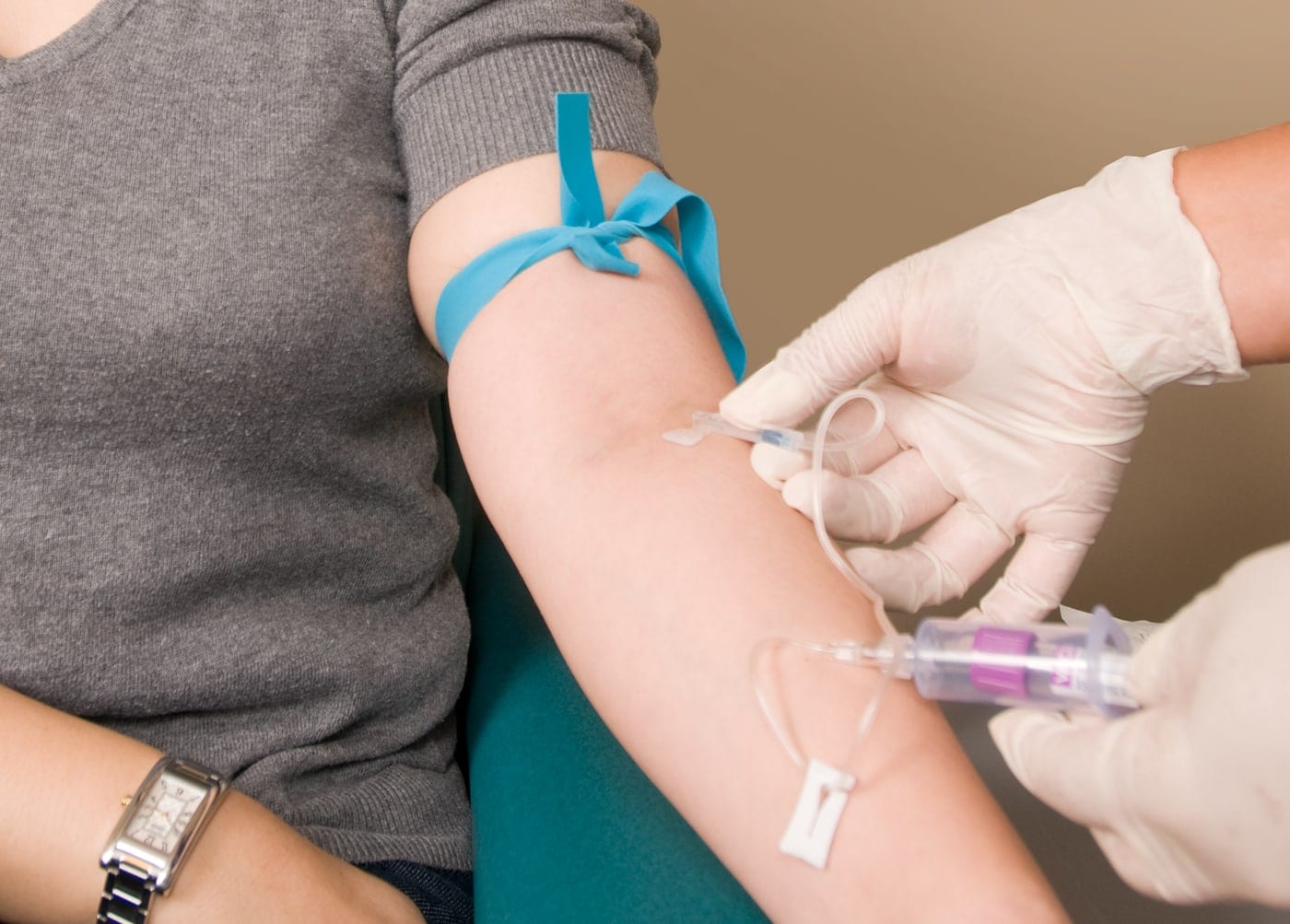
Certifiers count draws on live people. NHA asks for the fewest, 30 venipunctures and 10 capillary or finger sticks; AMT, NCCT and California's CPT I ask for 50, each with 10 skin or capillary punctures. ASCP's program route asks for 100 successful, unaided draws, and NCCT in Louisiana for 100 plus 25 capillary punctures.
Required blood draws range from 30 to 100
Venipunctures on live people, before you can certify
The draws usually come inside the program. Delgado's three-week hospital practicum runs 8-hour days that start between 6 and 8 a.m., as early as 4:30 a.m. at some sites, and you get yourself there.
Washington sets no number: practice goes on “until the trainee demonstrates proficiency.”
Step 4: Pass a national certification exam
Most employers want a national certificate: 77% of the 195 employers in NHA's 2026 survey require one for phlebotomists, and 14% encourage it. NHA sells the CPT exam, so that is its own survey. Four of the six certifiers California accepts:
National exams: fee and renewal (Oct 2026)
| Exam | Fee | Renewal |
|---|---|---|
| NHA CPT | Not on NHA's pages (Stark State lists $125 and $175) | Every 2 years: $195 and 10 CE credits |
| ASCP PBT | $155 | Every 3 years: $110 and 9 points |
| AMT RPT | $125, with your first year's dues | $75 a year; 24 points every 3 years |
| NCCT NCPT | $119 | Every year, with a fee and CE hours |
NHA's and ASCP's exams take two hours and AMT's 2.5, and 75.96% of the 57,457 CPT exams NHA gave in 2024 were passes. Fail NHA's and you wait 30 days and pay again.
Expect questions on the order of draw, which NHA's CPT test plan lists: the tubes are filled in a set sequence. Get it wrong and EDTA from a lavender tube can skew a serum sample's potassium and calcium results, Mayo Clinic Laboratories reports.
Blood cultures first, gray tops last
The order of draw for venipuncture, CLSI standard GP41
Blood culture bottles
Germ cultures; colors vary by brand
Light blue
Citrate: clotting tests
Red, speckled or gold
Serum: chemistry and serology
Dark or light green
Heparin: plasma chemistry
Lavender, pearl or pink
EDTA: blood counts; pink for blood bank
Gray
Fluoride: glucose
Worth it? Yes: most employers ask for it. Pick a certifier from your state's list, if it has one.
Step 5: Get a state credential if your state requires one
“State certification is required in California, Washington, Nevada, and Louisiana,” says ASCP, a certifier. Wherever you live, BLS advises checking with your state's licensing agency.
- California: Certified Phlebotomy Technician I. A state-approved program with 40 hours of class and 40 clinical, then an approved national exam. $150 to apply and each year, under state law.
- Louisiana: phlebotomist certificate. A board-approved national exam and your school transcript. $40; continuing education every year.
- Nevada: laboratory assistant certificate. Six months of approved training, an approved certification or three years of lab work. $60 ($64 under a 2026 rule); $45 to renew every two years.
- Washington: Medical Assistant-Phlebotomist. An accredited program, a national certification or practitioner-approved training. $145, and $145 to renew every two years.
Louisiana exempts staff at certain employers that give at least five days of phlebotomy training and two weeks on the job, under a 2023 law.
Three big states need none. New York's Office of the Professions says “phlebotomists are not required to be licensed,” Florida's law leaves them out of the lab staff it licenses (section 483.803), and Central Texas College says Texas “does not require state licensure for phlebotomists.”
Step 6: Land your first job
Experience is the hurdle: employers wanted “so much experience” when Helena Simms started, the phlebotomist of 15 years, now a trainer, told The Lansing Journal in 2025. Not every employer waits for a certificate: Labcorp's Chicago posting, in the pay chart above, takes a finished program instead.
JobGet, an app for hourly jobs, lets you apply with one tap and set up interviews. Its phlebotomist search for Chicago showed 23 openings on October 16, 2026.
Worth it? Apply as soon as you finish training; some employers train you first (next section).
How to train for free, or get paid to train
Blood centers, plasma centers and some hospitals train beginners on the clock, and public money can pay for a program.
CHOP, the Children's Hospital of Philadelphia, shows how a paid class plays out, as its lab told CAP Today:
CHOP's first paid class: 280 applicants, 7 hires
- Recruiting
280 applied; 10 were picked
50 interviewed for the first class
- Jan 2023
Training starts, paid $15 an hour
Eight weeks, half classroom, half practice
- Week 8
7 of 10 finish and are hired
One let go after the background check; two quit in days
- After
Pay rises to $17 to $19 an hour
Plus benefits; nobody had to promise to stay
- Month 6
5 of the 7 still at CHOP
One left for a nearby hospital
Two recruits quit within days rather than put a needle in a baby, and one was let go after the background check. The class cost CHOP $16,000 a trainee, half paid by Philadelphia Works, and was open to unemployed West Philadelphia residents with a diploma or GED.
Bottom line: If an employer near you trains new hires, apply before you pay tuition: you earn while you learn, and the job comes with it.
What a phlebotomist does
Besides the draw, BLS lists the work: confirming who the patient is, labeling every tube, entering samples in a database and calming nervous patients.
Hospitals and labs employ 69% of phlebotomists: 36% work in hospitals and 33% in medical and diagnostic labs, BLS counts. Some travel to set up blood drives, up to 300 miles one way at Vitalant, and some visit long-term care centers or patients' homes.
Most work full time, and hospital and lab jobs can mean nights, weekends and holidays; Quest's Forest Lake job runs 8:30 a.m. to 5 p.m. on weekdays, with rotating weekends. BLS counted 143,900 phlebotomist jobs in 2025 and expects 7% growth by 2035, against 3% for all jobs: about 18,000 openings a year.
Skills employers want
BLS lists six qualities the job needs:
- Communication skills. Explaining each procedure to the patient.
- Compassion. Some patients are anxious about having blood drawn.
- Detail oriented. The right amount of blood, every vial labeled and logged.
- Dexterity. Handling the equipment so the draw hurts as little as possible.
- Interpersonal skills. Working well with the rest of the medical staff.
- Physical stamina. Standing for long periods and moving all day.
Postings add their own: Labcorp's Chicago opening wants you to pass a color blindness test, Quest's prefers medical assistant or paramedic training, and a Red Cross hiring event for mobile blood drives asked for a valid driver's license.
Who becomes a phlebotomist: real paths in
Five routes in, as the programs and a local newsroom told them, three by first name only:
- C'Yani Powell, Philadelphia (CHOP, July 2025). Let go from a pharmacy technician job, Powell joined CHOP's paid class and is now a full-time phlebotomist there.
- Colleen, Lake County, Illinois (county job center, 2025 to 2026). Laid off after 20-plus years in benefits work, Colleen had WIOA pay for a college certificate (August to December 2025). Endeavor Health hired Colleen in January 2026.
- Sarah, Minnesota (Takoda Institute, January 2026). After nursing school, Sarah thought healthcare was the wrong fit; Minnesota's CareerForce program led to Takoda's free 12-week training, an internship and a hospital lab job two miles from home.
- Natasha, Chicago (Goodwill, 2025). With a Goodwill workforce center's help on documents and applications, Natasha earned a phlebotomy certification and, two months in, a full-time job as a lead phlebotomist.
- Frenchie Burks, Petersburg, Virginia (WRIC, July 2025). Certified by ASPT and drawing blood for nearly a decade, Burks began mobile services in 2020 and has turned them into an on-site business.
Bottom line: Most of these paths ran on someone else's money, and the fastest, CHOP's paid class, took eight weeks from no experience to a hospital job.
What are the risks of being a phlebotomist?
Needlesticks are the hazard to plan for: CDC estimates 385,000 needlestick and other sharps injuries a year among hospital-based healthcare workers. Needles drawing blood from a vein were in 111 (7.6%) of the 1,465 sharps injuries with a recorded purpose at 39 US hospitals in 2023, the International Safety Center's EPINet shows; suturing (27.6%) and injections (22.0%) caused far more.
Drawing blood from a vein caused 7.6% of sharps injuries
1,465 injuries at 39 US hospitals in 2023, by what the sharp was for
Under OSHA's bloodborne pathogens standard, your employer must offer the hepatitis B vaccine free within 10 working days of your first assignment, and free protective equipment.
Vitestro says its Aletta robot won FDA De Novo authorization on August 20, 2026. Aletta finds a vein with imaging and AI and draws the blood itself, but Vitestro plans a US trial before selling it here. BLS still projects 7% more phlebotomist jobs by 2035.
Bottom line: The hazards are real and managed. If needles or blood bother you, as they did two of CHOP's recruits, pick another healthcare job.
Phlebotomist vs. medical assistant, CNA and other healthcare jobs
Five other jobs draw the same people: short training, no degree, patients all day. Phlebotomists' median pay was within $520 of the best paid, pharmacy technicians at $45,750.
Phlebotomists earn within $520 of the best-paid job here
Median pay, May 2025
BLS expects jobs for home health and personal care aides to grow 18% by 2035 and for medical assistants 13%, against 7% for phlebotomists, 6% for pharmacy technicians and EMTs and 3% for nursing assistants.
Is CMA or phlebotomy better? If CMA means a certified medical assistant, the pay is close: medical assistants earned $460 a year more in May 2025. Their training is longer, about 1 or 2 years, but BLS projects 109,700 openings a year against 18,000. Pick phlebotomy to start sooner, medical assisting for the wider job market.
What each job takes, from the same BLS profiles:
- Phlebotomist. A program of under a year; a state credential in 4 states.
- Medical assistant. A program of about 1 or 2 years; employers may want certified hires.
- Nursing assistant (CNA). A state-approved program and the state's exam.
- Pharmacy technician. Under a year, often on the job; most states regulate it.
- EMT. A program of under a year; a license in every state.
- Home health or personal care aide. A diploma and short on-the-job training; a test at certified agencies.
Traps to avoid
- Theory sold as training. NHA and AMT count only draws on live people, so no online course alone can qualify you. Coursera's “Phlebotomy Fundamentals,” made by MedCerts, is 16 hours of online lessons whose own FAQ says it “does not fully prepare students to test for national certification.” It can show whether the work suits you, not train you.
- An online course that leaves the clinical to you. Of the 20 newest BBB complaints about MedCerts, read October 16, 2026, 7 concerned clinicals or placement and 9 a refund. MedCerts answered each, and 3 of its 20 newest Trustpilot reviews on phlebotomy report no help finding a clinical site.
- An unlicensed school. North Carolina's attorney general settled with Stepping Stone Phlebotomy in 2021, letting more than 300 students who had not passed their national exam get their money back. Check that your state licenses the school before you pay.
Is becoming a phlebotomist worth it?
For a fast, low-cost start in healthcare, yes: you can train in weeks or be paid to train, and the job grows faster than average. The ceiling is the catch: the top tenth earned over $28.26 an hour in May 2025, so treat it as a step if you want more.
Next step: check your state's rules, then ask the nearest blood center, plasma center and hospital lab whether they train new hires. Our guides to the best second jobs and same-day pay jobs cover income while you train. Our Jobs & Careers section has more.
Phlebotomist FAQ
How long does it take to become a phlebotomist?
About three weeks to two semesters. Phlebotomy Training Specialists fits 48 hours of class into about three weeks, Stony Brook takes six weeks, and college certificates one or two semesters.
Can I be a phlebotomist with just a certificate?
Yes: that is the usual route, and no degree is needed. Most employers also want a national certification, and four states require a state credential.
Can you become a certified phlebotomist online?
Only the classroom part: NHA wants 30 venipunctures and 10 capillary sticks on live people, and California requires a program it has approved. Ask an online course who arranges your clinical draws.
Is a phlebotomy license the same as certification?
No. A license or state certificate is a state's permission to work, required in California, Louisiana, Nevada and Washington. Certification is a national exam from a body such as NHA or ASCP. Elsewhere, as in New York, employers decide, and most want certification.
Is phlebotomy training difficult?
The class is short; getting draws right on real people is the hard part. About three in four NHA exams are passes (Step 4), and Delgado's graduates passed at 83% to 100% in the three years it reports.