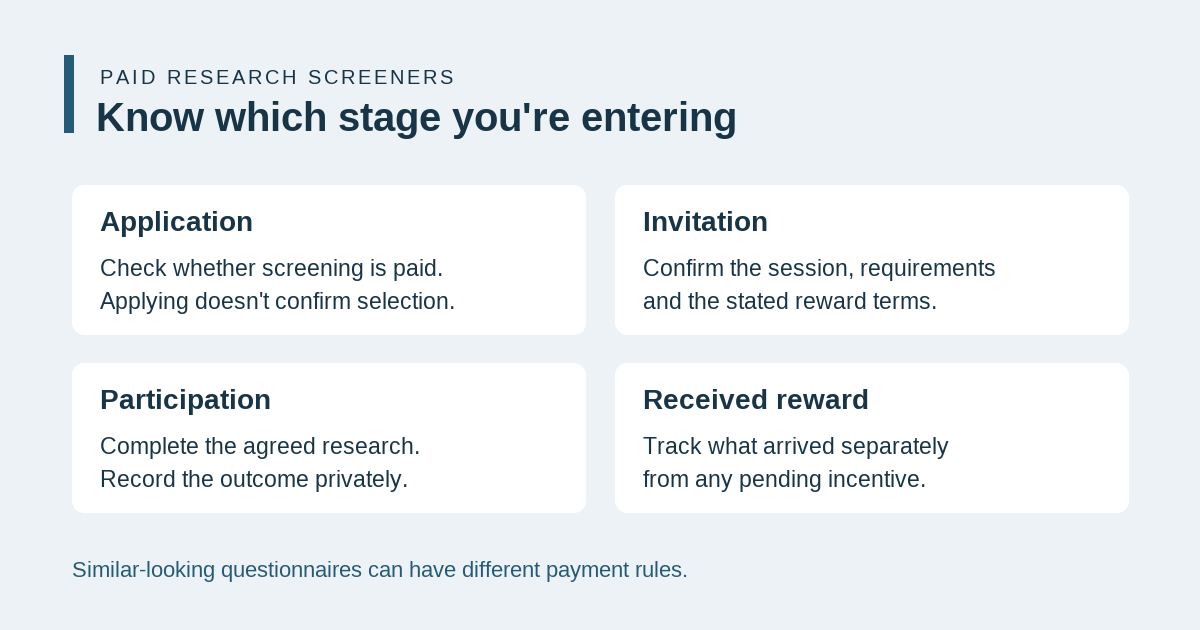
A paid research screener is a questionnaire used to decide whether you fit a study. The study may pay even when the application doesn't. Before spending time on one, check what stage you're entering, whether that stage earns anything, and what must happen before the advertised incentive becomes payable.
The useful question is more specific than “Are screeners paid?” Which platform, which kind of check, and which payment terms? Similar-looking questionnaires can have different rules.
Are paid research screeners actually paid?
Respondent says its application screeners are unpaid. Prolific pays participants who are screened out through its in-study screening feature, while its separate pre-study checks have different rules. User Interviews separates applying from being selected and completing a session. Read the exact study's terms before treating an advertised reward as money you'll receive.
| Stage or feature | What it means for the participant | What to check |
|---|---|---|
| Respondent application screener | Unpaid application reviewed for a possible invitation | Fit, time required and whether a partner screener follows |
| User Interviews study application | An application can lead to selection and a scheduled session; applying doesn't guarantee selection | The study requirements and invitation status |
| Prolific in-study screening | The labeled feature pays a screening reward when you are screened out | The label, completion instructions and reward on your submission |
| Prolific pre-study check | A separate check before access to the study; failing it is unpaid | Whether you're taking a pre-study check rather than in-study screening |
Policies checked November 14, 2026. These examples shouldn't be generalized to every survey panel or research platform.
Recognize the stage before you start
On Respondent, the screener is an application. Its official screener guide says researchers review responses and decide whom to invite. Payment follows attended or completed research and attendance confirmation, rather than the act of applying.
Some Respondent partner projects add a second screener on a partner's site. The guide says both screeners are unpaid and either can end without selection. A second questionnaire therefore isn't necessarily a paid task or a confirmed booking. Follow the project thread's instructions and check the extra time before continuing.
For context on the wider process, see the existing Respondent review. The distinction to carry into any listing is application, invitation, completed participation, then payment.
User Interviews' participant overview similarly separates completing a screener from confirming a session and participating. A study appearing to match your background is a reason to apply, not a booking. Its premium-screening documentation also describes possible follow-up contact or a video response before approval.
Check the confirmation inside the platform rather than clearing your calendar on the strength of a promotional email. The existing User Interviews review covers the platform's broader study process.
Prolific screening has an important exception
Prolific's in-study screening guidance says these studies carry an in-study-screening label. If your answers screen you out, you receive a screening reward; that outcome doesn't affect your account standing.
Its help page describes two versions: one based on screening time, and a newer version with a fixed reward and a minimum of £0.10/$0.14. Both are described as available while the system transitions. Follow the actual submission's reward and instructions rather than assuming the full study incentive is due after a screen-out.
The separate pre-study-check policy concerns short checks about attention, understanding, honesty and consistency before study access. Participants who pass and finish the study are paid for the total time, including the check. Participants who don't pass cannot complete the study and aren't paid for it.
That distinction matters when deciding whether a missing payment is an error. Save the study title, the feature shown and the outcome message. A screenshot of a reward without the stage or result may not explain what happened.
Why you can match a study and still not get selected
A public description is an invitation to apply. The screener narrows the pool further. A professional study might need someone who personally uses a particular tool at work; an adjacent job title or past experience may not meet that requirement.
User Interviews' premium-screening guidance describes researcher checks for quota balance and availability as well as further review. Those requirements help explain why a plausible match may still end without a booking. They don't tell you the reason for an individual rejection unless the researcher provides it.
Don't guess at a hidden qualification formula. Answer with your actual experience, including “none” or “I don't know” where appropriate. If a form doesn't offer an accurate answer, leave it or ask support rather than inventing one. Respondent specifically warns that exaggeration can risk study or platform removal.
Keep your profile current when your circumstances change. That means correcting stale employment or device information, rather than editing it to resemble each new listing.
Set a time budget before opening applications
An advertised interview amount says little about your return on all the time spent applying. Track the search and application time too.
A small log is enough:
| Date and platform | Application minutes | Result | Research minutes | Reward received |
|---|---|---|---|---|
| Your own entry | Include all attempts | Not selected, invited or completed | Include required follow-up tasks | Record received value and reward type |
For a hypothetical example, suppose five unpaid applications take four minutes each, and one leads to a 40-minute session. That's 60 minutes of activity before any setup or payment administration. If the confirmed reward received is $30, that example returns $30 per hour of counted time. It doesn't predict your selection rate or earnings.
For your own record, calculate:
Reward actually received ÷ total active minutes × 60.
Keep gift-card rewards separate from cash if they aren't equally useful to you. Keep pending incentives separate from received rewards. Otherwise an attractive listing can make the spreadsheet look better before any payment arrives.
Choose a personal application-time limit before browsing. Stop when you reach it, even if another high advertised reward appears. After enough recorded attempts to understand your own experience, compare the time spent with completed, paid participation. A smaller budget or a break can be a sensible response to repeated poor matches.
When to stop and ask for help
Pause if the advertised task turns into substantial extra work without clear terms. Ask whether the extra questions are still screening, whether there is a separate incentive, and what completion requires before continuing.
Don't pay a fee to qualify. Respondent's guide explicitly warns against that and says to use the links supplied in platform notifications or the project thread. A partner screener named by an official project can be part of the process; an unsolicited payment demand deserves a different response. Verify it through the platform.
If you completed a selected User Interviews session and payment is missing, use its incentive-payment guide to check who distributes the reward. It distinguishes platform-distributed incentives from researcher-distributed ones and explains the statuses shown under My studies. A completed interview and a redeemed reward are separate milestones.
Keep a private record of the study name, participation date, promised reward and relevant messages. Contact the platform or researcher through the established study channel. Avoid publishing the screener or confidential research material in a public complaint.
Does “not selected” mean my account has a problem?
It doesn't establish one. Study selection depends on the researcher's needs and review. Look for an explicit account notification before interpreting an unsuccessful application as a restriction. Prolific specifically says an in-study screen-out doesn't affect account standing.
Should I apply again with different answers?
Don't change truthful answers to try to force a match. Check for an actual mistake or outdated profile detail, then follow the platform's correction process if needed. A study's requirements don't change your real experience.
Is a high-paying study worth a long screener?
Only you can decide the time tradeoff, but the headline reward belongs to completed qualifying participation. Check unpaid stages and required follow-up first. If you need predictable income, an unconfirmed research invitation shouldn't be treated as money already budgeted.