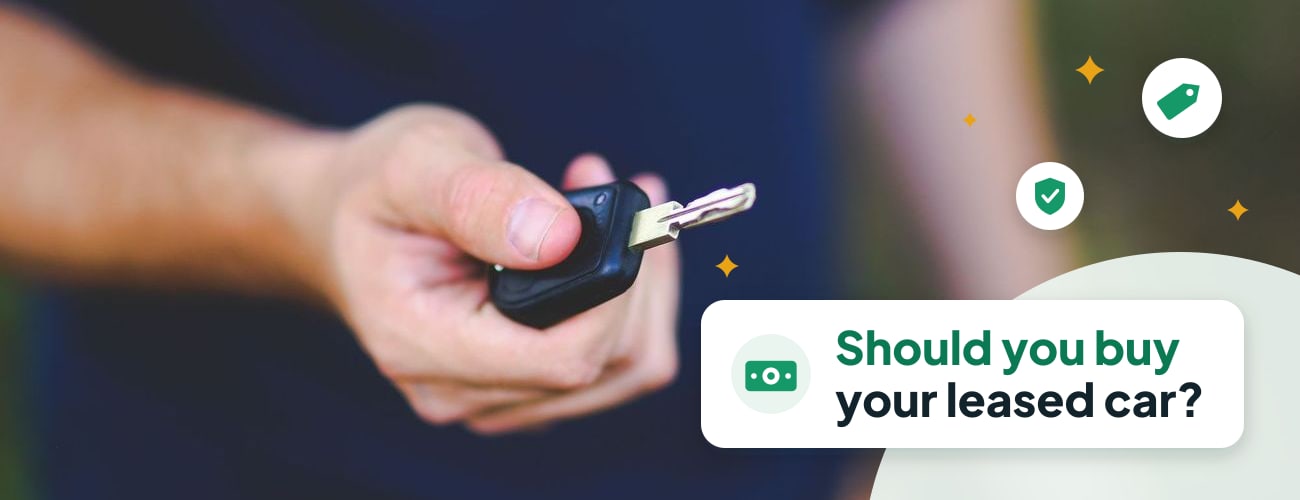
This guide works through the six checks that decide whether to buy your leased car: the payoff number, your monthly costs, the car’s condition, mileage overages, wear charges and the next few years. It also covers what to do instead if the numbers say no.
Key takeaways
- Two numbers decide it: the payoff on your lease against what the car is worth today. Buy only when the payoff is lower.
- Run the loan math: at the 11.19% average used-car rate, a $25,000 payoff over 60 months is $545.93 a month and $32,756 in total.
- Mileage and wear: going over the cap costs $0.10 to $0.25 a mile, and both charges vanish if you keep the car.
- Condition counts: a car you have serviced yourself is the rare used car with no unknown history.
- Check the rules first: some leasing companies bar third-party buyouts, so you may have to buy and title the car before you can sell it.
- If you pass: return it, lease again, extend, transfer the lease, or ask for a lower lease-end price.
When Should You Buy Your Leased Car
1. Buyout Price is Lower than Car’s Value
Your lease fixes a buyout price the day you sign it. That is what you pay to own the car instead of handing it back.
Buy only when that price sits below what the car is worth today.
That test is harder to pass than it was. Three-year-old cars held just 66% of their original sticker price in the first quarter of 2026, a five-year low, and off-lease supply is set to rise 25.7% this year.
The payoff starts from the car’s residual value: the leasing company’s estimate, made at signing, of what the car would be worth at the end of the term.
What a lease payoff adds up to:
Residual value + purchase-option fee + any remaining lease payments + sales tax + title and registration fees = your lease buyout price
Sometimes that total still lands under the car’s market value. Then buying beats shopping for the same model used, and you could resell it and keep the difference.
EXAMPLE:
- Buyout price: $17,000
- Current market value: $18,000
You are $1,000 ahead buying the car you already drive instead of the same model from a private seller.
2. Buying Leased Car Reduces Monthly Expenses
Say your payoff is $25,000 and you finance all of it. A lease buyout loan is a used-car loan, and the average used-car rate was 11.19% in the second quarter of 2026, which over 60 months works out at $545.93 a month.
If your lease payment is higher than that, buying starts to look cheaper month to month.
What the budget rule says:
Investopedia’s 20/4/10 rule caps transport costs, insurance and fuel included, at 10% of your income, on a loan of four years or less.
If your lease or loan payment breaks that ceiling, the answer is a cheaper car, not a longer loan.
Putting cash down cuts both the monthly figure and the interest you pay over the term.
Investopedia calls 20% the ideal down payment, though plenty of buyers put down closer to 10% to 12%.
Financing a $25,000 payoff over 60 months at 11.19%, with and without $5,000 down:
| Option | Loan amount | Interest rate | Monthly payment | Total cost |
|---|---|---|---|---|
| No down payment | $25,000 | 11.19% | $545.93 | $32,756 |
| $5,000 down payment | $20,000 | 11.19% | $436.75 | $31,205 |
The $5,000 up front takes $109 off the monthly payment and about $1,550 off the total, all of it interest. The total cost column counts the down payment itself.
3. Your Leased Car is Well Maintained
A leased car you have serviced on schedule is the rare used car with no unknown history. You hold the records, and you know what it has been through.
That matters more than it sounds. The main risk in any used car is paying for someone else’s neglect, and here there is none to find.
What you get by buying a car you already know:
- No surprises: you know every service, every repair and every knock the car has taken.
- A longer run: a car kept to its schedule can carry you well past the point the lease would have ended.
- A record to sell with: a full service history is the easiest thing to put in front of a private buyer later.
4. Exceeded Mileage Allowance
Every lease caps your miles, and going over costs you at the end of the term.
Most leases allow 10,000 to 15,000 miles a year. The overage fee usually runs $0.10 to $0.25 a mile; Toyota Financial Services charges $0.15.
EXAMPLE:
A 36-month lease at 12,000 miles a year allows 36,000 miles. Hand the car back with 45,000 on the clock and you are 9,000 miles over, which at $0.15 a mile is a $1,350 bill.
Buy the car and that bill disappears. If you pass the cap every year, that alone can settle the decision.
5. The Car Has Excess Wear and Tear
Damage past “normal wear and use” is charged at lease end. What counts, and what it costs, is set by your own lease agreement.
Each leasing company publishes its own standard, and some build in a cushion. Mazda Financial Services waives up to $500 of excess wear and use on leases written after 27 January 2026, though not missing keys, parts or equipment.
Tires and wheels are the usual catch. Exposed cords, sidewall damage or anything outside the manufacturer’s guidelines for safe operation counts as excessive, and you pay for the replacement.
Buying the car ends the inspection altogether. Nobody prices the scuffs, and you fix what you choose to fix, when you choose to.
6. Car Fits Your Future Needs
If the car still suits you and you plan to keep it for years, buying builds equity instead of handing the car back for nothing. That equity goes towards whatever you drive next.
You also set your own service schedule, pick your own garage and keep the car as long as it keeps running.
If your life is about to change – a longer commute, a bigger family, a move – leasing again keeps you flexible.
A new lease means few repair bills of any size and a different car every two or three years. What it costs you is the equity.
Worth it? The buyout pays off when the payoff price beats the market, the car has been looked after, and you are already facing mileage or wear charges. Miss on the first of those and the other five rarely rescue it.
Reasons You Shouldn’t Buy Your Leased Car
- The payoff price is higher than the car is worth.
- The car no longer fits how or how far you drive.
- It needs repairs you would be paying for alone once the warranty ends.
- You have not enjoyed owning it.
- You cannot cover the payoff in cash or at a rate you can live with.
Pros of Buying Your Leased Car
- No mileage limits: the cap and the per-mile penalty both end the day you buy.
- No wear-and-tear charges: no lease-end inspection, so nobody bills you for scuffed alloys or a marked seat.
- A car you know: full service history and no unknown previous owner.
- Equity at the end: a buyout loan spreads the cost, and when it is paid the car is yours to sell or keep.
- A possible profit: if the payoff is below market value, you can buy and resell for the difference.
Cons of Buying Your Leased Car
• You pay more in total – lease fees and finance charges mean a buyout costs more than buying the same car outright would have at the start.
• You need the cash or the credit – you either hand over the payoff in full or take on a used-car loan, at a rate that follows your credit score.
• Less warranty left – the factory warranty has usually run out or is close to it, so repairs come out of your pocket.
• You keep the old technology – the driver aids and infotainment that arrived since you signed stay on the showroom floor.
Worth doing
- The payoff is below what the car sells for today.
- You are over the mileage cap or facing wear charges.
- You have the full service history and plan to keep the car for years.
Skip
- The payoff is above the car’s market value.
- You would be borrowing well above the 11.19% average used-car rate.
- The car needs work the warranty will no longer cover.
- Your needs are about to change.
Bottom line: Two numbers settle it, the payoff on your lease and what the car sells for today. Mileage, wear and condition only widen or narrow the gap between them.
What if You Decided Not to Buy Your Leased Car?
If you pass on the buyout, you have five other routes:
• Return the car – book the pre-return inspection first, so you see the mileage and wear charges before the final bill arrives.
• Lease again – sign a new lease with the same brand or another one, and keep driving something recent.
• Extend the lease – many leasing companies will add a few months while you decide, which also buys time to watch the car’s market value.
• Transfer the lease – some leasing companies let another driver take over the remaining payments.
• Ask for a lower price – the residual written into your contract does not change, but the leasing company can still offer a lower lease-end purchase price.
What Does it Mean to Lease a Car?
A lease is a long rental. You pay a dealership, a bank or a leasing company for a set term and a set number of miles.
You never own the car. At the end of the term you hand it back, unless you take the buyout.
Is Residual Value the Same as Buyout?
They are related, but they are not the same number:
- Residual value: the leasing company’s estimate at signing of what the car will be worth at the end, built from the capitalized cost, the term (usually 24 to 36 months) and a depreciation percentage.
- Buyout price: the residual plus any remaining payments, the purchase-option fee, sales tax, and title and registration fees.
So the payoff is always more than the residual. Ask your leasing company for the full figure in writing before you decide anything.
What if You Want to Buy Your Leased Car but Don’t Have the Money?
A lease buyout loan covers the payoff plus the fees and the tax. It is a used-car loan, so the rate follows your credit: Experian put the average at 11.19% in the second quarter of 2026, from 6.29% for super-prime borrowers to 21.62% at the deep-subprime end.
If the rate you are offered sits at the wrong end of that range, hand the car back. Returning it costs you nothing beyond the mileage and wear charges you already owe.
Can You Sell or Trade in the Leased Car?
Start with the car’s value. The Kelley Blue Book calculator gives you a number to set against your payoff.
Then check who is allowed to buy it. Some leasing companies restrict third-party buyouts, which means you have to purchase and title the car yourself before you can sell it on, and that adds tax and fees to the sum.
Selling privately is slow. It can take up to 52 days and about 15 hours of your own time.
Trading in or selling online is faster and far less work, and it usually pays less. Our guide to trading in versus selling puts the two side by side.
EXAMPLE:
Buy the car for $25,000 when it is worth $27,000 and you are $2,000 ahead before costs.
That profit is taxable. Hold the car more than a year and the long-term rate is 0%, 15% or 20%, so $0, $300 or $400 on a $2,000 gain; sell inside a year and you pay tax at your ordinary income rate.
Lease Buyout FAQ
Can you negotiate a lease buyout price?
The residual value written into your contract does not change. The leasing company can still offer or agree to a lower lease-end purchase price, so ask before you commit to anything.
Do you pay sales tax when you buy out a lease?
In most states, yes. A payoff quote normally includes sales tax alongside the purchase-option fee and the title and registration fees, so ask for the full figure rather than the residual on its own.
Can a dealer or an online buyer pay off my lease for me?
Not always. Some leasing companies restrict third-party buyouts, and then you have to buy and title the car yourself before you can sell it.
What credit score do you need for a lease buyout loan?
There is no fixed cut-off, but the rate moves a long way. Experian put the average used-car rate at 11.19% in the second quarter of 2026: 6.29% for super-prime borrowers scoring 781 to 850, and 21.62% at the deep-subprime end.