
This list of free stuff for seniors gives every item the age and income test that open it, with a link to the agency or company that sets the rule. The programs are ranked by what each is worth a year. Discounts that other lists call free get a table of their own.
Key takeaways
- 16 free programs, the most valuable first: Extra Help is worth about $5,700 a year, and Lifeline carriers give a $0 phone plan to people who qualify.
- 10 free things by mail, at home or nearby: five arrive in the mail, including talking books with a free player.
- 60 opens the most: the USDA food box, farmers-market money, senior-center meals and SNAP’s easier rules. Nothing new starts nationally at 70.
- 9 things called free cost money: the park Senior Pass is $20 or $80, New York’s senior fare is half price, and AARP costs $15 for a first year.
- A “free” brace or gene test offered by phone is a fraud pattern: one June 2025 federal action charged 324 defendants over $14.6 billion.
Every freebie at a glance
Not sure what you qualify for? Three free services check for you: NCOA’s BenefitsCheckUp online, 211 by phone, and the Eldercare Locator on 1-800-677-1116. The programs below are ranked by what each is worth a year where a figure is published; one-off grants and free services follow.
| What you get | Age | Who qualifies |
|---|---|---|
| Extra Help with drug costs | Medicare | Income up to $23,940 a year |
| Medicare premiums paid | Medicare | Income up to $1,816 a month |
| Food money (SNAP) | 60+ rules | Net income up to $1,330 a month |
| Help with energy bills | Any | Set by your state |
| Energy-saving home work | Any | 200% of poverty |
| Tax preparation | Any | None at Tax-Aide |
| A $0 phone plan | Any | 135% of poverty, or Medicaid, SNAP, SSI |
| Home repair grant | 62+ | Rural, very low income |
| Dental treatment | 65+ | Cannot afford care |
| Hearing aids | Veterans | Enrolled in VA care |
| Rides to the doctor | Any; 60+ | Medicaid, or a local aging agency |
| Equipment on loan | Any | Your state’s rules |
| Medicare advice | Medicare | None |
| Checkups and vaccines | Medicare | A provider that takes assignment |
| Legal advice | Any; 60+ | 125% of poverty; none at 60+ |
| College courses | 60 or 65 | Set by each state |
| Talking books and a player | Any | A print disability |
| Ebooks and large print | Any | A library card |
| A monthly food box | 60+ | 150% of poverty |
| Farmers-market money | 60+ | 185% of poverty |
| Senior-center meals | 60+ | None, by law |
| Glasses and an eye exam | Any; 18+ | 250% of poverty for glasses |
| Sample boxes | 18+ | None |
| Print catalogs | Any | None |
| Gift cards from apps | 13+ or 18+ | None |
| Statements by mail | 60+; Medicare | None |
16 free programs worth the most
Extra Help with Medicare drug costs
Extra Help is Medicare’s subsidy for Part D drug plans, and Social Security puts its value at about $5,700 a year. In 2027 it means a $0 plan premium, no deductible, and no more than $5.80 a generic or $14.40 a brand-name drug. Once your drug costs reach $2,400, you pay nothing.
The 2026 limits are an income of up to $23,940 a year for one person ($32,460 for a married couple) and savings under $18,090 ($36,100). Social Security says you may qualify on a higher income, for example if you support relatives who live with you.
- Automatic for some. Anyone on full Medicaid, a Medicare Savings Program or SSI gets it without applying.
- How to apply. Form SSA-1020, online at ssa.gov, on 1-800-772-1213, or at a Social Security office.
- Help with the form. Your state’s SHIP counselors (number 13 below) help you apply, free.
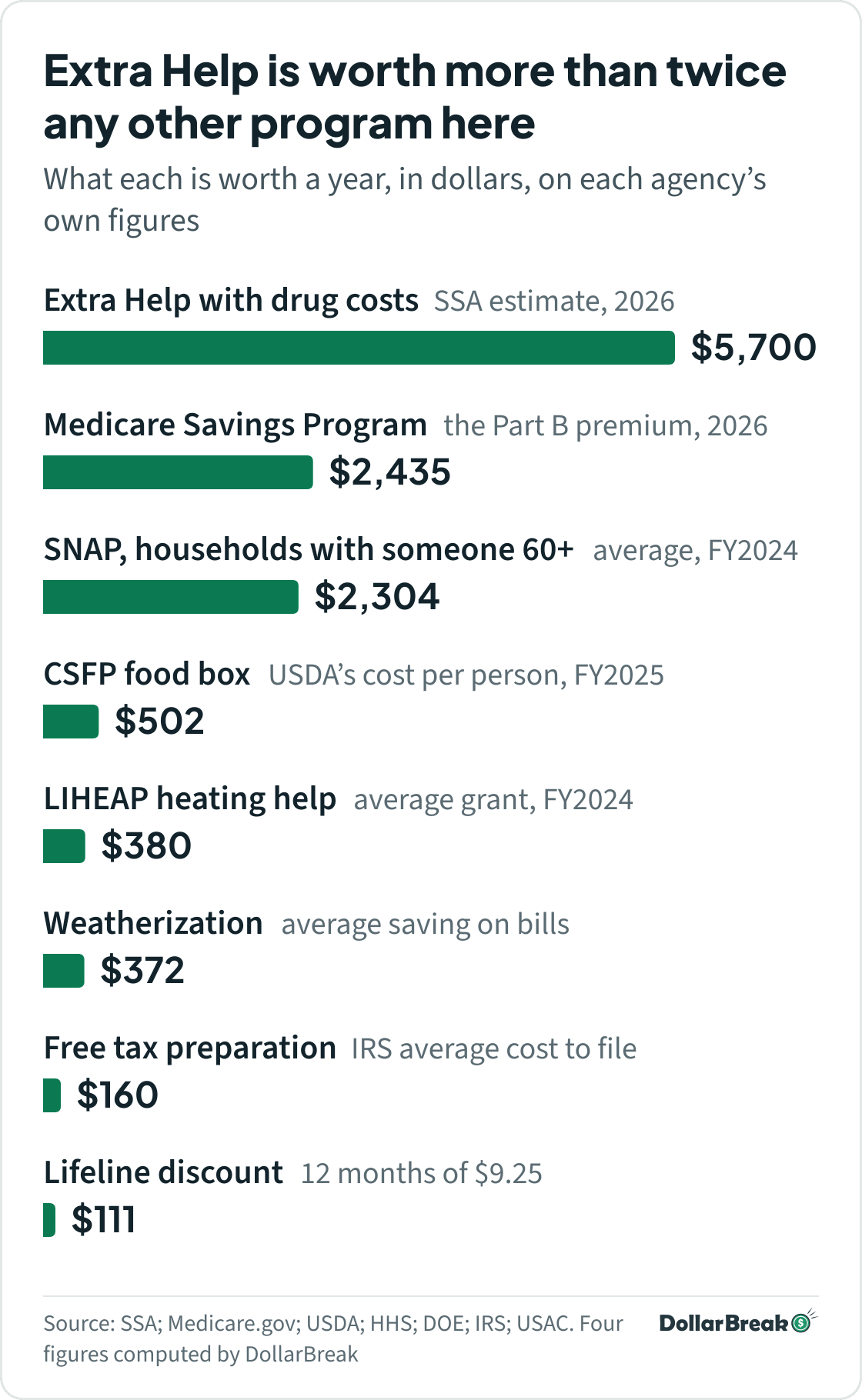
Worth it? Yes. It is the most valuable item on this page, worth more than the next two programs combined.
Medicare Savings Programs: your premiums paid
Your state’s Medicaid office runs three Medicare Savings Programs that pay Medicare’s own bills. All three pay the Part B premium, $202.90 a month in 2026, or $2,434.80 a year. The richest, QMB, also pays deductibles, coinsurance and copays, and providers “aren’t allowed to bill you”.
| Program | Income limit, one person | What it pays |
|---|---|---|
| Extra Help | $23,940 a year | Drug plan costs |
| QMB | $1,350 a month | Premiums, deductibles, coinsurance |
| SLMB | $1,616 a month | The Part B premium |
| QI | $1,816 a month | The Part B premium, renewed yearly |
Two catches. QI is approved “on a first-come, first-served basis” and must be applied for every year. And Medicare.gov says some states accept you “even if your income or resources are higher than the federal limits”, so apply even if you look a little over.
Worth it? Yes for anyone near the limits: $2,434.80 a year back, and it brings Extra Help with it.
SNAP food money, with easier rules at 60
At 60, SNAP counts you as elderly, and its rules loosen. USDA’s wording: “A household with an elderly or disabled person only has to meet the net income limit.” From October 2026 to September 2027 that limit is $1,330 a month for one person and $1,804 for two.
- More savings allowed. $4,750 instead of $3,000, and the home and most retirement accounts do not count.
- Medical costs count. Costs over $35 a month, such as prescriptions, dentures and insurance premiums, come off your income, with proof.
- No cap on housing costs. Shelter costs above half your income come off in full; other households stop at $769.
- A shorter form in some states. Where every member is an older adult with no earnings, a simplified application drops the recertification interview.
Households with someone 60 or over got $192 a month on average in fiscal 2024, or $2,304 a year. Many who qualify do not claim it.
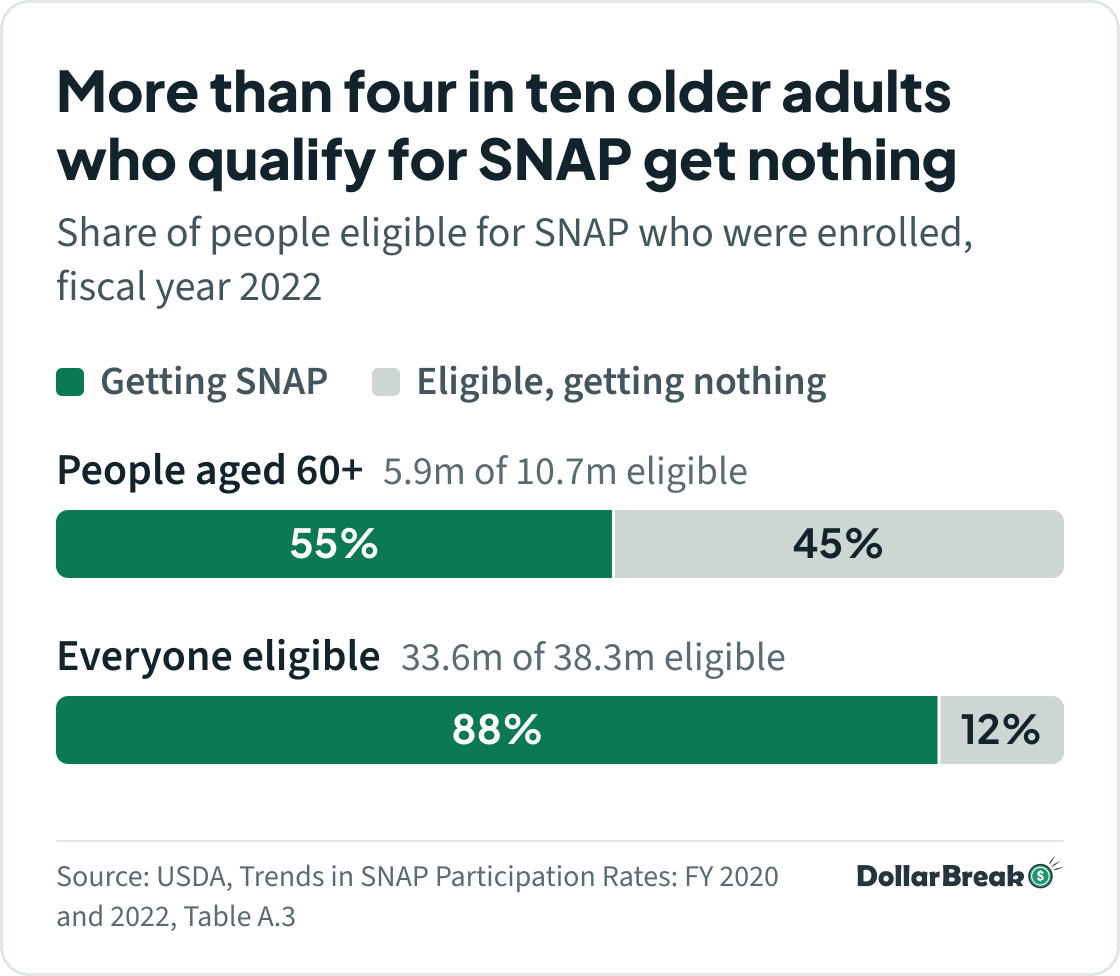
USDA’s newest estimate, for fiscal 2022, put take-up at 55.3% for people 60 and over against 87.6% for everyone. That leaves about 4.8 million eligible older adults getting nothing, by our subtraction.
Worth it? Yes. The medical deduction is the part people miss: a big pharmacy bill can bring an income back under the line.
LIHEAP: help with heating and cooling bills
The Low Income Home Energy Assistance Program pays toward energy bills. In fiscal 2024 the average heating grant was $380 and the average cooling grant $583. Of the 5.9 million households it served, 2.5 million included an older adult.
Each state sets its own income limit, no higher than the greater of 150% of the poverty guidelines or 60% of the state’s median income. At 150%, that is $23,940 a year for one person in 2026. Crisis help runs through at least March 15, and states may add cooling, weatherization or repairs to heating equipment.
Apply through energyhelp.us or the referral line, 1-866-674-6327. HHS says LIHEAP “does not charge a fee”, so anyone asking for one is not LIHEAP.
Worth it? Yes for anyone whose energy bills strain the budget. Apply as soon as your state opens its season.
Weatherization: free work to cut your energy bills
The Department of Energy’s Weatherization Assistance Program sends an energy auditor, then a crew, to make a home more energy efficient. DOE’s eligibility fact sheet says the work is “offered at no cost to eligible households”. Afterward, households save $372 or more a year on average.
The income line is 200% of the poverty guidelines, and anyone on SSI qualifies. DOE gives priority to “the elderly” and to people with disabilities, among others. Renters can apply too, with the landlord’s permission.
Worth it? Yes, if you can wait: DOE says an eligible household goes on a waitlist before the audit.
Free tax preparation, at any age
AARP Foundation Tax-Aide is free and says “You don’t need to be an AARP member to use the service.” IRS-certified volunteers work from early February to mid-April at over 3,600 sites, in person and online. AARP says they helped more than 1.7 million taxpayers in the 2025 season.
The IRS funds the same work through Tax Counseling for the Elderly, aimed at people 60 and older, and through VITA, for incomes of about $70,244 or less. As for what it saves, the IRS puts the average cost of a return with no business income at about $160, counting free filing.
In 2018 a ten-year regular at a Spokane site told the Spokesman-Review that Tax-Aide saved him $200 to $300 a year.
Worth it? Yes for anyone with a pension, an IRA or a Social Security form to sort out. Book early: sites close in mid-April.
A $0 phone plan through Lifeline
Lifeline is a federal discount of up to $9.25 a month ($34.25 on qualifying tribal lands) on phone or internet service. Some carriers turn it into a free plan. Assurance Wireless, on T-Mobile’s network, offers “FREE Monthly Lifeline Service” with 10GB of data, unlimited talk and text, and a free phone or your own.
You qualify with an income at or below 135% of the poverty guidelines, $21,546 for one person in 2026, or through Medicaid, SNAP, SSI, federal public housing or a Veterans Pension. Apply through the National Verifier from lifelinesupport.org (Oregon and Texas use their own state sites), then pick a carrier. One benefit per household, checked every year.
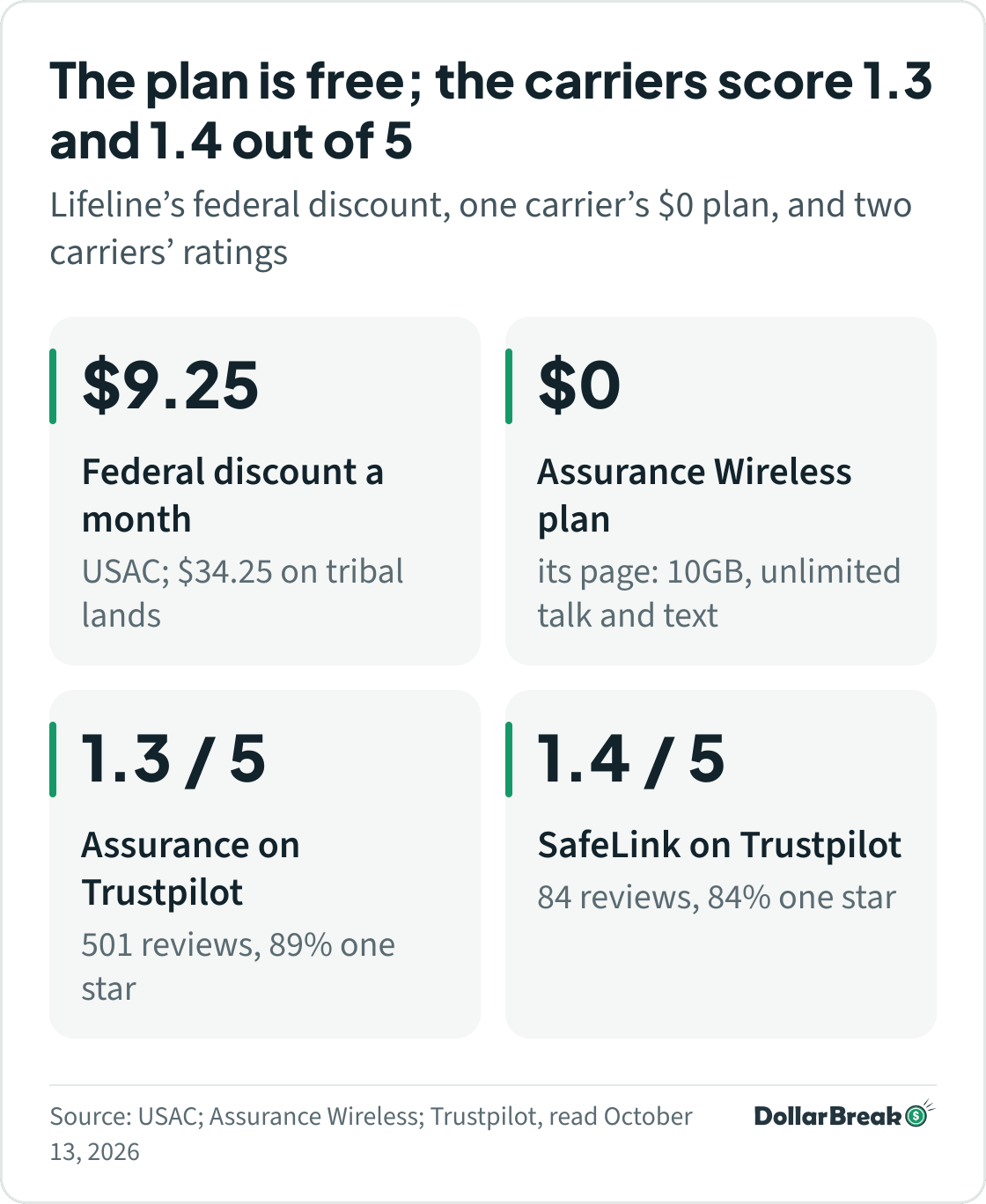
The catch is the carrier. Assurance scores 1.3 out of 5 on Trustpilot, and one of its newest reviews describes a SIM card arriving without the promised phone. BBB’s listing shows 2,705 complaints against it in three years. Assurance’s own pages also say you must use the service at least once every 30 days to keep it free.
Worth it? Yes if you qualify: the plan costs nothing. Keep a record of every call, since the complaints are about phones that never arrive and support that is hard to reach.
A USDA home repair grant at 62
USDA Rural Development’s Section 504 Home Repair program gives grants of up to $10,000 to homeowners 62 and over on very low incomes. The money must be used “to remove health and safety hazards”.
The rules are strict. The home must be in a rural area (USDA’s eligibility map checks an address), you must live in it, and you must be unable to get affordable credit elsewhere. The $10,000 is a lifetime limit, and the grant must be repaid if you sell within three years.
The local Rural Development office takes applications all year, but approval depends on the money left in your area. A loan of up to $40,000 at a fixed 1% for 20 years can be added to the grant.
Worth it? Yes for rural homeowners at 62 on a very low income. Ask the local office how much money it has left before you gather paperwork.
Donated dental treatment at 65
Dental Lifeline Network’s Donated Dental Services pairs volunteer dentists with people who cannot afford care and are 65 or older, permanently disabled or medically fragile. They donate full treatment, though not cosmetic work. Patients “usually pay nothing”, though some may be asked to help with lab costs.
The network says it has donated $581 million of treatment to 178,922 patients, about $3,250 each by our division. The waiting list is the catch: applicants are seen in the order they apply, and the wait “can be several months or over a year in some areas”.
Worth it? Yes. Apply the day you decide you need it, not the day it hurts.
Hearing aids from the VA, for veterans
Original Medicare pays for no hearing aids and no fitting exams. For veterans, the VA does: “the hearing aids, repairs, and future batteries will all be at no charge to you, as long as you maintain VA eligibility for care.”
Enroll in VA health care first, on Form 10-10EZ with your DD214, then book with VA Audiology directly. Everyone else is left with over-the-counter hearing aids, an FDA category since October 2022, which are bought, not given.
Worth it? Yes for any eligible veteran: the aids, the repairs and the batteries are all free.
Free rides to the doctor and around town
Three kinds of ride cost nothing for the people they serve, and a fourth only looks free:
| Ride | Who qualifies | Cost |
|---|---|---|
| Medicaid ride to care | On Medicaid, with no other way there | No fee in CMS’s guide |
| Older Americans Act ride | 60+, through a local aging agency | Free at or below the poverty line |
| Chicago Ride Free | 65+ in Illinois’s Benefit Access Program | Free |
| ADA paratransit | Riders with a disability | Up to twice the bus fare |
Federal rules require Medicaid to “ensure necessary transportation” to care. CMS’s guide for patients says it “may give you a ride if you do not have a car that works or do not have a driver’s license”, if you have no other reasonable way there. Some states need approval first.
The Older Americans Act funds rides through local aging agencies, and the law bars any charge to someone “at or below the Federal poverty line”. In Chicago, Ride Free covers buses and trains for people 65 and over in Illinois’s Benefit Access Program, open to incomes up to $33,562 for one person.
Worth it? Yes. Ask the Eldercare Locator what rides your county runs before you pay for one.
Equipment on loan from your state
Federal law funds an assistive-technology program in every state, built around short-term device loans and a device reuse service. Vermont’s program lets you borrow equipment “for 30-days, free of charge”. California’s lending centers lend for up to 30 days, and its reuse centers make open-ended loans you keep as long as you need.
The law does not say loans must be free, and the AT3 Center’s directory lists each state’s loan contact without prices. So call yours and ask two things: is there a fee, and how long can you keep it?
Worth it? Yes before you buy anything costly: California’s centers lend devices so you can try one first.
Free one-to-one Medicare advice (SHIP)
Every state runs a State Health Insurance Assistance Program: “objective” one-on-one counseling on Medicare, paid for by the federal government. Its own words: “There is no cost to consumers to use SHIP services.”
It goes by other names in some states, such as HICAP, SHINE or VICAP. The national number, 877-839-2675, finds yours, and counselors also help with the Extra Help application.
Worth it? Yes, before any change to your Medicare coverage.
$0 checkups, screenings and vaccines on Medicare
Medicare.gov is plain: “You pay nothing for most preventive services if you get the services from a health care provider who accepts assignment.” That covers the Welcome to Medicare visit, a yearly Wellness visit, and flu, COVID-19, hepatitis B and pneumococcal shots. It also covers mammograms and screening for colorectal cancer, diabetes, heart disease and depression.
Two limits. Extra tests added to a wellness visit can bring back the Part B deductible. And Original Medicare does not cover routine eye exams for glasses, hearing aids, most dental care or routine physicals.
Worth it? Book the yearly Wellness visit and ask whether the office “accepts assignment”: that word is what makes it $0.
Free legal advice
Two doors lead to a free lawyer. Legal Services Corporation grantees, 129 of them covering every congressional district, serve people with incomes up to 125% of the poverty guidelines. The Older Americans Act funds a second route for anyone 60 or over, through local aging agencies, and the law bars charging for it.
Both handle civil matters only, never criminal defense. The Eldercare Locator finds the office that serves your county.
Worth it? Yes. LSC says its grantees helped 6.4 million people in 2024; call before a deadline, not after it.
Free college courses at 60 or 65
This is state law, and each state writes its own catch. Three examples, read from the statutes:
For classes that do not depend on your state, Senior Planet from AARP runs free classes online and in person. They are designed for people 60 and over but open to any age, with no AARP membership needed.
Worth it? Read your state’s statute, then the college’s own page: “space-available” and “discretionary” are where these promises end.
10 free things by mail, at home or nearby
Talking books and a free player from the Library of Congress
The National Library Service for the Blind and Print Disabled mails audiobooks, magazines and braille, lends a player, and pays the postage both ways. Its FAQ: “There is no direct cost to eligible readers.”
Age alone does not qualify. Under 36 CFR 701.6, you need a visual or physical limitation that stops you reading regular print, such as macular degeneration or arthritis that stops you holding a book. A doctor, optometrist, nurse, social worker or librarian can certify it.
- The player. NLS lends “two models of digital talking-book players, free of charge”. Its newest, the DA2, is in “limited quantities”, so ask your network library for one.
- The app. Registered readers can also download books through BARD, on iPhone and Android.
- How to apply. Online at loc.gov/nls, on a paper form, or on 888-657-7323.
Worth it? The best thing on this page for anyone whose eyes have given up on print, and the player comes on extended loan.
Large print, ebooks and audiobooks from the library
NLS makes no large print; its FAQ sends readers to public libraries for it. A library card also opens Libby, OverDrive’s app, which lends ebooks and audiobooks free through participating libraries.
Two national collections need no card at all. Project Gutenberg holds more than 75,000 ebooks, “completely free and always will be”. Open Library lends ten books at a time, for an hour or 14 days, to anyone with a free account.
Worth it? Yes, with no age rule and no income test. Large-print stock varies by branch, so call before you go.
A monthly food box at 60 (CSFP)
USDA’s Commodity Supplemental Food Program gives a monthly box of food to people at least 60 with incomes at or below 150% of the poverty guidelines. In 2026 that is up to $1,995 a month for one person, by our arithmetic, and your state can set it lower.
Inside: milk, cheese, juice, oats, cereal, rice, pasta, peanut butter, dry beans, canned meat or fish, and canned fruit and vegetables. USDA says the boxes “do not provide a complete diet”. The Deseret News reported in October 2026 that a box is about ten days of food, and that the Utah Food Bank hands out nearly 37,000 a year.
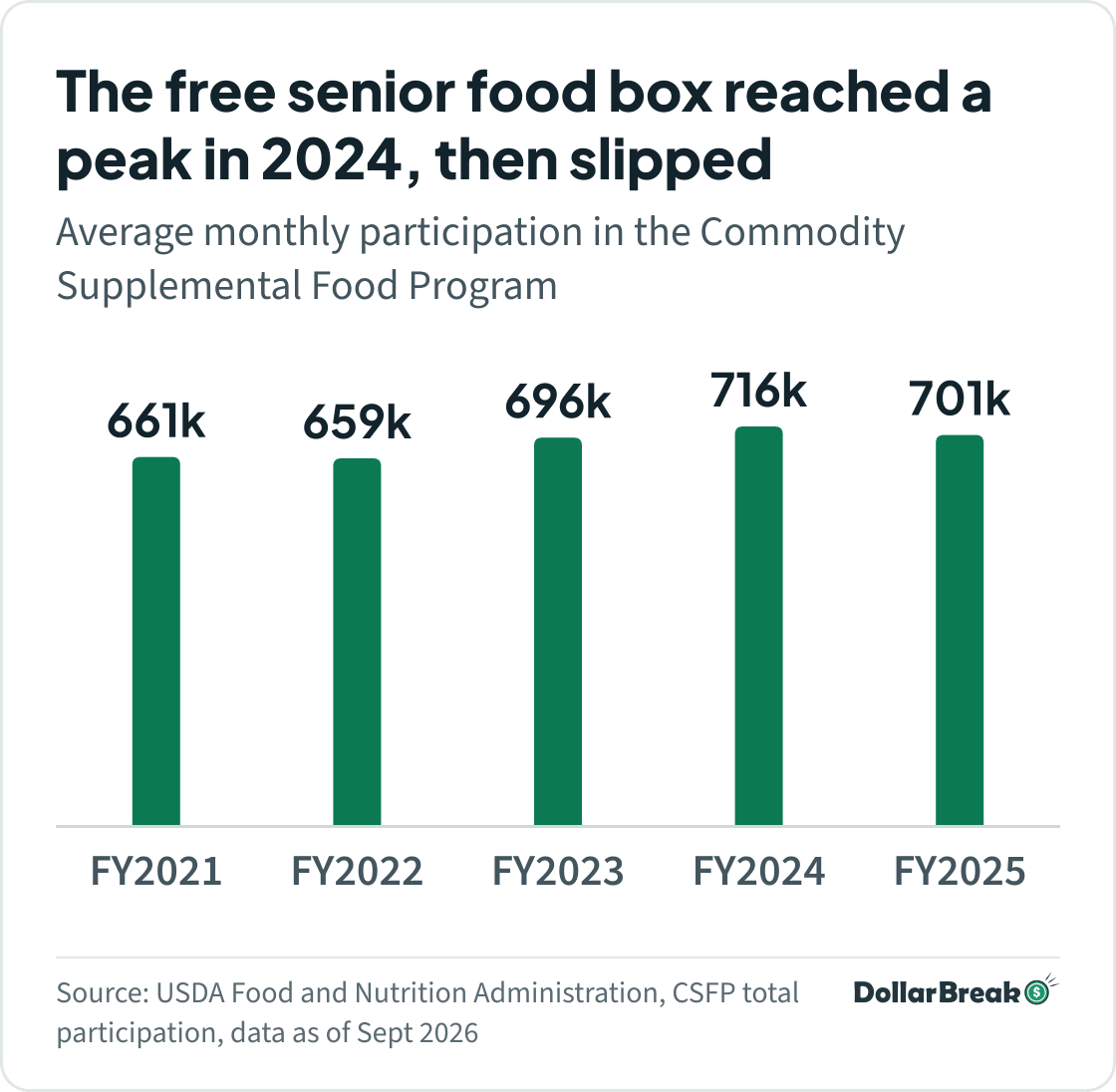
Places are capped. USDA’s caseload memo sets 707,000 for 2026, and about 700,700 people took part each month in fiscal 2025, so a state at its cap can make new applicants wait. The program cost USDA about $42 a month per person in fiscal 2025, storage and administration included.
Worth it? Yes at 60 and under the income line, as a top-up rather than a month’s groceries. Ask the local agency how long its list is.
Farmers-market money at 60 (SFMNP)
The Senior Farmers’ Market Nutrition Program gives people 60 and over, with household incomes up to 185% of the poverty guidelines, money for local fruit, vegetables, herbs and honey. You spend it at farmers markets, roadside stands and CSA farms.
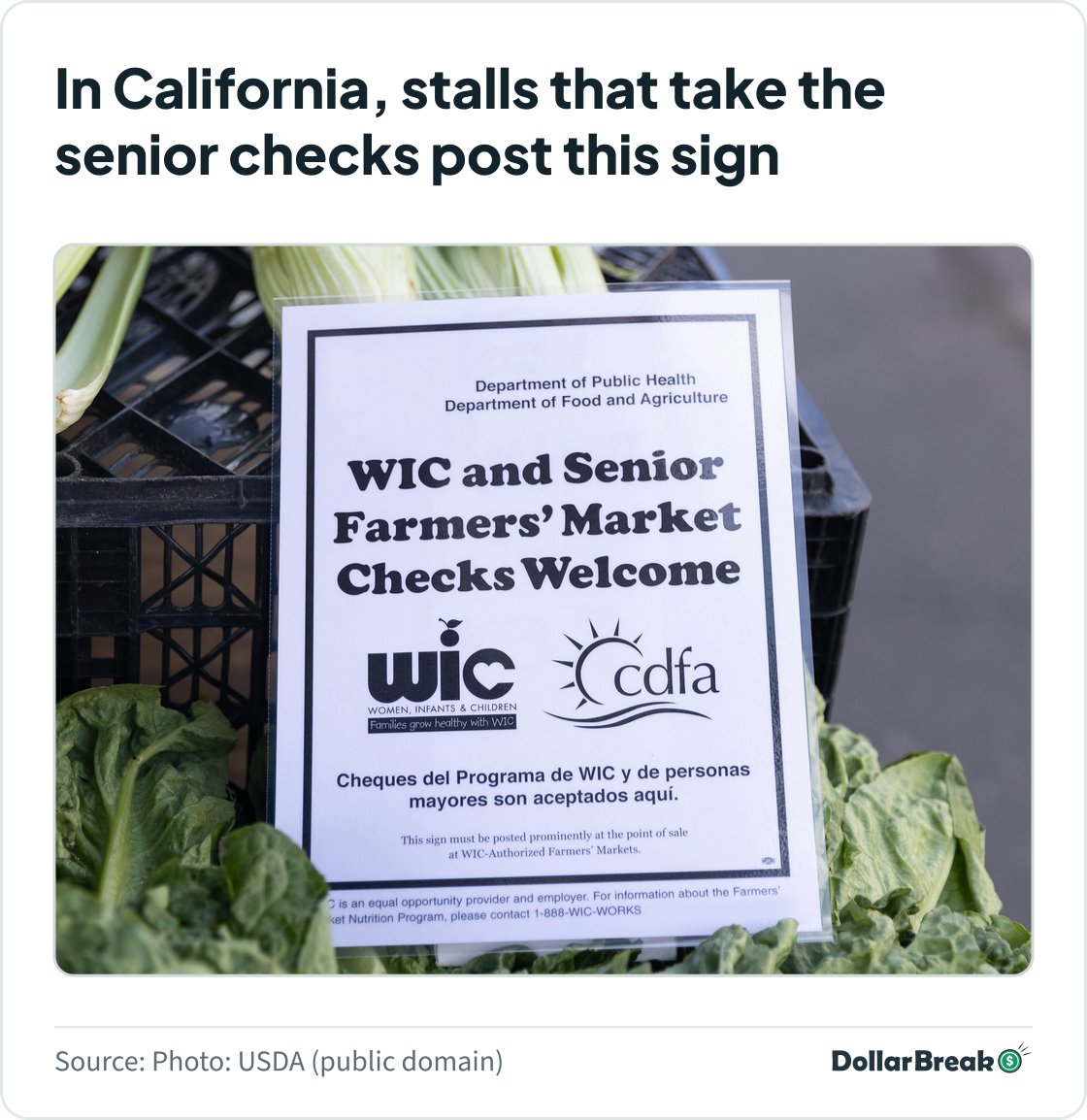
The sum is small and set in regulation. 7 CFR 249.8 says it “may not be less than $20 per year or more than $50 per year”, and that participants “must receive SFMNP benefits free of charge”. In fiscal 2025 it reached 808,396 people, with an average benefit of $44.
Worth it? Yes if you shop at markets. Some states accept proof that you already get the food box or SNAP instead of a new income check.
A free meal at a senior center, or delivered
Under the Older Americans Act, anyone 60 or over can eat at a senior center, or have meals delivered if homebound. The law bars charging for these meals, and providers may not “deny services to any individual who does not contribute”.
A provider may suggest a donation; it may not refuse you a meal for skipping it. Salt Lake County’s Meals on Wheels delivered 365,000 meals to 2,600 homebound seniors in a year, the Deseret News reported in October 2026.
Worth it? Yes at 60, and the donation envelope is optional by law. Find your nearest center through the Eldercare Locator.
Free glasses, and a free medical eye exam
Two charities, and they do not join up. New Eyes gives a basic pair of glasses, with clear single-vision or lined bifocal lenses, as an e-voucher. You need a household income below 250% of the poverty guidelines and an eye exam in the last 24 months that measured your pupillary distance.
It charges a small application fee, does not pay for the exam, and puts the average US pair at $196.
For the exam, EyeCare America matches you with a volunteer ophthalmologist, for a medical exam and up to a year of follow-up. Its rules, quoted:
- Who qualifies. “18 years old or older” and “Not seen by an ophthalmologist in three or more years”.
- Medicare. Patients “should have Medicare and/or Medicaid or be uninsured”, and it turns away a “PPO, HMO, VA, and/or other supplemental insurance” (its FAQ). Our reading: Original Medicare alone qualifies, while a Medigap policy or a Medicare Advantage HMO rules you out.
- Not covered. A glasses prescription, surgery fees, medications or diagnostic tests.
Worth it? New Eyes if you have a prescription from the last two years; EyeCare America if you have not seen an ophthalmologist in three. The charity is new-eyes.org, and neweyes.org is unrelated.
Free sample boxes by mail
Two programs still mail free products to US addresses. PINCHme is free to join with no credit card: you apply for products, and once your box reaches four it ships free. You then review each one, 28 days after checkout.
- PINCHme’s limits. 18 and over, the contiguous US only, two accounts per household, four to six weeks for delivery.
- Its pages disagree. The homepage describes the four-product box; the help center still describes an older 500-coin checkout.
- SampleSource runs in seasons. Its site says “NEW SAMPLES SOON!” with no date, and allows one package per address.
Our guides to free samples and product testing cover programs that send full-size products.
Worth it? A hobby, not a grocery plan: neither program says how many boxes a member gets.
Free print catalogs by mail
A catalog still comes free on request, and none of these asks you to buy anything. The Vermont Country Store takes a name and address on its own form, or offers a digital edition. Miles Kimball sends any or all of its three catalogs in one to two weeks, or takes the request on 1-855-202-7394.
Harriet Carter (800-632-1578) and Dr. Leonard’s Healthcare (1-800-455-1918) say on their own request pages that they mail a free catalog too. LTD Commodities’ page says it is running low and cannot mail one.
Worth it? Only if you want the catalog: a request puts you on the company’s mailing list, and the mail keeps coming.
Free gift cards from receipt and survey apps
These apps pay you for shopping you already do, or for answering questions. They are free to join, with no income test. Start with the two that pay for groceries.
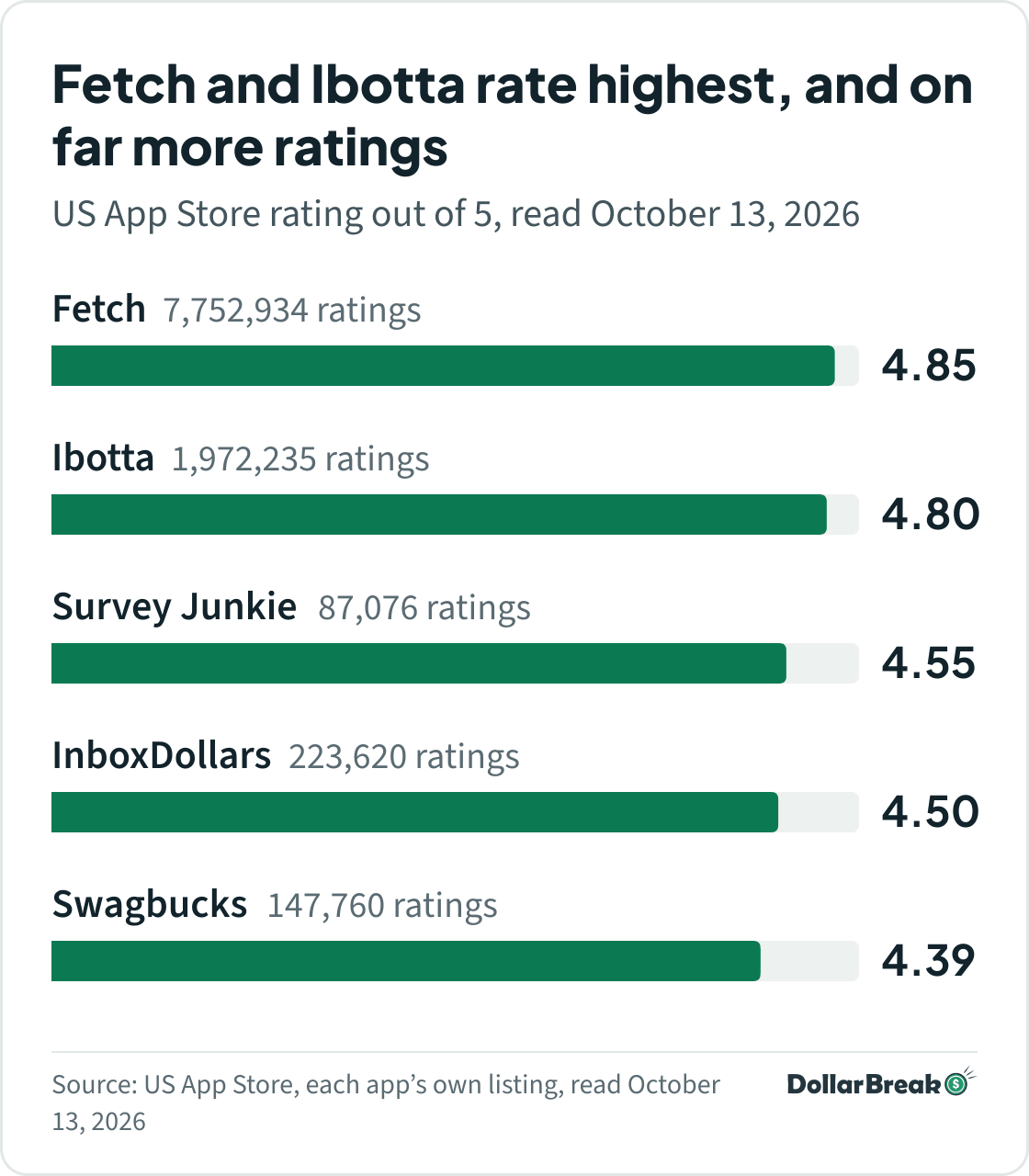
Fetch gives at least 25 points for a photo of any receipt, with extra on more than 500 brands. A first gift card takes $10 of points (10,000), and points expire after 90 days without activity.

Fetch Rewards Summary
- Easy to use
- Earn points with any grocery store receipt
- Earn points on over 500 product brands
- Rewards - gift cards and sweepstakes
Ibotta pays cash back on offers you pick before shopping, at more than 2,600 retailers. It says its savers earn $218 a year on average, and you can withdraw from $20 to a bank, PayPal or a gift card.

Ibotta Summary
- 2 ways to earn - app or browser extension
- Earn up to 30% cash back on purchases
- Get a bonus by referring friends
- Over 2,600 stores you can earn cash back at
How much each app needs before it pays out:
| App | Cash out from | Pays by |
|---|---|---|
| Fetch | $10 the first time | Gift cards |
| Ibotta | $20 | Bank, PayPal, gift cards |
| Survey Junkie | $5 | PayPal, bank, gift cards |
| InboxDollars | $15, then $10 | PayPal, Visa, gift cards |
| Swagbucks | $3 (300 SB) | PayPal, gift cards |
Two warnings. Swagbucks’ $10 welcome bonus is not a sign-up gift: its help center says you must first spend at least $25 on one eligible purchase. InboxDollars gives $5 for joining, but its help center says $15 for a first payment while its terms of use still say $30.
For questions rather than receipts, Survey Junkie pays out from $5 by PayPal, bank transfer or gift card, and says most surveys pay $0.50 to $5. Prefer paper or a phone? See surveys by mail for cash and phone survey sites.

Survey Junkie Summary
- $0.50-$5 for most standard surveys
- Extra points if you screened out of survey
- Additional ways to earn up to $150
- Install Survey Junkie extension for bonus
- Low payout threshold of $5
- Variety of surveys

InboxDollars Summary
- $5 sign up bonus
- Referral program - $3 per friend plus 10%
- First cash-out at $15, then $10
- Many ways to earn money
- Get paid to read emails and play games
- Over $80 million in cash rewards paid
Capital One Shopping, a browser extension and app that tests coupon codes, is free even to people who are not Capital One customers, Capital One says. It watches your browsing to work, which is the trade.
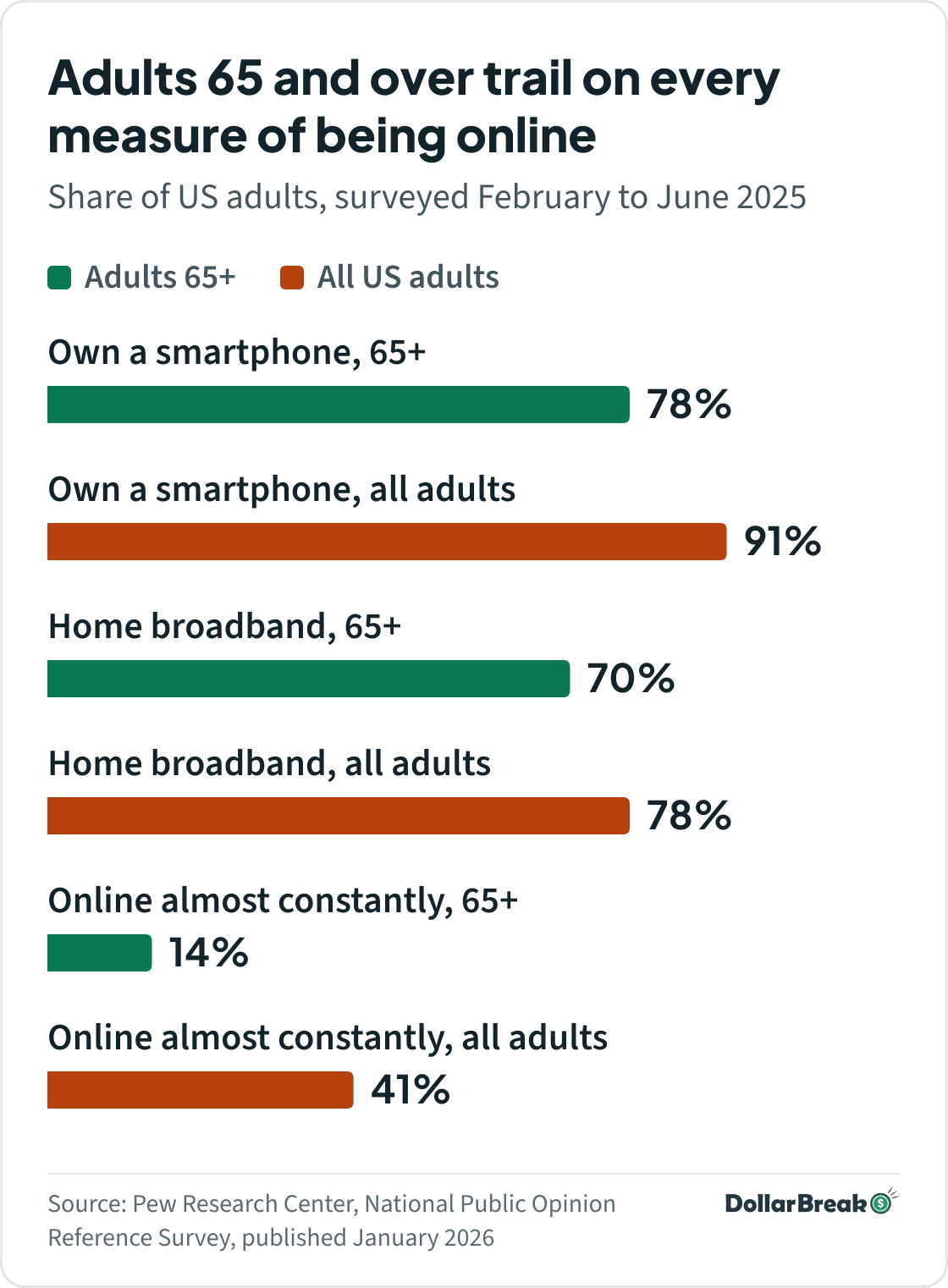
Every app here needs a smartphone or a computer. Pew found in a 2025 survey that 78% of adults 65 and over own a smartphone, against 91% of all adults.
Worth it? Fetch and Ibotta first, because they pay for shopping you already do and rate best. Treat the survey apps as pocket money.
Your Social Security Statement and Medicare & You, by mail
Two official mailings are free. Social Security mails your Statement three months before your birthday if you are 60 or older, still working and have no online my Social Security account. Medicare mails the Medicare & You handbook to every Medicare household in late September.
The handbook also comes in large print, braille and audio, worth asking for if regular print is hard.
Worth it? Yes: both cost nothing, and they arrive whether you ask or not.
Called free, but it costs something
Many lists of senior freebies are really lists of senior discounts. Each of these nine costs something, however it is billed.
| What it is | What it costs | Age |
|---|---|---|
| National park Senior Pass | $20 a year or $80 for life | 62+ |
| New York subway and bus | Half fare, $1.50 | 65+ |
| LA Metro | 35 to 75 cents a ride | 62+ |
| Texas fishing license | $12 and up | 65+ |
| Ohio fishing license | $10 and up | 65+ |
| SilverSneakers gym access | Free only with some plans | Any |
| Over-the-counter hearing aids | Sold in stores | 18+ |
| AARP membership | $15 the first year, then $20 | 18+ |
| Restaurant, grocery and travel discounts | A cut, set by each company | Varies |
The Senior Pass at 62 costs $20 a year or $80 for life, plus $5 processing and $7.50 handling by mail. The park service’s fee-free days are free for everyone, and the last two of 2026 are October 27 and November 11.
SilverSneakers comes at no extra cost with “many Medicare Advantage and select Medicare Supplement plans”, not with Original Medicare alone. For food that really costs nothing, see our lists of free meals and free coffee.
Bottom line: Fishing makes the point. Florida exempts residents 65 and over outright, Texas charges them $12 for a freshwater license, and Ohio’s reduced license starts at 65.
What each age unlocks
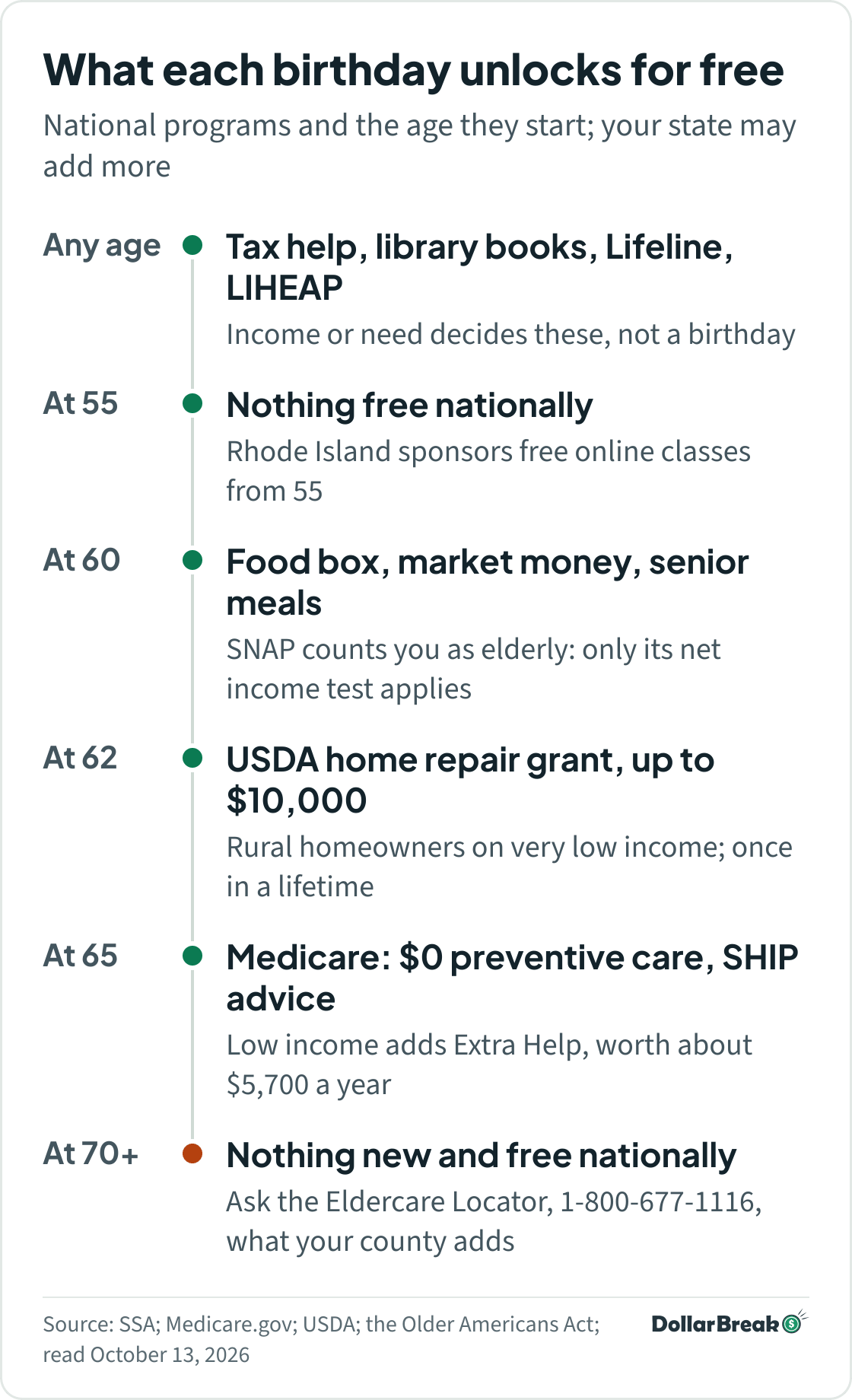
Sixty opens the most programs: the food box, market money, senior meals and SNAP’s easier rules all start there. Sixty-two adds the $10,000 repair grant, and 65 brings Medicare’s free care and, on a low income, Extra Help. After that, nothing new starts nationally.
The “free” offers aimed at seniors that are fraud
The pattern is always the same. An unsolicited call, text, email or TV ad offers something medical for free, then asks for your Medicare number. The brace, the cheek swab, the medical alert pendant and the “Medicare kit” are the usual wrappers.
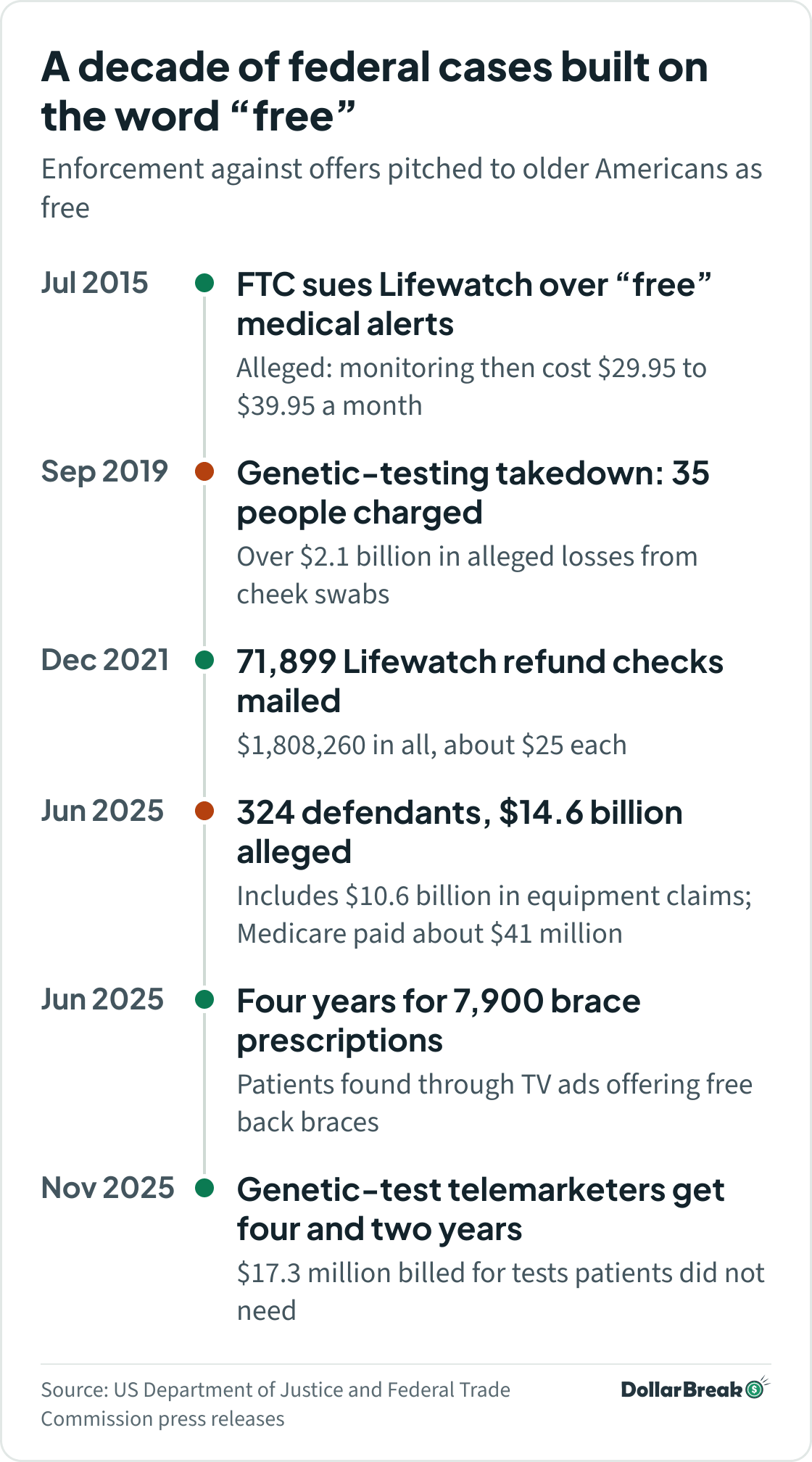
In one June 2025 case, the Justice Department’s own words describe how patients were found: “deceptive television commercials offering free back braces”. A Michigan doctor signed off more than 7,900 braces for more than 2,600 Medicare patients, and got four years.
BBB’s Scam Tracker holds the same pitch in consumers’ words; we read five such reports, filed from September 2024 to January 2026. One caller offered “a free back brace and knee brace” and asked for a Medicare number, claiming to be Medicare. A complimentary “Medicare Kit” took a card for postage and charged $11.69.
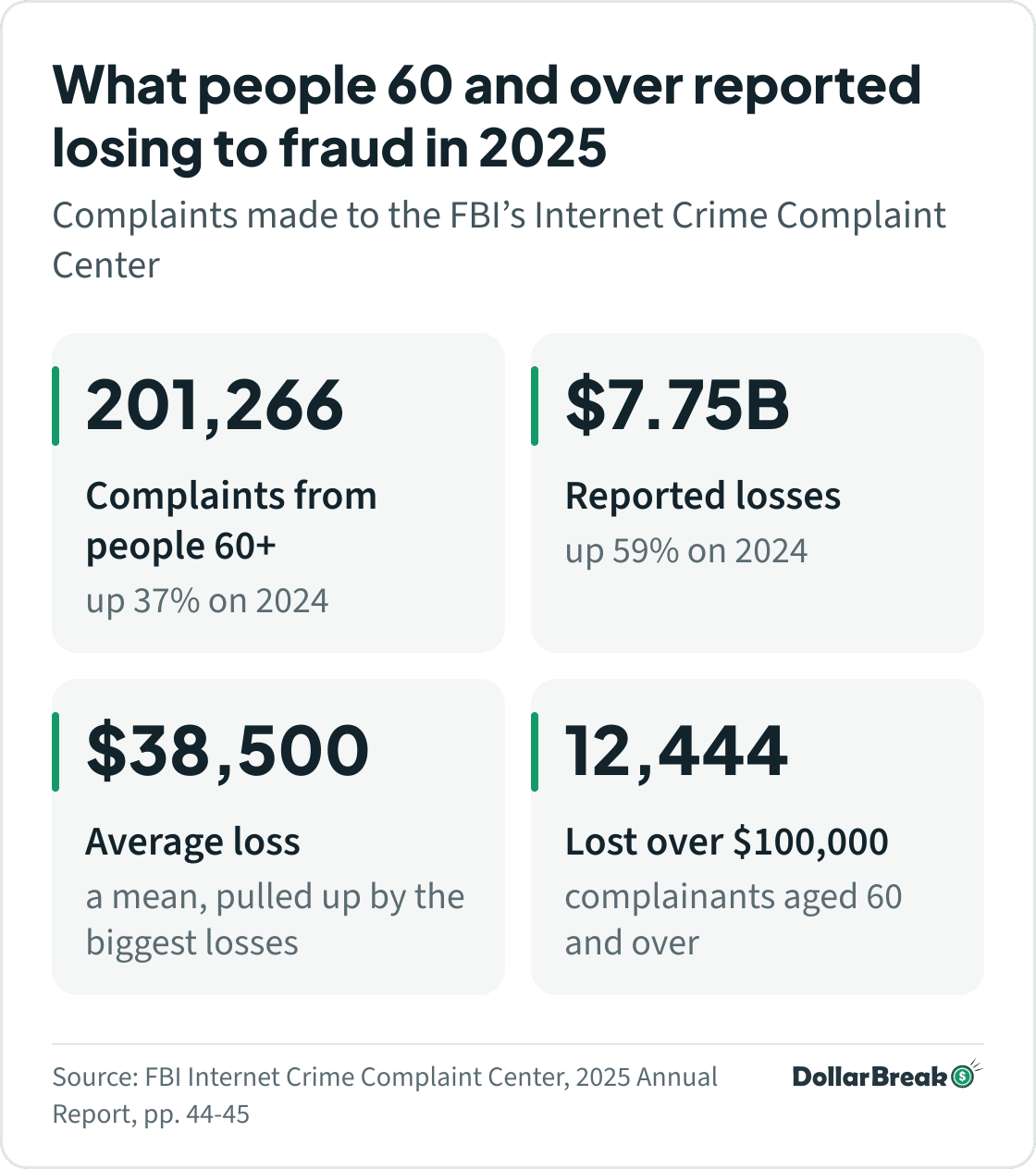
The scale is federal. The FBI’s complaint center logged 201,266 complaints from people 60 and over in 2025, with $7.748 billion in reported losses, up 59% on 2024. The FTC runs a separate system that puts 60-plus losses at about $2.4 billion in 2024, and the two must never be added.
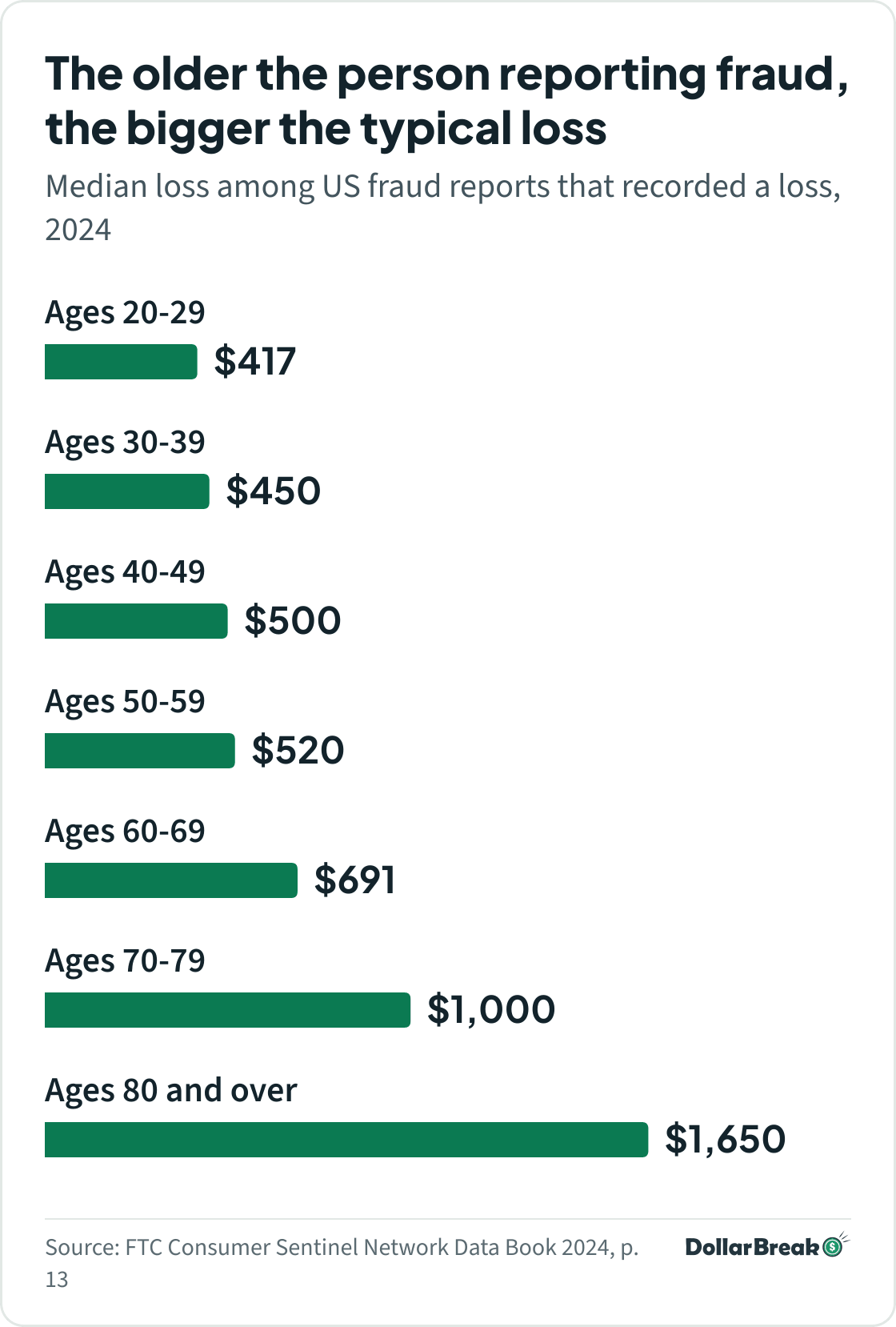
The FTC’s figures also show that older adults who report fraud lose money less often than younger ones, but lose more when they do: a median of $1,650 at 80 and over, against $417 in their twenties.
- Never give your Medicare number to a caller offering something free. In the brace and gene-test schemes above, the number was what the callers wanted.
- No real freebie needs a card for postage. A genuine sample, food box or catalog asks for an address, never a card.
- “Free” medical alerts are a documented billing trap. The FTC mailed 71,899 refund checks to people sold one “at no cost whatsoever” that then cost $29.95 to $39.95 a month.
- Talk it through first. AARP’s free Fraud Watch Network Helpline is 877-908-3360, weekdays from 8am to 8pm ET.
Bottom line: Every genuine item on this page is something you ask for. None of them phones you first.
Who should claim what
Worth doing
- On Medicare with a small income: Extra Help and a Medicare Savings Program, with SHIP’s help.
- At 60 on a small income: SNAP, the food box and market money; senior-center meals at any income.
- At any age: free tax preparation, February to April.
- If print has become hard: NLS talking books and a free player.
- If you shop and own a phone: Fetch or Ibotta, nothing more complicated.
Skip
- Any free offer that arrives by phone, text or unsolicited email.
- Sample boxes, if you are counting on them for anything.
- Catalog requests, unless you want the mailings that follow.
- Survey apps, if you expect more than pocket money.
- Any list that calls the park pass or a senior fare free.
The numbers that start each claim:
| What you want | The number to call |
|---|---|
| Extra Help | 1-800-772-1213 (Social Security) |
| Medicare advice | 877-839-2675 (SHIP) |
| A Lifeline plan | 800-234-9473 (USAC) |
| Energy bill help | 1-866-674-6327 (LIHEAP referral) |
| Free tax preparation | 1-888-227-7669 (Tax-Aide) or 800-906-9887 (IRS) |
| Meals, rides and legal help | 1-800-677-1116 (Eldercare Locator) |
| Talking books | 888-657-7323 (NLS) |
| A medical eye exam | 877-887-6327 (EyeCare America) |
| A scam to talk through | 877-908-3360 (AARP Fraud Watch) |
How we researched this
Every age, income limit, dollar figure and rule here was read on October 13, 2026 from the body that sets it, from Social Security and USDA’s Food and Nutrition Administration to state statutes and each charity’s or company’s own pages. The yearly values are each agency’s own average or estimate, or our arithmetic from its figures, as the chart’s caption says. What claiming looks like is credited to the reporters and complainants who recorded it.
Free Stuff for Seniors FAQ
Is anything free for seniors at 55?
Very little nationally: no program on this page starts at 55. Some states pay for free online classes, such as Rhode Island’s for residents 55 and over. AARP focuses on people 50 and over but sells membership to anyone 18 or older.
What free stuff can seniors get at 60?
Sixty opens the USDA food box, farmers-market money, senior-center and home-delivered meals, Older Americans Act rides and legal help, and SNAP’s easier rules. Florida and Virginia also open free university courses at 60.
What free stuff can seniors get at 62?
Sixty-two opens USDA’s Section 504 repair grant, up to $10,000 for rural homeowners on very low incomes. The national park Senior Pass also starts at 62, but it costs $20 a year or $80 for life.
What free stuff can seniors get at 65?
Sixty-five is mostly a Medicare age: $0 preventive care, free SHIP advice and, on a low income, Extra Help and a Medicare Savings Program. Donated dental care, Chicago’s free rides, Texas’s tuition exemption and Florida’s fishing-license exemption also start at 65.
Is there free stuff for seniors over 70?
Nothing new and free starts at 70 nationally: every federal program on this page opens at 60, 62 or 65, or at any age. Ask the Eldercare Locator (1-800-677-1116) what your county and state add.
What free stuff for seniors comes by mail?
Five things on this page arrive in the mail: NLS talking books and their player, PINCHme and SampleSource sample boxes, print catalogs, your Social Security Statement (at 60, if you work and have no online account) and the Medicare & You handbook. Senior-center meals can also be delivered to a homebound person’s door. Library books, large-print devotionals and Bibles by mail are on our list of free books by mail.
Can seniors still get free catalogs by mail?
Yes. The Vermont Country Store and Miles Kimball take requests on their own sites, and Harriet Carter and Dr. Leonard’s say they do the same. LTD Commodities’ page says it cannot mail one.
Do seniors get free birthday gifts by mail?
The White House greetings form lets you request a free card for an adult’s birthday or a 25th, 50th or later anniversary, with no 80-or-older rule. Restaurant rewards land in your rewards account instead: IHOP’s pages name no purchase for its birthday pancakes, while Red Robin retired its set birthday burger on June 1, 2026. Red Robin’s sign-up appetizer needs a $10 purchase, and Denny’s says a minimum purchase may apply.