
To sell a car out of state, you follow your own state’s seller rules and give the buyer the papers their state asks for. Below are the nine steps, the states that want a notary or keep plates on the car, what the buyer pays at home, and the payment scams that target long-distance sales.
Key takeaways
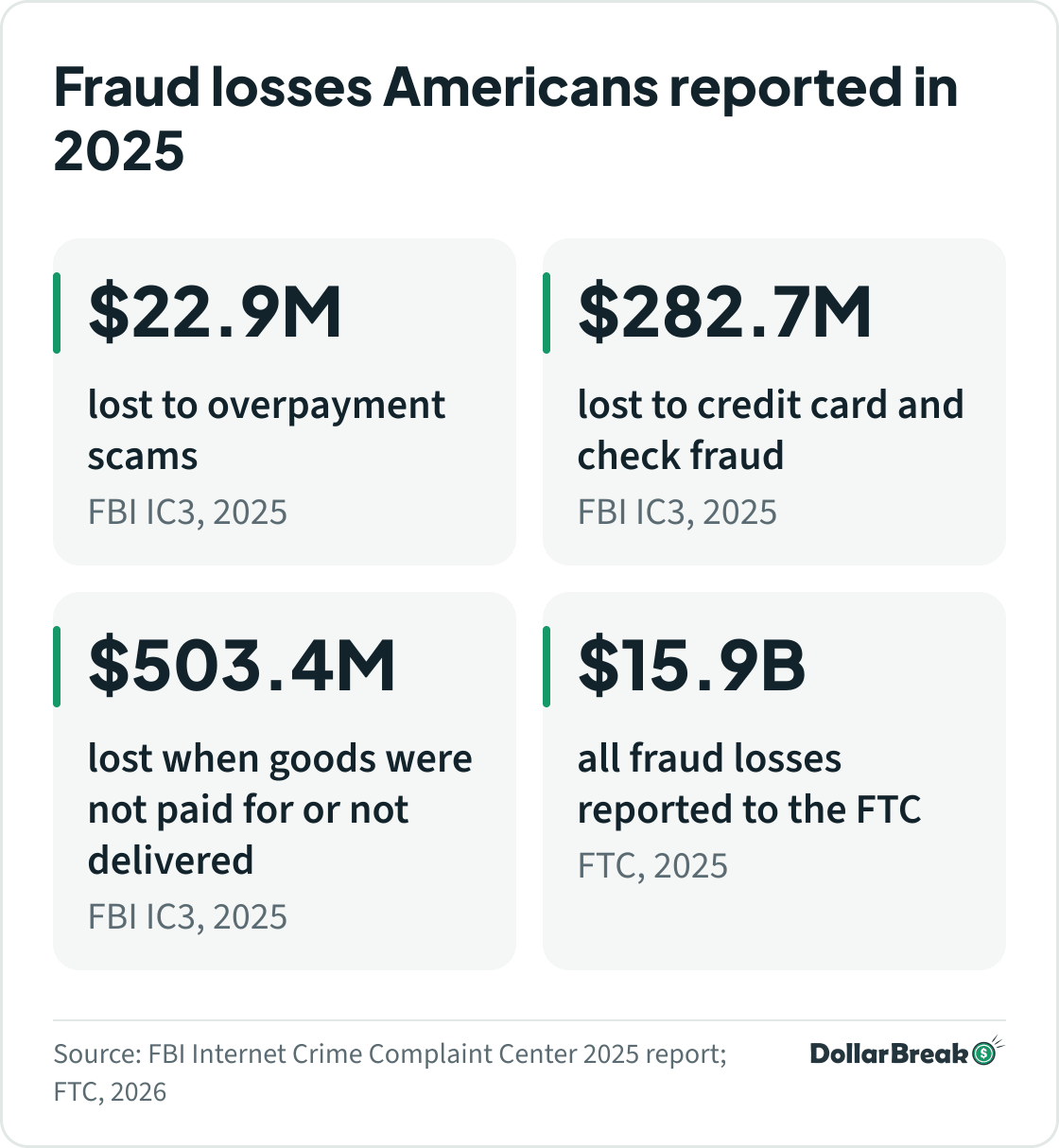
- Payment: Take a bank wire or a check your bank says has cleared; the FBI logged $22.9 million lost to overpayment scams in 2025.
- Title: Sign the original; Kentucky, Louisiana, North Carolina, Ohio, Oklahoma, Pennsylvania and Wyoming want your signature notarized.
- Seller’s notice: Report the sale to your state, within 5 days in California and Washington and 30 days in Texas and Missouri.
- Plates: Of the states we checked, California, Minnesota and Alaska (standard plates) leave them on the car, Texas lets you choose, and the rest have you take them off.
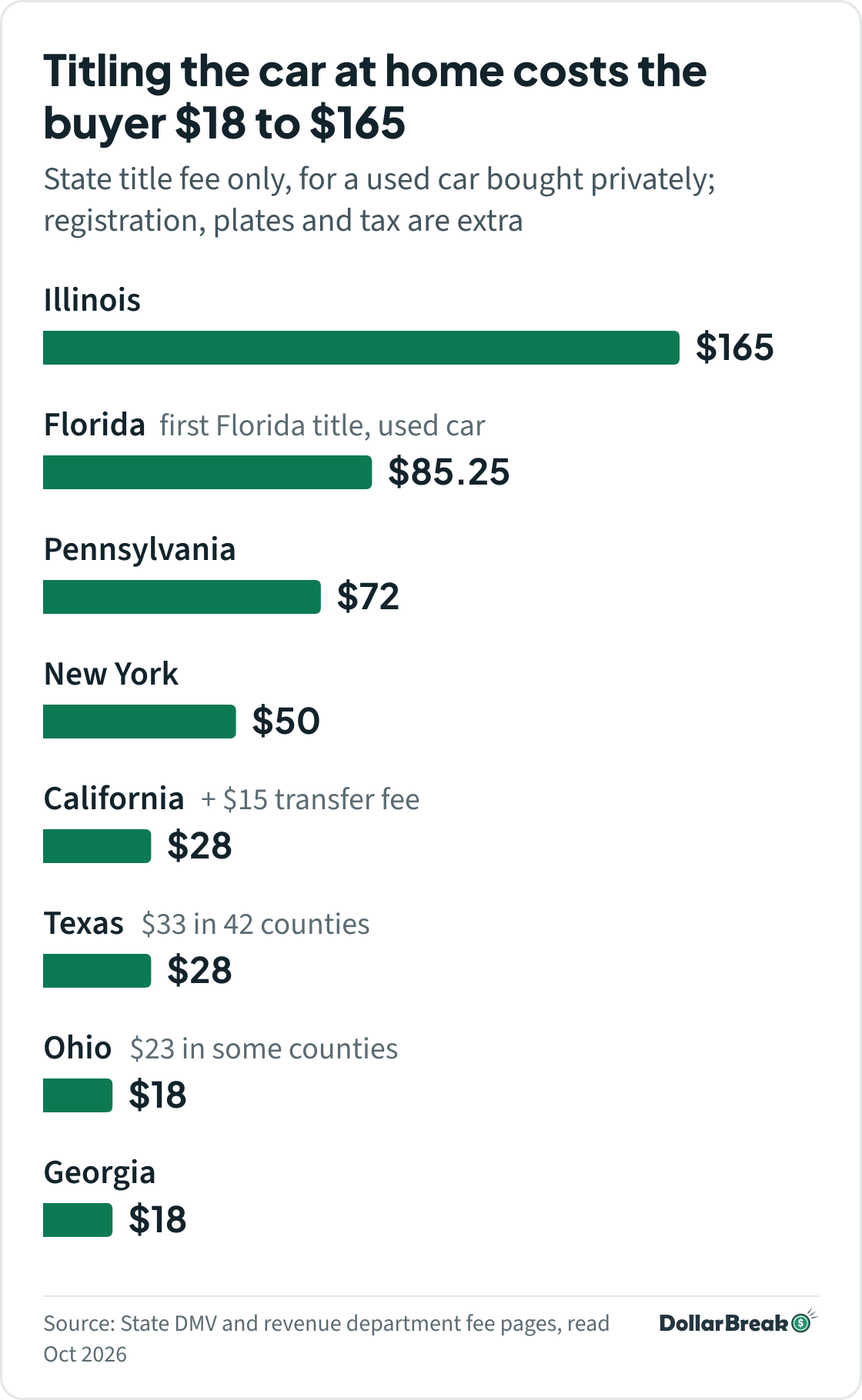
- Buyer’s costs: Titling the car at home costs the buyer $18 (Georgia, Ohio) to $165 (Illinois), before registration and sales tax.
Best Used Car Buyers
Peddle

Trustpilot Rating
Get a legit offer in minutes – provide VIN, mileage and condition
$0 fees + you don’t have to pay for towing – Peddle will take care of it
Get paid in check during the pick up for any car (damaged, junk)
Wheelzy

Trustpilot Rating
Quick car evaluation without the hassle – sell your car within 30 min
Choose a convenient date and time for free pick-up, even tomorrow
Get cash in hand the same day the Wheelzy agent picks up your car
CarBrain

Trustpilot Rating
Get an offer within 2 minutes and sell your car within 24 hours
Free vehicle towing and no fees to getting rid of your damaged car
The tow truck driver will arrive with your check (nationwide service)

My Experience Selling a Car Out of State
In 2020, I fixed a damaged 2015 Honda Civic with 50,000 miles and decided to sell it on eBay Motors for $11,000.
Within a week, I got an offer of $9,000 from a trusted buyer from California and agreed to proceed with the sale.
Things I did to sell a car out of state:
- Researched the paperwork requirement in both my and the buyer’s states
- Got an emissions test required by the buyer’s state (paid $100)
- Got a temporary tag (drive away permit for 30 days for $9)
- Received the payment from the buyer
- Signed Title and Bill of Sale and sent documents to the buyer (via mail)
- Filed a Title transfer form and provided the required paperwork (at DMV)
- Signed the Release of liability form
- Agreed upon vehicle pickup (funded by buyer)
- Canceled my vehicle insurance
The whole paperwork process took about 14 days as I needed to send the original paperwork to the buyer via mail.
Steps to Sell a Car Out Of State
1. Ask for a Copy of the Buyer’s License
Ask the buyer for a copy of their driver’s license before you sign anything. It confirms who you are dealing with, and you need their name and address for the bill of sale and the title.
- Check that the license is valid and not expired.
- Ask before you take a photo or a copy.
- Copy the front of the license.
The copy also helps when you fill in the title transfer paperwork and the buyer can’t be reached.
2. Agree Upon a Secure Payment Method
Payment is where long-distance sales go wrong. A buyer you never meet can send a fake check, and your bank can take the money back weeks after it let you spend it.
Payment methods that protect you:
- Bank wire transfer: a Fedwire transfer is final and can’t be reversed once processed.
- Certified or cashier’s check: only once your bank confirms the check itself has cleared, not just that the funds are available.
Skip personal checks and money orders: the FTC says fake checks include cashier’s checks and money orders. In February 2025 it warned of “buyers” who say they aren’t local and can’t see the car, then send a check for more than the price and ask for the difference back. Never accept a check for more than the selling price.
It happens at scale. In November 2023, federal prosecutors in southern Illinois charged four St. Louis men with buying cars from private sellers on Facebook and Craigslist with more than $1 million in fake cashier’s checks; prosecutors say each car was resold before its check could be cashed.
The FBI’s Internet Crime Complaint Center counted $22.9 million lost to overpayment scams in 2025, $282.7 million to credit card and check fraud, and $503.4 million when goods were not paid for or not delivered. All fraud reported to the FTC that year came to $15.9 billion.
3. Prepare Documents Required by Both States
Selling across state lines means two sets of rules. Your state decides how you sign the title, whether the plates come off and how you report the sale. The buyer’s state decides what it takes to title and register the car there.
What every sale needs:
- The original certificate of title, signed over to the buyer
- An odometer disclosure, which federal rules require for 20 years on model-year 2011 and newer cars (2010 and older are exempt)
- Your state’s notice of sale or release of liability, where it has one (Georgia instead has you cancel the registration)
What some states add:
- Bill of sale: a New Jersey seller hands one over with the title, showing the buyer’s name and address, the date, the odometer reading and the price. Louisiana needs none when the price is on the notarized title.
- Smog certificate: a California seller gives the buyer a valid one; cars under four years old are exempt.
- Safety inspection: a Missouri seller gives the buyer one under 60 days old (plus an emissions test in the St. Louis area). For a buyer from another state, Missouri says to check that state’s rules.
- The buyer’s checks at home: California registers a car from another state only after a DMV employee, police officer or licensed verifier completes a Verification of Vehicle (REG 31).
Important note: Few states want the bill of sale notarized. West Virginia does only when the price is below 50% of the NADA clean loan value, and Arizona for its own Title Transfer Bill of Sale. Missouri says the title signatures need no notary, and Colorado names none for its bill of sale.
4. Sign the Bill of Sale
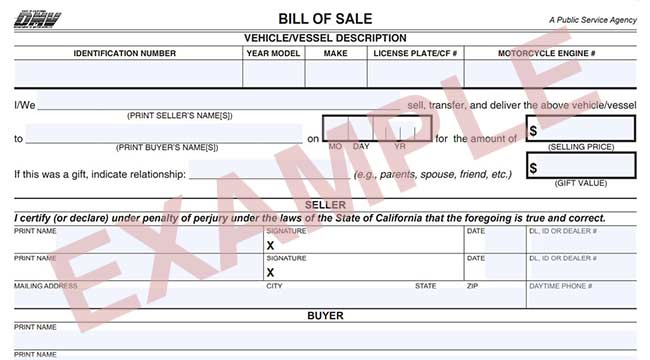
Sign a bill of sale even where your state doesn’t ask for one. It is your contract with the buyer and your record of the car, the price and the date.
It should include the following information:
- The names and addresses of the buyer and seller
- The make, model, year and VIN of the car
- The odometer reading
- The purchase price
- The date of the sale
You and the buyer both sign it. It doesn’t have to be typed: Virginia accepts a handwritten statement signed by the seller and the buyer.
5. Transfer the Title
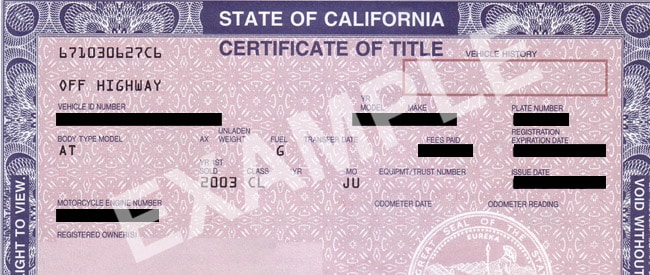
Title transfer takes 3 steps:
- You sign the title and write in the odometer reading and the sale price.
- The buyer takes the original title and your papers to their state’s office (often the DMV).
- That state issues a new title and registration.
Send the original title, never a copy. Pennsylvania, for one, keeps the out-of-state title when the buyer applies for a Pennsylvania one.
The buyer pays the title fee at home. It is $18 in Georgia and Ohio ($23 in some Ohio counties), $28 in Texas ($33 in 42 counties) and California (plus a $15 transfer fee), $50 in New York, $72 in Pennsylvania, $85.25 for a used car’s first Florida title and $165 in Illinois. Registration, plates and sales tax come on top.
Follow the instructions printed on your title, since they differ by state. Wherever you live:
- Sign clearly, in the space marked for the seller only.
- Sign the original certificate of title; copies are not allowed.
- Match the signature on your driver’s license.
- Never use a stamp or a printed copy of your signature.
States that require the seller’s title signature notarized: Kentucky, Louisiana, North Carolina, Ohio, Oklahoma, Pennsylvania (or verified by an authorized agent) and Wyoming. Montana’s MVD brochure (2014) also says all owners sign in front of a notary. Arizona does not: you sign the back of the title and hand it to the buyer, unless the title came from another state.
6. Sign the Release of Liability Form
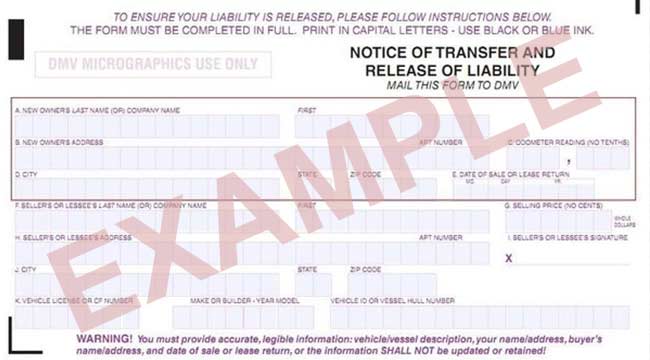
Tell your state you sold the car with its notice of sale or release of liability. It records the date the car stopped being yours; California’s Notice of Transfer and Release of Liability (REG 138) is shown above.
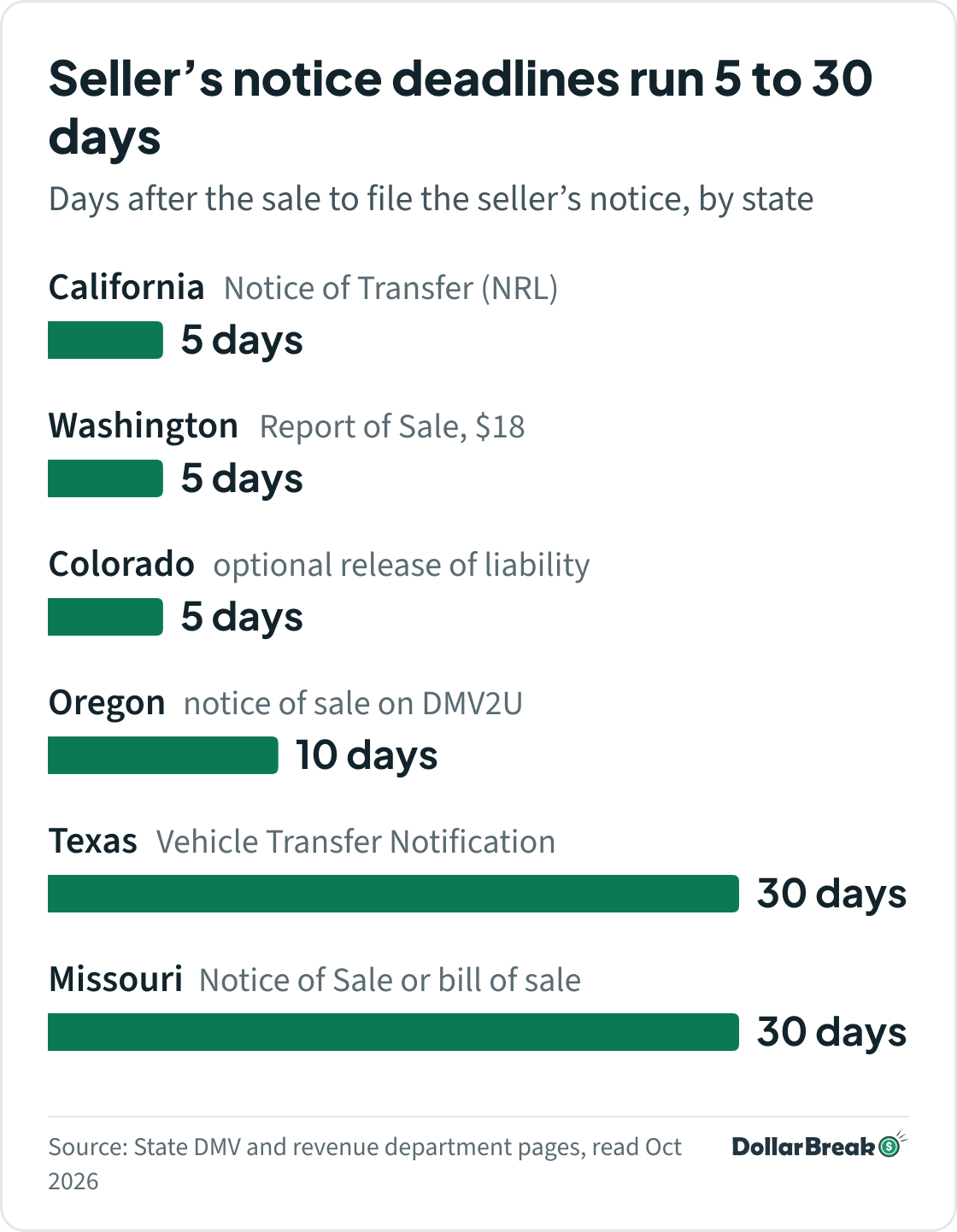
The deadlines are short. California and Washington give you 5 days (Washington’s Report of Sale costs $18), Oregon 10 days, and Texas and Missouri 30 days. Colorado’s release of liability is optional, filed on myDMV within 5 days.
Some states do it differently. Illinois has you mail the Notice of Sale attached to the bottom of the title, and Georgia has you cancel the registration as well as transfer ownership.
If you skip the notice:
- You can be held responsible for the buyer’s parking tickets, traffic violations and tolls (California and Texas name these).
- You can be drawn into civil or criminal actions involving the car after the sale (California).
- You can be billed for towing, impound and abandoned-vehicle costs (Washington).
- If the car is still registered to you after an accident, sorting it out with your insurer gets harder.
7. Remove License Plates (if required)
In most states you take the plates off before the buyer drives away. Illinois and Colorado say it plainly: the plates belong to the owner, not the vehicle.
Move them to another car you own or return them as your state directs. Iowa, for example, has you turn them in at your county treasurer’s office.
States where the plates stay with the car:
- California (generally)
- Minnesota (the plate and registration tax pass to the new owner; exceptions apply)
- Alaska (standard plates only; personalized and specialty plates come off)
In the other states we checked, including Arizona, Colorado, Florida, Illinois, Iowa, Missouri, New York, Pennsylvania and Virginia, you remove them. Utah leaves them on only when you sell the plates with the car. Texas leaves it to you: the seller has the option to remove the plates and registration sticker.
8. Arrange Shipping or Pickup
With the money in your account and the papers signed, agree how the car gets to the buyer.
The buyer usually pays for shipping or comes to collect the car. Settle who pays, and when, before it moves.
A buyer who drives it home needs a temporary plate unless your plates stay on the car, and in most states we checked they come off. Texas sells a One-Trip plate for $5 (15 days) or a 30-Day plate for $25, each plus a $4.75 processing fee, at a county tax office. California’s One Trip Permit costs $28, and Florida issues a 30-day temporary plate for a car sold there to a resident of another state.
When arranging transportation:
- Confirm the pickup date so you can be there.
- Confirm the pickup and drop-off addresses.
- Check that the carrier or broker is registered with the FMCSA (search its MC number); every interstate auto-transport broker and carrier must be.
- Ask what insurance covers the car in transit.
If the other side insists on a shipper or escrow company they chose, look it up yourself. The BBB receives hundreds of Scam Tracker reports a year about fake vehicle shippers and escrow companies.
9. Cancel Your Insurance
Cancel your insurance once the car is gone, giving the insurer the date of sale. The order can matter: New York has you surrender the plates and registration first, or your registration and license can be suspended.
More tips for canceling:
- In Florida, surrender the plate when you cancel the insurance, and file a Notice of Sale (HSMV 82050).
- Cancel as soon as the car is sold, so you stop paying for cover you no longer need.
- Keep the cancellation notice as a record of when your coverage ended.
Documents You Need to Sell a Car Out of State
These are the rules we confirmed on each state’s DMV or revenue site. For any other state, read its DMV page on selling a vehicle before you sign.
| State | What the seller does |
|---|---|
| Alaska | Standard plates stay on the car; personalized and specialty plates come off. |
| Arizona | Sign the title, no notary (unless another state issued it); remove the plate. |
| California | Give the buyer a smog certificate; plates generally stay; Notice of Transfer (REG 138) within 5 days. |
| Colorado | Remove the plates; optional release of liability on myDMV within 5 days. |
| Florida | Surrender the plate; file a Notice of Sale (HSMV 82050). |
| Georgia | Transfer ownership and cancel the registration. |
| Illinois | Remove the plates; mail the Notice of Sale attached to the title. |
| Iowa | Remove the plates and turn them in at the county treasurer’s office. |
| Kentucky | Title signatures notarized. |
| Louisiana | Title assigned before a notary; no separate bill of sale if the price is on the title. |
| Minnesota | The plate passes to the new owner (exceptions apply). |
| Missouri | No notary; safety inspection under 60 days old; remove the plates; report the sale within 30 days. |
| New Jersey | Hand over the title with a bill of sale. |
| New York | Surrender plates and registration before canceling the insurance. |
| North Carolina | Title notarized. |
| Ohio | Title signature notarized. |
| Oklahoma | Title assigned and notarized. |
| Oregon | Notify the DMV of the sale within 10 days on DMV2U. |
| Pennsylvania | Title notarized or verified by an authorized agent. |
| Texas | Removing the plates is your option; Vehicle Transfer Notification within 30 days. |
| Utah | Remove the plate unless you sell the plates with the car. |
| Virginia | Remove the plates before the buyer takes the car; a handwritten bill of sale is accepted. |
| Washington | Report of Sale within 5 days, $18. |
| West Virginia | Notarized bill of sale only if the price is below 50% of the NADA clean loan value. |
| Wyoming | Title signed before a notarial officer. |
Pros and Cons of Selling a Car Out of State
Weigh what a wider market gets you against the extra paperwork and risk.
Pros of Selling a Car Out of State:
- Potentially higher offers – especially when your model is in more demand in another state.
- More potential buyers – a nationwide pool of buyers makes the car easier to sell.
Cons of Selling a Car Out of State:
- Shipping hassle – if the buyer doesn’t arrange pickup, the transport falls to you.
- Negotiations – expect the buyer to push the price down to cover shipping and paperwork.
- Paperwork – two states’ rules can mean extra fees and time.
- Safety – long-distance buyers are a favorite of fake-check scams (see step 2).
Bottom line: Selling out of state pays when the better offer outweighs the buyer’s shipping and your paperwork. Let the title go only after a wire or a cleared check is in your account.
People Also Asked
How do you price a car when selling out of state?
To find your car’s market value:
- Compare similar listings on eBay Motors, Autotrader and CarGurus, whose Instant Market Value is recalculated daily from comparable local listings.
- Use Kelley Blue Book’s car value calculator.
Unsafe payment methods when selling a car out of state
- Personal checks: easy to fake, and your bank can take the money back weeks after making it available.
- Money orders: the FTC lists them among the fake checks scammers send.
- Direct mail payments: hard to verify until they arrive, and they can be lost in transit.
- A check for more than your price: the FTC’s sign of an overpayment scam; never accept one.
How long does it take to sell a car out of state?
Kelley Blue Book puts a private sale at one to three weeks on average. Selling out of state adds the time to mail the papers and ship the car.
Time and process depend on the following:
- Market demand
- Car price
- Condition of the car
- Paperwork
- Transportation
Do I need to pay taxes when selling a car out of state
Not sales tax: the buyer pays it in the state where they register the car. Texas, for one, credits similar tax already paid to another state.
If you sell for more than you paid, the profit is a capital gain, taxed at a rate set by your income and how long you owned the car. A loss on a personal car isn’t deductible, says the IRS.
How do I sell a car to someone in another state?
Get paid first, by wire or a check your bank says has cleared, then sign the original title (before a notary if your state requires one) and a bill of sale. Take your plates off unless your state leaves them on, file your state’s notice of sale, and let the buyer title and register the car at home.
Can a bill of sale be handwritten?
Yes, in Virginia, which accepts a handwritten statement signed by the seller and the buyer. Include both names and addresses, the car’s year, make, model and VIN, the odometer reading, the price and the date.
Does the buyer need a temporary tag to drive the car home?
Yes, if they drive it and your plates come off, as they do in most states we checked. Texas sells a One-Trip plate for $5 or a 30-Day plate for $25 (each plus $4.75), and Florida issues a 30-day temporary plate when a car sold there goes to another state’s resident.