This car valuation guide covers twelve places, and they do not do the same job. Some buy the car outright and hand you a check, some pass you a dealer’s offer, and some only publish an estimate. Each entry says which it is, what it costs and how long its number holds.
Key takeaways
- Estimates are not offers: Kelley Blue Book, J.D. Power, Edmunds and Consumer Reports publish numbers, and none of them buys your car.
- Four companies here buy it themselves: Peddle, Wheelzy, CarBrain and Carvana all quote online and collect the car.
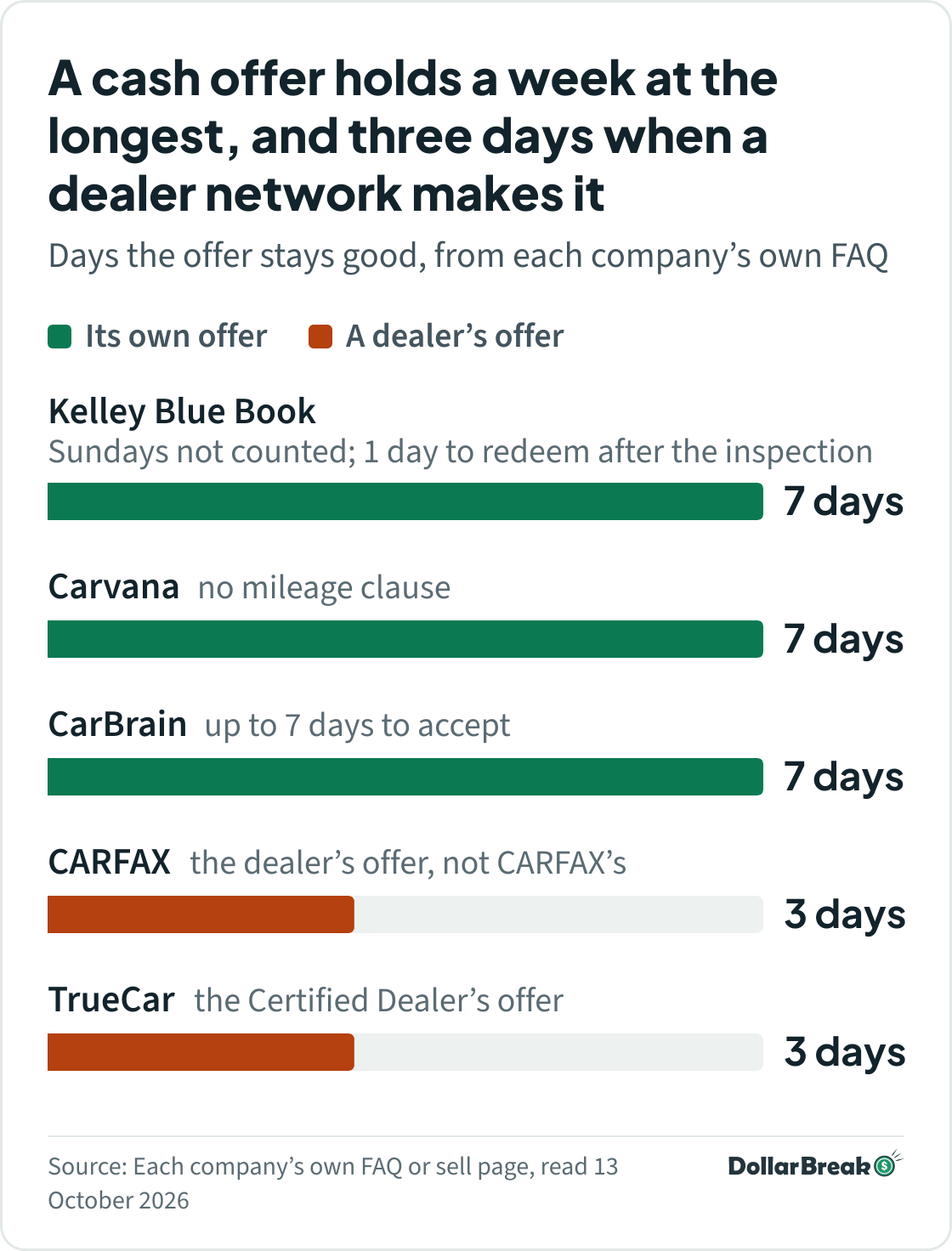
- Offers expire fast: seven days at most from Kelley Blue Book, Carvana and CarBrain, three days from a CARFAX or TrueCar dealer.
- Two of these cost money: Consumer Reports puts its car-price service behind a membership from $39 a year, and a standalone CARFAX report is a paid product.
- Collect more than one: 62% of Consumer Reports members who took an instant cash offer were satisfied with it, against 34% who traded in.
Best Used Car Buyers
Peddle

Trustpilot Rating
Get a legit offer in minutes – provide VIN, mileage and condition
$0 fees + you don’t have to pay for towing – Peddle will take care of it
Get paid in check during the pick up for any car (damaged, junk)
Wheelzy

Trustpilot Rating
Quick car evaluation without the hassle – sell your car within 30 min
Choose a convenient date and time for free pick-up, even tomorrow
Get cash in hand the same day the Wheelzy agent picks up your car
CarBrain

Trustpilot Rating
Get an offer within 2 minutes and sell your car within 24 hours
Free vehicle towing and no fees to getting rid of your damaged car
The tow truck driver will arrive with your check (nationwide service)

Where to Get Your Car Valuation
| Place | What it gives | Holds |
|---|---|---|
| Peddle | Buys the car | No window |
| Wheelzy | Buys the car | No window |
| CarBrain | Buys the car | 7 days |
| Carvana | Buys the car | 7 days |
| CarGurus | Dealer offers | Not stated |
| Kelley Blue Book | Estimate, dealer offer | 7 days |
| J.D. Power | Estimate only | – |
| Edmunds | Estimate, CarMax offer | Not stated |
| Consumer Reports | Estimate, members only | – |
| CARFAX | Estimate, dealer offer | 3 days |
| TrueCar | Estimate, dealer offer | 3 days |
| CarsDirect | Research, third party | Not stated |
1. Peddle
Peddle Summary
- Sell used, damaged or junk car nationwide
- Free towing, scheduled within 1 business day
- Receive payment upon car collection
- Get free online quote – offer in seconds
- Instant quote available on (855) 925 4302
- No obligation to accept the offer
Peddle buys cars, trucks, vans and SUVs in any condition, in all 50 states, and gives an instant cash offer for each one. It does not take motorcycles, RVs, campers, trailers or boats.
To get your car value estimates, you need to fill out an online form and provide details such as:
- Car’s make and model
- Car’s year of manufacturing
- Car’s mileage
- Your zip code
- Describe vehicle condition
The Peddle valuation is free and the number comes back in seconds. It is not locked in until you accept it: Peddle’s help center says its buyers can change or retract their bids, so there is no fixed window to think it over. Once you do accept, the offer holds unless the car is not as described or a major component is missing.
A carrier calls within one business day of your acceptance. Collection is usually 24 to 48 hours after that, and towing, pickup and the title transfer cost nothing. Peddle pays by company check when the driver loads the car, or by ACH within three business days if you arrange it.
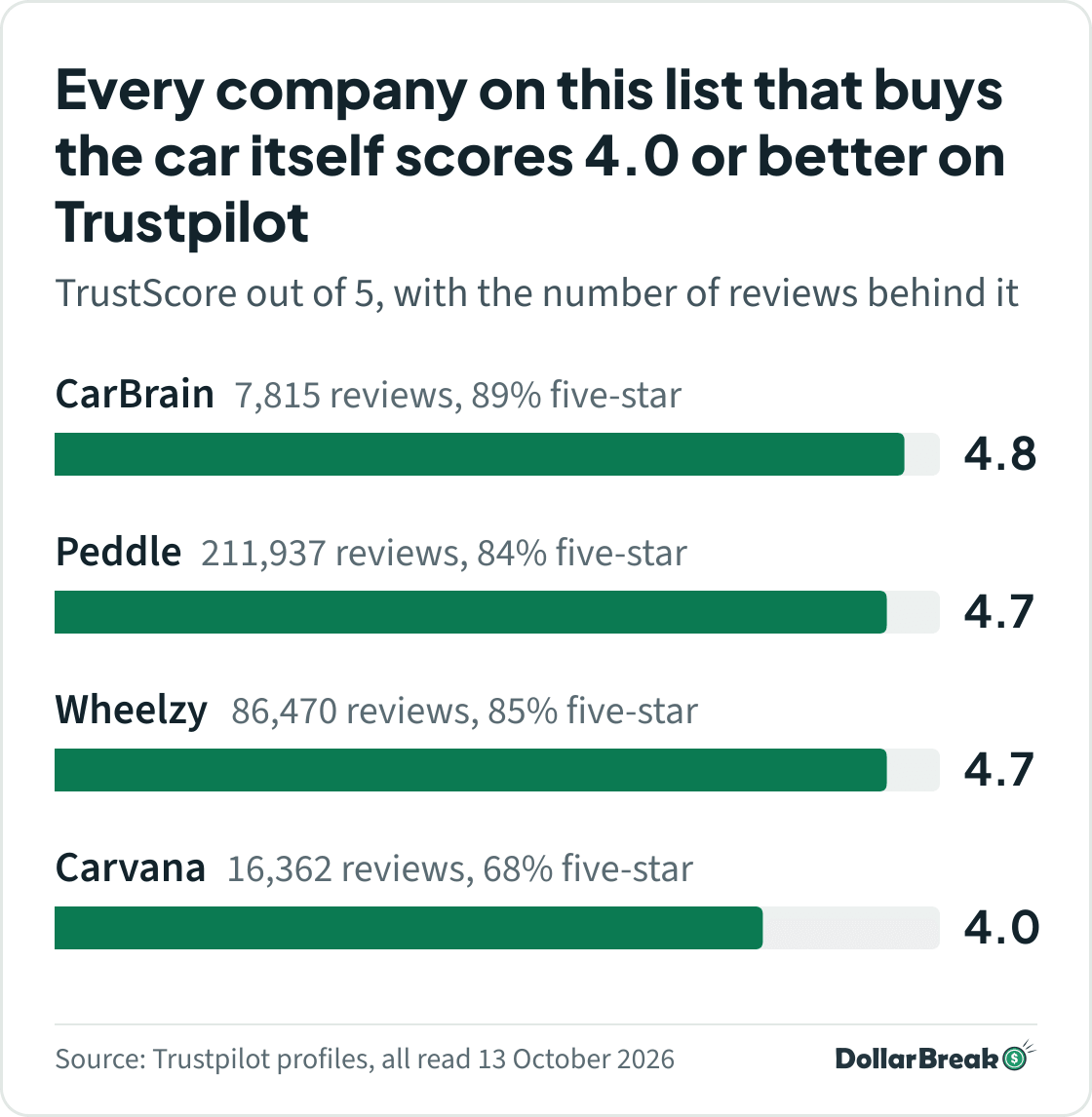
Worth it? Yes, as your baseline cash number: no fees, every condition, all 50 states, and 211,937 Trustpilot reviews behind a 4.7.
2. Wheelzy
Wheelzy Summary
- Service is completely free – no hidden fees
- Get offer in minutes – (855) 510-1108
- Free towing of your car from your location
- Instant payment via cash or check
- The offer is firm – no haggling
- Available nationwide (50 states)
Wheelzy does the same job as Peddle and also values your car free. It buys model year 1981 and newer, and takes damaged, old and non-running cars, including ones with parts missing, as long as the engine and transmission are still attached.
What it will not take is a boat, a motorcycle, an ATV, a camper or an RV, and it does not buy parts on their own. It has no stores or drop-off points at all: every sale is a free pickup from wherever the car is standing.
To get an instant cash offer, you need to fill out an online form and provide your zip code, vehicle’s make and model, year and your phone number.
The offer comes back in a few minutes and Wheelzy says it is firm — “the price we offer is the price we pay”, with no last-minute haggling. It publishes no expiry date either, and pays cash or check when the driver collects. The Better Business Bureau rates it A– and has accredited it since January 2025.
Worth it? Yes if the firm price matters more to you than haggling, and if your car is from 1981 or later.
3. CarBrain
CarBrain Summary
- Call for a free quote – (844) 407-2200
- Get cash for your car in under 48 hours
- CarBrain buys cars in over 7 conditions
- Up to 7 days to accept CarBrain’s offer
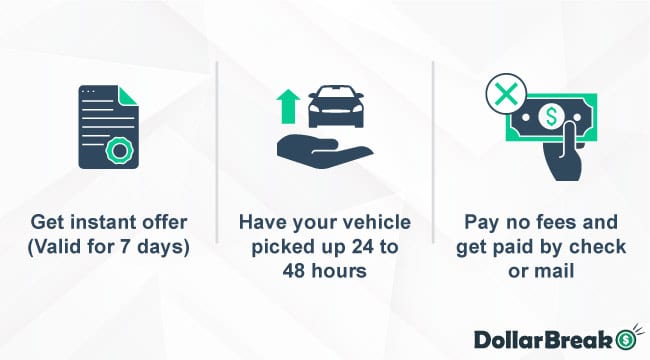
CarBrain is a nationwide car-buying company that will give you an instant offer for your car. All you need to do to get the offer is to fill out an online application with your car details. This offer will take into consideration the make, model, age, and condition of your car, giving you a fair and accurate valuation of your vehicle.
Once you accept, CarBrain handles the pickup and the payment, generally within 24 to 48 hours, and the carrier pays by check at collection. It scores 4.8 on Trustpilot from 7,815 reviews, 89% of them five-star. The Better Business Bureau rates it A and has accredited it since December 2017 — a letter grade, not a star score.
CarBrain charges no fees, and you are under no obligation to sell after a free valuation. It will also buy a car with a loan outstanding where its offer is bigger than the lien, which most of this list will not.
Worth it? Yes for a damaged or non-running car, and it is the only buyer here that will work round an outstanding lien.
4. Carvana

Carvana Summary
- Get an online quote within 2 minutes
- Free drop off at a hub or vending machine
- Offer valid for 7 days, no haggling
- Haggle-free process to sell your car
Carvana has been selling cars since 2013 and was founded in Phoenix in 2012. It buys your car whether or not you buy one from it, and it will put the offer against a Carvana car instead if you prefer.
To get an instant cash offer fill out an online form and provide your license plate number or VIN. You might need to provide additional details about your car and it’s condition.
The offer comes back in under two minutes and Carvana says it holds for seven days and “will not change” if what you told it was accurate. There is no mileage clause. Photo review and the inspection at the appointment can still produce a revised number.
Dropping the car at a Carvana hub or one of its 34 vending machines is, in its own words, “always free”. A driveway pickup is a paid service in the areas that have it: Carvana charges by location and demand, and shows the amount when you book. You are paid at the appointment by printed check, or by ACH that “normally take between 2-5 business days”.
Carvana publishes no model-year floor and no “must be running” rule. What it does require is a valid, marketable title free of undisclosed liens, and a car that passes the safety and diagnostic check at the appointment.
Worth it? Worth a quote on a clean, running car, but read the pickup fee before you book: it is the one charge on this list that catches sellers out.
5. CarGurus

CarGurus Summary
- Receive payment within 3 working days
- Find out the market value of your car
- Compare local dealer offers in about 2 minutes
- Instant Market Value recalculated daily
CarGurus is another company that allows you to get free car valuation. The process is very simple and only takes a few minutes.
To get an instant offer for your vehicle add your VIN or license plate number to online calculator and provide additional information about car’s condition.
CarGurus comes back with offers from local dealerships rather than buying the car itself, so the money, the paperwork and the collection are the dealer’s, not CarGurus’.
What it will not do is list your car privately. Its help center is explicit that CarGurus “does not provide the option to list or sell your car privately on the site”. Browsing its listings is still a fair way to see the asking prices near you. Its Instant Market Value is recalculated daily from comparable local listings, and every listing is labeled Great Deal, Good Deal, Fair Deal, High Price or Overpriced.
Worth it? Useful for reading the local market and for a dealer offer, but it is not a place to sell privately, whatever older guides say.
6. Kelley Blue Book

KBB Summary
- Provides an Instant Cash Offer
- Helps to determine your car’s value
- It’s free to use the KBB valuation tool
- Check your car for any recalls
Kelley Blue Book has published used-car values since 1926 and is now a Cox Automotive company. It is the name most dealers and lenders will know when you quote a number at them.
It does not buy cars. It gives you an estimate of what your car should fetch when you trade it in or sell it privately, and its Trade-In Value is updated weekly.
Ideally, Kelly Blue Book determines the book values of cars by analyzing market factors, gathering pricing information of vehicles, and comparing them with current economic conditions.
KBB values different categories of vehicles, including new and used. Besides, it uses a variety of tools to help you find the market value of a vehicle, including;
- Private party value
- Trade-in value
- Suggested retail value
- Certified pre-owned(CPO) value
The Instant Cash Offer is the one to understand. Kelley Blue Book says it is “free” to obtain and to redeem, and that it stays valid for seven days, not counting Sundays. You then take it to a participating dealer, who checks the car’s condition and pays — in cash or against another vehicle. After the inspection you have one day to redeem it, and the amount is recalculated if the condition has changed or you have added more than 50 miles.
Almost everything on the site is free. The only fee Kelley Blue Book names is $35 for a Valuation Certified Report, which gives a car’s value on a date in the past. Its recall check lives at kbb.com/recall.
Alongside the valuation, Kelley Blue Book carries car reviews, buyer’s guides, repair guides and a car finder. That is the research most people do once they know what their current car is worth.
What each Kelley Blue Book number is for
| Number | What it is | Cost |
|---|---|---|
| Trade-In Value | What a dealer should allow you against another car; updated weekly | Free |
| Private Party Value | What a private buyer should pay | Free |
| Suggested Retail Value | What a dealer should ask for the same car | Free |
| Instant Cash Offer | A real offer, redeemed at a participating dealer | Free |
| Valuation Certified Report | The car’s value on a past date | $35 |
One thing worth being clear about: Kelley Blue Book never writes the check. Its Instant Cash Offer is redeemed by a participating dealer, who inspects the car first and may adjust the amount.
Worth it? Start here. It is free, it is the number a dealer will argue against, and its Instant Cash Offer turns the estimate into something redeemable.
7. NADA Guides (now J.D. Power)

NADA Summary
- Access buyer and seller resources
- Get accurate car evaluation
- Car values are updated every month
- Trusted by dealers for car evaluation
If a guide sends you to NADAguides.com, it is out of date. That address now redirects to a page on the dealers’ association site that does not exist, and NADA itself offers car owners no valuation. The values that carried the NADA name are J.D. Power’s, at jdpower.com/cars.
J.D. Power announced that it completed its purchase of the NADA Used Car Guide on 1 July 2015, and it bought NADAguides.com itself in 2017. The National Automobile Dealers Association, founded in 1917, is now only the trade body.
What you get at jdpower.com/cars is free: used-car values, new-car prices, a trade-in value tool, and a VIN and license-plate lookup. J.D. Power is candid that its numbers “inherently differ” from Kelley Blue Book’s and Black Book’s. That is the point of checking it as a second opinion.
These are the values lenders, insurers and dealers have used for decades, so a J.D. Power number carries weight in an argument about an insurance settlement or a loan.
Alongside the values, the site publishes its own vehicle dependability and quality awards, which are what most people know J.D. Power for.
Worth it? Yes as a free second opinion, especially against an insurer or a lender — but go to jdpower.com, not NADAguides.
8. Edmunds

Edmunds Summary
- Edmunds will buy a car directly from you
- Free car appraisal tool
- Offer is valid for 7 days
- Bring in your vehicle for inspection and get paid
Edmunds is an online car resource dealing with expert car reviews and vehicle information.
Its free appraisal returns three numbers for the same car — trade-in, private party and dealer retail — for passenger vehicles back to model year 1990. It does not cover motorcycles, RVs or boats.
The web-based platform has resources such as;
- New car pricing
- Car buying tools
- Best-rated cars by price
- Car comparison guides
- Best cars by category
- Comprehensive car reviews
Edmunds does not buy cars either. Its help center says the Instant Cash Offer on the site is provided by CarMax, so an Edmunds offer and a CarMax offer are the same number from the same buyer.
The figure Edmunds is known for is True Market Value: the average transaction price in your area, or what other people are actually paying. It includes manufacturer-to-dealer incentives, destination and advertising fees, and leaves out consumer rebates, sales tax, registration and documentation fees.
The site also runs loan and trade-in calculators, lease deals and car comparisons, and tests more than 300 new vehicles a year, around 200 of them instrumented at its own private test track.
Searching the value of a new or used car on Edmunds works from make or model, type and price.
Worth it? Yes, and it is the fastest way to see a CarMax offer without going to CarMax. Treat its True Market Value as the private-sale sanity check.
9. Consumer Reports
Consumerreports.org is a non-profit organization that provides unbiased information on products. You can use Consumer reports to find reviews about products and services, including cars, clothing, and food.
It is also the only name on this list that tests cars itself and takes no advertising, which is why its numbers are worth a look even though they are the hardest to get at.
Its car-value estimator will tell you what your used car is worth and what it should fetch as a trade-in at a dealership. The catch is the price of admission, below.
Consumer Reports’ car-buying arm is the Build & Buy service, and it is worth knowing who runs it: TrueCar does, operating both the dealer network of more than 12,000 prescreened dealers and the service’s website. Consumer Reports states that its member savings “require Digital or All Access Membership”, which costs $39 or $64 a year.
For example;
- To get started, you need to enter vital information about the car, including make, model, and year of manufacture.
- Next, provide vital information about the vehicle, including the mileage, condition, and extra features.
- After that, the system will generate your car’s value for trade-in or sale purposes.
Consumer Reports also surveyed more than 14,000 of its members who had sold a car. The result is the most useful thing on this page about how to sell, rather than where to look up a number.
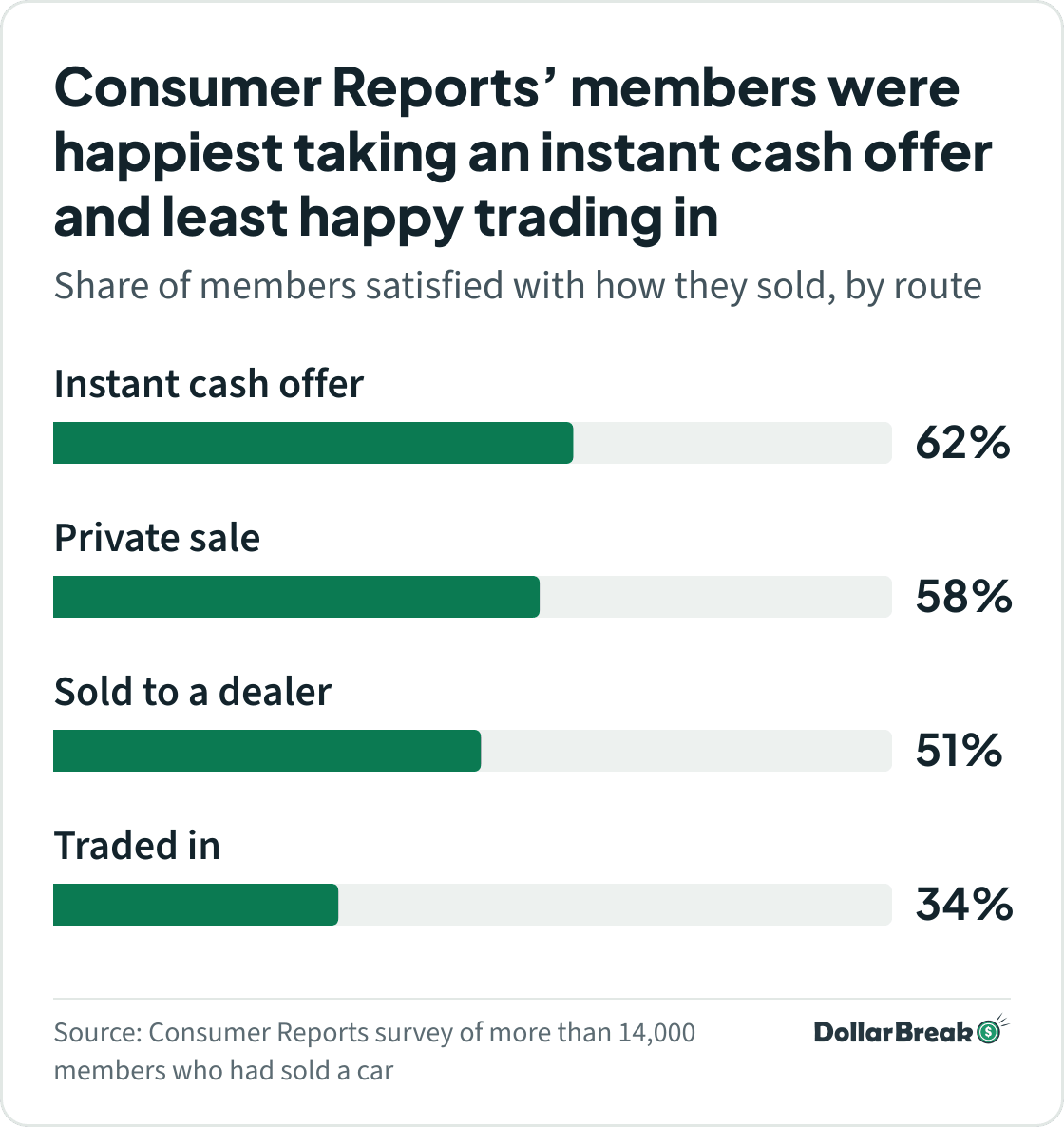
An instant cash offer satisfied 62% of them, a private sale 58%, a sale to a dealer 51% and a trade-in 34%. That is satisfaction with the route, not the money each one brought in — but it is a straight answer to the question most people are really asking when they look up a valuation.
Worth it? Only if you are already a member, or want its survey work. For a free number, four other entries here do the same job.
10. CARFAX
CARFAX is a vehicle-history company, and it does not buy cars. Its own About page claims more than 35 billion records from more than 151,000 sources in the United States and Canada. The figures its parent filed with the SEC for 31 December 2025 are higher still: more than 38 billion records from more than 177,000 sources.
To get a car history, you only need to search by VIN and get a detailed report.
What it adds to a valuation is CARFAX History-Based Value, a price for one specific VIN rather than for the model: it works from that car’s accidents, title brands, service history and number of owners. Our CARFAX review goes through what the report does and does not catch.
Carfax considers the following attributes when generating a detailed vehicle history report:
- Salvage titles
- Estimated mileage
- The general condition of the vehicle
- Police reports, including inspection
- Registration history
- Any accidents
- Previous ownership
- Any recalls
There is no seven-day free trial. CARFAX names two free routes only: a report attached to any listing on its own site, and a free Car Care account showing your own car’s report and recall alerts. A standalone report is a paid product.
Its Sell My Car tool takes your VIN or plate, you book a free appraisal, and dealers in its network make cash offers good for three days. The dealer pays, and CARFAX takes no part in the sale.
Worth it? Worth it for the history, not for the price: a buyer will ask for the report anyway, and a wrong record on it costs more than any estimate.
11. TrueCar

TrueCar Summary
- Enter VIN to instantly get a car estimate
- Offer is good for three days
- The Certified Dealer pays by check
- Offer comes from one of Certified Dealers
TrueCar.com is a web-based automotive marketplace that enables individuals to shop for their favorite cars.
For selling, it passes your VIN to its network of more than 11,500 Certified Dealers and brings back an instant cash offer. The offer is good for three days, the dealer pays by check, and the whole thing takes about three business days.
It is also the engine behind other people’s car programs. American Express’s Auto Purchase Program runs on TrueCar, and so does the Sam’s Club Auto Buying Program, which needs an active Sam’s Club membership at the time of purchase.
On the buying side it lists more than 700,000 used cars and shows what nearby buyers have paid, so you can see both ends of the same car’s price.
One caution worth carrying into it: TrueCar is a lead-generation business, and a quote means a dealer now has your details.
Here is how to get a quick estimate of your vehicle;
- You can start by providing your car’s information with parameters such as License plate, VIN, Make, Model, and State or city.
- In addition, you can narrow down your search to include other features such as color, mileage, and condition.
- After that, the system generates the true value of the car.
Worth it? Yes for a quick dealer offer, as long as a three-day window and the follow-up calls suit you.
12. CarsDirect

CarsDirect Summary
- Lets you research used car prices to price your car fairly
- Routes sellers to a third-party instant-offer service
- Provides lead generation and referral services to auto dealers
- The platform is free to use
CarsDirect is a US-based online portal that enables customers to get information about car values, insurance options, and vehicle financing.
Its sell-your-car page hands you to a third party rather than to CarsDirect. The page says the service “will come to you to pick it up and pay you on the spot”, at a time and date you choose, and that you receive a check. It names no buyer, states no time window, and warns that the service “may not be available in all states”. Older guides promising a 48-hour Peddle sale through CarsDirect describe something the site no longer says.
Where CarsDirect earns its place is research. Its used-car search shows what cars like yours are advertised for near you, filtered by the make, model, trim and condition that decide a price.
Beyond the listings it publishes reviews, how-to guides and loan calculators, and runs a lender network for buyers with poor or no credit.
Worth it? As a price-research site, yes. As a way to sell, go to a named buyer instead and keep control of who gets your details.
Bottom line: Take a free estimate from Kelley Blue Book and one more publisher, then put the car in front of two or three buyers who will actually collect it. The estimate tells you whether an offer is fair; only the offer is money.
How to Estimate Vehicle’s Value?
Start with a free estimate from a publisher. What your car is worth depends on mileage, trim, condition, options, accident history and your ZIP code, and every tool asks for them. Then get at least two real offers. An estimate is modeled; an offer is a commitment.
Nobody has published a controlled test of one valuation site against another, with the same cars and the gap in dollars. Consumer Reports came closest and withheld its numbers. What is on the record is a handful of documented cases of the estimate not surviving contact with a buyer.
| Who and when | What they recorded |
|---|---|
| Consumer Reports, October 2024 | Submitted two of its own outgoing test cars by VIN to Carvana, CarMax, Carwiser and Kelley Blue Book. It published no dollar figures; its conclusion was that it is “really important to get multiple quotes”. |
| ABC27 (WHTM), October 2023 | Consumer reporter John Matarese covered a Chevrolet Silverado owner whose Kelley Blue Book trade-in value read $37,000 and whose own dealer’s instant cash offer came back at $30,000 — about 19% less. |
| DollarBreak count, 13 October 2026 | Of the eight newest one-star reviews on Kelley Blue Book’s Trustpilot profile, four were about the number not holding, including an Instant Cash Offer above $2,200 against real dealer offers of $300. |
| Matty D Media, June 2026 | Filmed a 2023 Tesla Model Y sale to Carvana after comparing four buyers. The video’s own description says the online offer was adjusted down at the inspection for a scratch; we did not read the transcript, so we cannot say by how much. |
Maximizing Your Car’s Value: Expert Tips and Tricks
To get the most for your car, keep up the routine maintenance. Oil changes and tire rotations keep it running well and head off the repairs that cut an offer.
Enhance its curb appeal by keeping it clean and addressing minor cosmetic issues, as first impressions can significantly influence a buyer’s decision.
Keep every service record. Proof of care is the one thing a private buyer cannot check for themselves, and it is worth real money at the curb.
A professional detail and small touches like new floor mats cost little and lift the first impression. None of it changes what a cash buyer pays, though: the instant-offer forms ask about damage and mileage, not about how clean the car is.
Understanding the Factors That Affect Car Valuation
Every tool on this page works from the same handful of inputs, and it helps to know which ones move the number most.
Vehicle age is a primary determinant, as newer cars tend to retain more value than older ones due to their longer remaining lifespan and often more advanced technology.
Mileage also plays a crucial role, as higher mileage often indicates more wear and tear, potentially reducing the car’s value.
Make, model and condition do the rest, and a title brand does more damage than any of them: J.D. Power puts a rebuilt or salvage title at 20% to 40% below the same car with a clean title, and says the loss is permanent.
The Role of Market Trends in Car Valuation
Used-car values move as a market, so the same car is worth different money in different months. The yardstick the trade watches is Cox Automotive’s Manheim Used Vehicle Value Index, which tracks wholesale prices adjusted for mix, mileage and seasonality.
In September 2026 that index stood at 205.9, down 0.6% on the year and 1.1% on the month. Cox also split it: its electric-vehicle index was up 4.3% year on year while the rest of the market was down 1.6%.
That is the background against which every estimate on this page is drawn, and it is why a number you looked up six months ago is not the number today.
Seasonal trends must be considered too, with convertibles being more sought-after in summer, which may temporarily boost their value.
Car Valuation FAQ
What is the most accurate car valuation site?
Nobody has published a controlled test of one against another, so there is no measured winner. Kelley Blue Book, Edmunds and J.D. Power each build their estimates from different data, and the only figure that is certain is a written offer from a buyer who will collect the car.
What is the difference between trade-in value and private party value?
Trade-in value is what a dealer should allow you against another car. Private party value is what a private buyer should pay. Kelley Blue Book publishes both, plus a suggested retail price, and updates its trade-in figure weekly.
Is a car valuation free?
On Kelley Blue Book, J.D. Power, Edmunds, CarGurus and TrueCar, yes. Consumer Reports puts its car-price service behind a membership from $39 a year, and a standalone CARFAX report is a paid product.
How long does a car valuation offer last?
Seven days from Kelley Blue Book, Carvana and CarBrain, and three days from a CARFAX or TrueCar dealer. Peddle and Wheelzy publish no window at all; Peddle says an offer is not locked in until you accept it.
Why is the real offer lower than the online valuation?
An estimate is modeled from the details you type in. An offer is what one buyer will pay after seeing the car. Buyers re-price at the inspection for damage, missing parts and wear the form never asked about. That is why several offers beat any single estimate.