How long you can drive a deceased person's car comes down to whether the insurance still covers the driver, whether the registration is valid and who has authority over the title. Below are the state rules we found, the forms that move a car without probate, what the penalties cost and what happens to a car loan.
Key takeaways
- No 30-day rule: No state DMV or statute we read sets one; Pennsylvania lets an heir or executor drive through the current registration and one renewal.
- Insurance first: A policy can lapse when the named insured dies unless its terms say otherwise, so call the insurer before anyone drives.
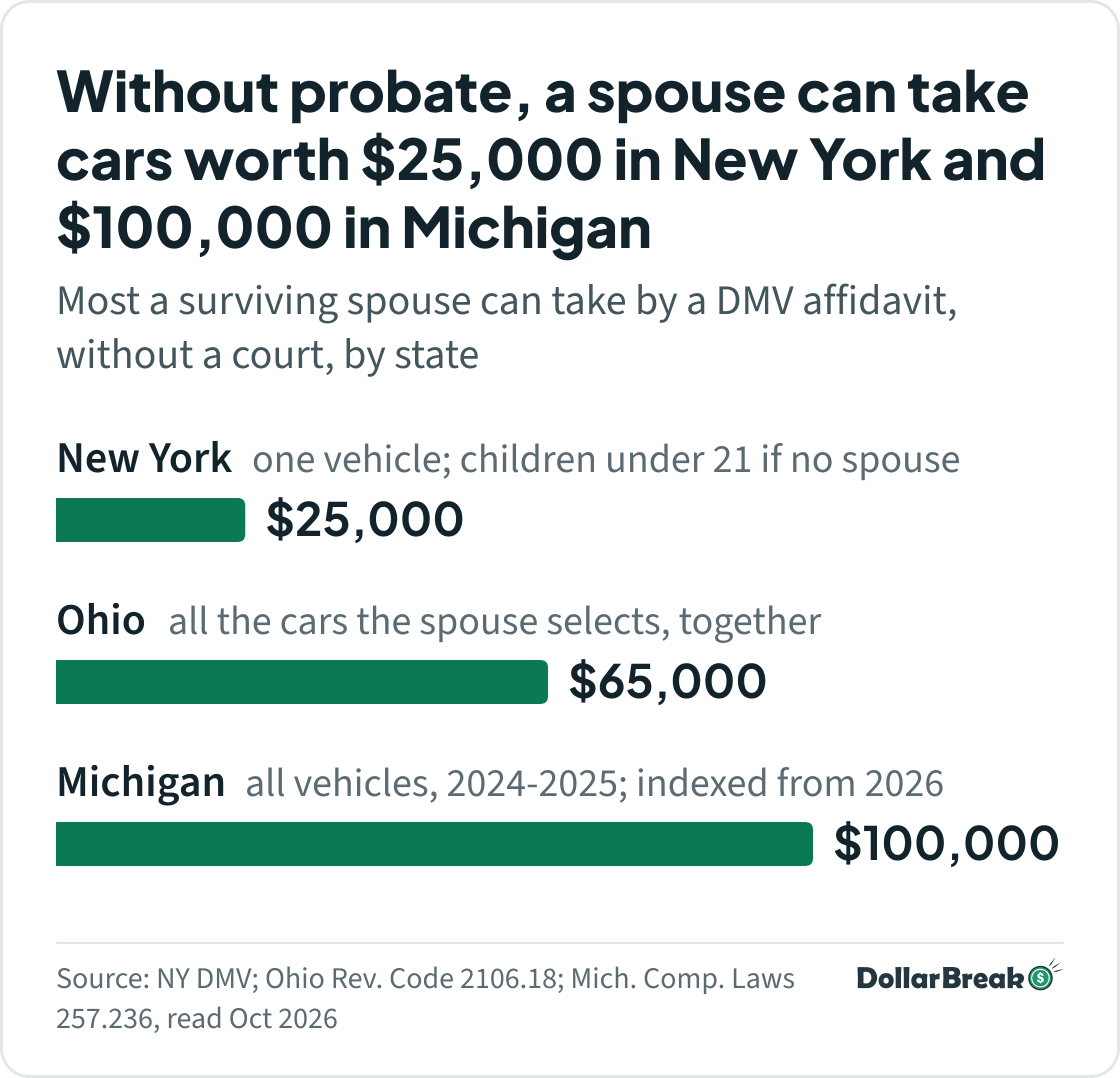
- Often no probate: A spouse can take cars worth up to $25,000 in New York, $65,000 in Ohio and $100,000 in Michigan (its 2024-2025 limit) by a DMV form.
- Title fees: From $18 in Ohio and Georgia to $165 in Illinois.
- Car loans: The estate pays; a cosigner, or a spouse in a community property state, may owe what is left.
- Tell the DMV: New York asks the family to mail a copy of the death certificate with the license.
Best Used Car Buyers
Peddle

Trustpilot Rating
Get a legit offer in minutes – provide VIN, mileage and condition
$0 fees + you don’t have to pay for towing – Peddle will take care of it
Get paid in check during the pick up for any car (damaged, junk)
Wheelzy

Trustpilot Rating
Quick car evaluation without the hassle – sell your car within 30 min
Choose a convenient date and time for free pick-up, even tomorrow
Get cash in hand the same day the Wheelzy agent picks up your car
CarBrain

Trustpilot Rating
Get an offer within 2 minutes and sell your car within 24 hours
Free vehicle towing and no fees to getting rid of your damaged car
The tow truck driver will arrive with your check (nationwide service)

Is It Legal to Drive a Car of a Deceased Person?
Until the title moves, the car belongs to the dead owner's estate, and the executor or administrator controls it. No state we checked makes driving it an offense in itself. Driving it uninsured or on an expired registration is.
We found no 30-day grace period, or any general time limit, in California, New York, Texas, Florida, Ohio, Michigan or Illinois. Louisiana's heirs' title law (R.S. 32:707.1) says only how heirs get a title.
Of the states we checked, Pennsylvania is the only one with a set window. Under Vehicle Code section 1315, an heir, executor or administrator may drive the car for the rest of the current registration and the whole next one. The registration must be renewed in the estate's name, says the PennDOT fact sheet.
Whoever drives it should carry the insurance card and a copy of the death certificate. Check first that the policy still covers you (see car insurance after the owner dies).
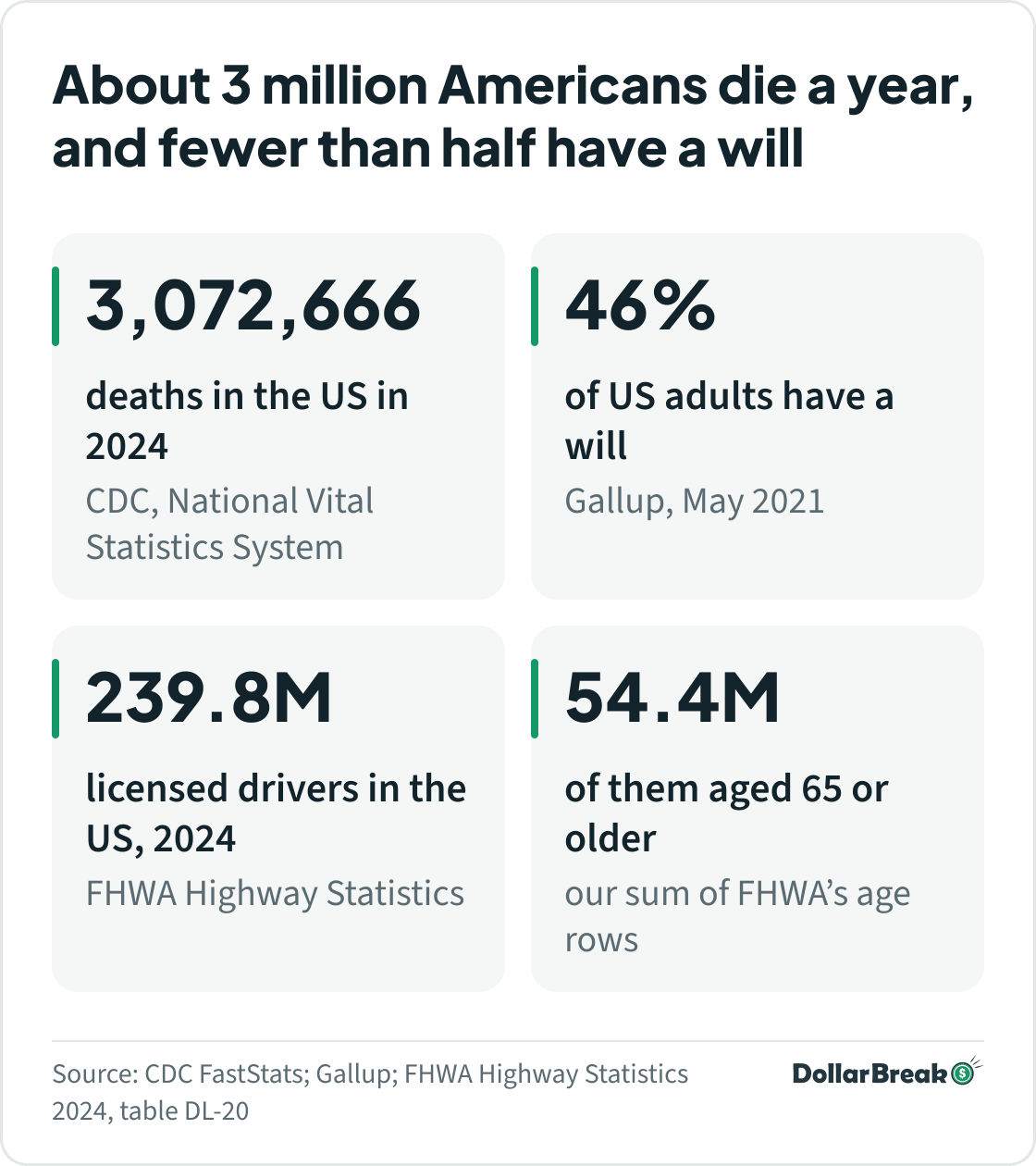
The question comes up in many families. The CDC counted 3,072,666 deaths in the US in 2024, and only 46% of adults have a will, Gallup found in 2021. Of the 239.8 million licensed drivers in 2024, 54.4 million were 65 or older, by our sum of the Federal Highway Administration's age rows.
Who Can Drive the Deceased Person’s Car?
Who may drive the car depends on who has authority over it, not on family ties alone. In most cases that is one of these people.
1. Estate administrator or executor
A will names an executor, and the probate court confirms them. The executor manages the car until it is sold or passed to an heir, and decides who may drive it meanwhile.
With no will, the court appoints an administrator, who has the same role.
2. A surviving co-owner or a named beneficiary
If the title shows joint ownership with right of survivorship, the car passes to the surviving owner. Where a state issues transfer-on-death titles, as Missouri does, the named beneficiary gets a new title on proof of death.
3. Close family, in Pennsylvania
Pennsylvania is the one state we found that names relatives. A spouse living in the household may keep renewing the registration in the estate's name until the court approves the final account; with no spouse, a child, then a parent in the household.
In practice, the insurance decides it. In August 2026 a New York appeals court (Allstate Ins. Co. v. Cabrera) ruled on a dead owner's girlfriend who drove the car without the permission of the court-appointed representative. Allstate owed the girlfriend no defense or coverage.

Risks of Driving a Car of a Deceased Person
Driving the car before the paperwork is settled carries legal and money risks. Most of them come from a lapsed policy or an expired registration.
The main risks:
- Personal liability for accidents: If the policy no longer covers the car or the driver, the driver can be liable for the damage and injuries.
- Fines and suspension: Driving uninsured or on an expired registration is an offense; the table below shows what some states charge.
- Insurance and registration in different names: New York requires both to show the exact same name, and its DMV can suspend the registration and the driver's license when coverage lapses.
- Expired registration: Once it expires, the car can't be driven legally; Texas allows five working days, and California charges late penalties with no grace period.
- Lower estate value: Extra miles, wear and any damage reduce what the heirs share.
- Conflict among heirs: One heir using the car without the others' agreement can start a dispute that slows the estate.
The safe course: ask the insurer and the executor before anyone drives the car, and keep it parked until both say yes.
Penalties for driving a deceased person's car uninsured or unregistered
We found no state with a penalty for driving a dead person's car as such. The penalties that apply are the usual ones for driving without insurance or on an expired registration.
| State | What goes wrong and what it costs |
|---|---|
| Texas | No insurance: a $175 to $350 fine for a first offense. Expired registration: an offense after the fifth working day, fine up to $200. |
| Florida | No insurance: the registration and license are suspended; reinstatement costs $150 the first time, $250 the second and $500 after that. |
| New York | No insurance: the DMV can suspend the registration and the driver's license. |
| California | Late registration: from 10% of the vehicle license fee plus $20 (1 to 10 days late) up to 160% plus $200 (over 2 years); no grace period. |
| Arizona | Late registration: no grace period; an $8 late fee plus $4 a month, up to $100. |
| Washington | Expired registration: a traffic infraction. |
How To Transfer Car Title After Death Of Owner
Moving a car's title after the owner dies follows your state's rules. In many states the heirs can do it at the DMV without a court order.
The paperwork usually includes:
- An order from the probate court, or your state's no-probate form (see the table below)
- The original certificate of title
- The death certificate (Pennsylvania wants an original; copies are not accepted)
- An odometer disclosure, for model year 2011 and newer cars only
Steps to transfer the title:
- Get the death certificate: It proves the death to the DMV, the insurer, the lender and the court.
- Find the certificate of title: It shows who owns the car and whether a lender holds a lien.
- Identify the heir: A will names the beneficiary. Without one, state intestacy law decides.
- Choose the route: Probate, unless a DMV affidavit, a survivorship title or a transfer-on-death title applies (see below).
- Settle what the car owes: Clear any unpaid fees, taxes or loan as state law requires.
- Fill in the title forms: Submit them to your state's DMV or title office.
- Pay the title fee: From $18 to $165 in the states below.
Title Transfer Fees
Moving a deceased person's car into an heir's name costs a title fee, and often registration, inspection and tax on top.
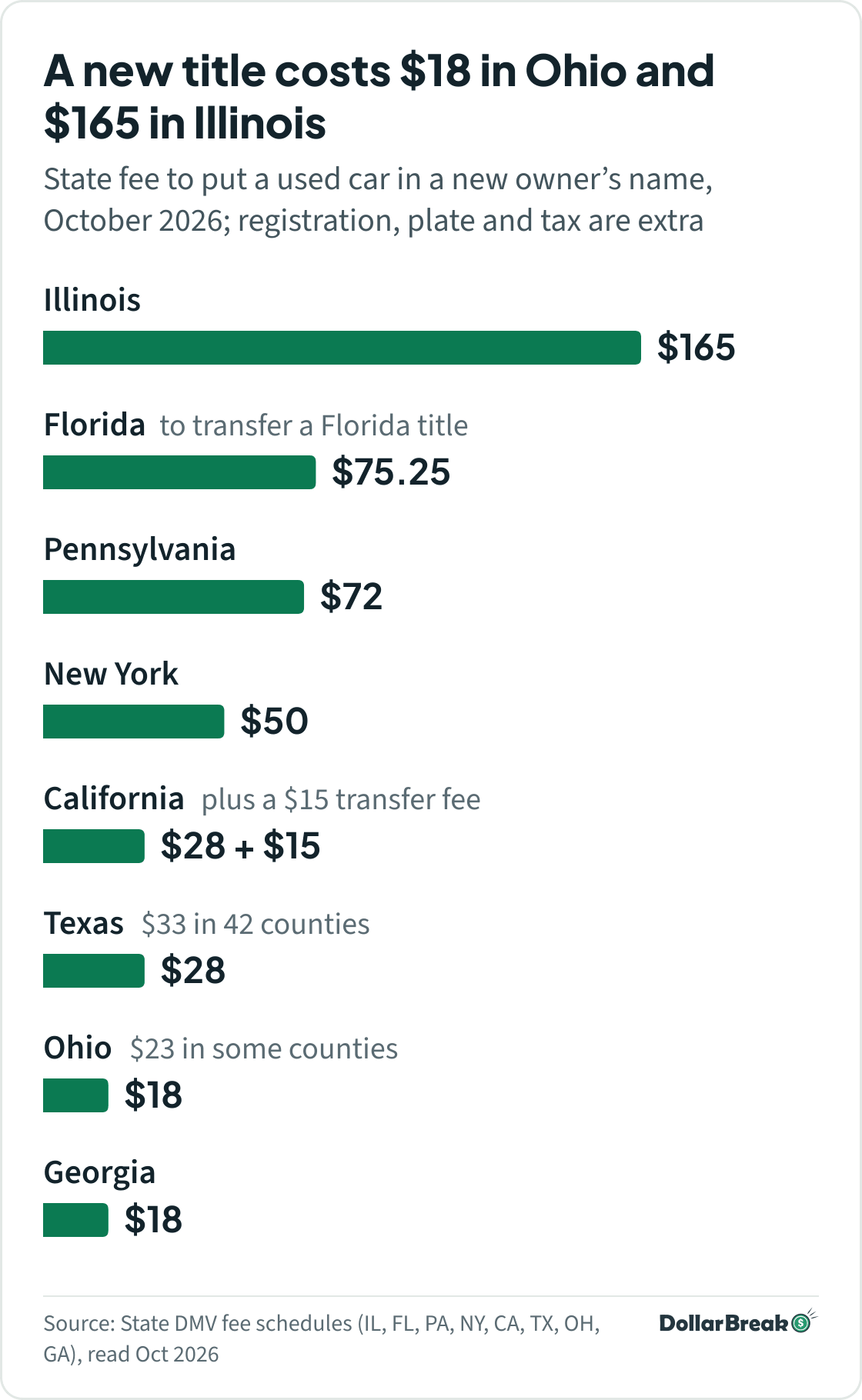
Title fee: From $18 in Ohio ($23 in some counties) and Georgia to $165 in Illinois. Florida charges $75.25 to transfer a Florida title, Pennsylvania $72, New York $50, Texas $28 ($33 in 42 counties) and California $28 plus a $15 transfer fee. Pennsylvania charges no title fee when the car goes to the surviving spouse.
Inspection fee: Some states require a safety inspection or a smog certificate before the new owner can register the car.
Registration fee: The new owner usually registers the car in their own name and pays the state's registration fee. In Pennsylvania, renewing the registration in the estate's name carries no transfer fee.
Other state fees: Some states add fees by vehicle type or county. Illinois, for example, charges $251 a year to register an electric vehicle, so titling and registering one costs $416 ($165 + $251).
How Soon Should You Transfer the Title of a Deceased Person’s Car?
When you can move the title depends on whether the car goes through probate.
If it does, the executor or administrator signs the title over, and many estates first wait out the time creditors have to file claims.
That time has a floor set by law. In California, creditors have until the later of four months after the court issues letters or 60 days after notice. In Florida, they have three months after the first published notice, and a lender's lien on the car survives that deadline.
Without probate it is faster. California's REG 5 affidavit can be used 40 days after the death, and Texas's VTR-262 needs only the heirs' signatures before a notary. In Pennsylvania you can keep the car on the road meanwhile by renewing the registration in the estate's name.
The no-probate route for a car, state by state:
| State | The no-probate route for a car |
|---|---|
| California | REG 5 affidavit, at least 40 days after the death; the form sets an estate limit of $184,500 (deaths from April 2022). |
| New York | MV-349.1: one vehicle worth up to $25,000 passes to the spouse, or with no spouse to children under 21. |
| Ohio | A surviving spouse takes cars worth up to $65,000 in total (Revised Code 2106.18). |
| Michigan | TR-40: a spouse or heir titles all vehicles worth up to $100,000 together (2024 and 2025; indexed from 2026). |
| Texas | VTR-262: the heirs sign before a notary; no further documents when no administration is needed. |
| Florida | The heirs' affidavit that the estate owes nothing and that they agree on the split; no probate order. |
| Illinois | A Small Estate Affidavit, a copy of the death certificate and the original title. |
| Pennsylvania | Form MV-39 with an original death certificate. |
Should You Notify the DMV When a Person Dies?
Yes. Telling the DMV cancels the dead person's license or ID, which the New York DMV says prevents further mailings and identity theft.
New York asks the family to mail a copy of the death certificate with the license or ID. Other states have their own form or office, so check your DMV's site.
What Happens to Car Insurance After Owner Dies?
Call the insurer as soon as you can, and before anyone drives the car. What happens to the policy depends on its own terms.
Without a term that says otherwise, a car policy lapses when the named insured dies, a Maryland appeals court held in 2011. The policy in that case did say otherwise: it kept coverage until the end of the policy period for the legal representative and the people covered on the date of death. So a household member driving the car after the owner died in May 2005 was covered until the term ended that September.
In New York, the 2026 Cabrera ruling read an Allstate policy as passing its rights to the legal representative and, until one is appointed, to anyone with proper temporary custody of the car.
Then put the policy in the new owner's name. Wisconsin's insurance commissioner tells families to retitle the car and change the name on the policy, and New York requires the insurance and the registration to show the exact same name.
If no one tells the insurer and the car is driven, a claim can be refused, leaving the driver and the estate to pay.
What Happens to a Financed Car when Someone Dies?
A car loan does not disappear when the borrower dies: the estate pays it. Family members usually owe nothing from their own money, the FTC says, with exceptions such as a cosigner and, in community property states, a spouse.
What happens next depends on the loan, any cosigner and your state's law.
- Paying the loan: The executor pays it from the estate's money. If the estate can't, the lender still holds its lien on the car.
- Taking over the loan: Most auto loans can't be transferred, so an heir who wants the car usually takes out a loan of their own to pay off the old one.
- A cosigner: A cosigner owes what is left if the estate can't pay it.
- Community property states: In Arizona, California, Idaho, Louisiana, Nevada, New Mexico, Texas, Washington and Wisconsin, a surviving spouse may have to pay the debt.
- During probate: The executor keeps up the payments from the estate until the car is sold or passed to an heir.
- Repossession: If payments stop and the estate can't settle the loan, the lender may repossess the car; handing it back voluntarily is also an option.
- Your options: Keep paying, pay it off from the estate, refinance into your own name, or sell the car and clear the balance.
Call the lender early to learn the payoff amount and what it needs from the estate. An estate attorney can help when the estate owes more than it holds.
What Happens to a Car When Someone Dies Without a Will?
Dying without a will is called dying intestate, and each state's intestate succession law decides who inherits.
The estate then usually goes through probate, where the court appoints an administrator to settle it.
For a car, many states skip probate with a DMV form, will or no will: the table above lists eight.
Sometimes the heirs sell the car and split the money, as the law or their agreement directs.
Your state's DMV site lists its form. A probate lawyer can help when the estate is large or the heirs disagree.
Can You Sell a Deceased Person’s Car Without Probate?
Yes, in many cases. Once a DMV form, a survivorship title or a transfer-on-death title has put the car in the heir's name, the heir can sell it like any other car.
The four routes:
- Transfer on Death (TOD) title: Where a state offers it, the title names a beneficiary. In Missouri the beneficiary shows proof of death, surrenders the title and gets a new one, with no court letter; a lien still binds the car.
- Affidavit of Heirship: In Texas, the heirs sign form VTR-262 before a notary, and no further documents are needed when the estate needs no administration.
- Small Estate Affidavit: For a car, this usually goes to the DMV, not the court. California's REG 5 can be used 40 days after the death, and Illinois's Secretary of State takes a Small Estate Affidavit with the death certificate and the original title.
- Joint Ownership with Right of Survivorship: If the title shows it, the surviving owner becomes the sole owner and can sell the car without probate.
A surviving spouse can often skip most of this. New York passes one vehicle worth up to $25,000 to the spouse, Ohio lets a spouse take cars worth up to $65,000 and Michigan up to $100,000 (its 2024-2025 limit, indexed since), each by a DMV form. Once the car is in your name, our guide to selling a deceased person's car walks through the sale.
Driving a Deceased Person's Car FAQ
Is it illegal to drive a car registered to a deceased person?
Not in itself, in any state we checked. It becomes illegal when no insurance covers the driver or the registration has expired; Pennsylvania lets an heir or executor drive through the current registration and one renewal in the estate's name.
How long can you drive a deceased person's car in New York?
New York sets no time limit. The insurance and the registration must show the exact same name, and one vehicle worth up to $25,000 passes to the surviving spouse by form MV-349.1.
Can you drive a deceased person's car in California?
Yes, if the insurance covers you and the registration is current; California charges late penalties with no grace period. The heirs can move the title with a REG 5 affidavit from 40 days after the death.
What are the requirements to transfer a car title to a family member in Pennsylvania?
File form MV-39 with an original death certificate; PennDOT does not accept copies. A surviving spouse pays no title fee, and the plate can pass, for a transfer fee, only to the spouse, parents, children, children-in-law, parents-in-law, step-children or step-parents.
My dad passed away. Can I drive his car?
Only if insurance covers you, so call the insurer first. Once an executor or administrator is appointed, you need their permission: in 2026 a New York appeals court held that a driver without the court-appointed representative's permission was not covered.